Facts
The petitioner challenged ten orders placing its Importer Exporter Code on the Denied Entry List (DEL) for alleged non-fulfilment of export obligations under Advance and EPCG Authorisations.
Source reference: para. 1–2The petitioner’s CIRP commenced on 9 June 2023; nine of the ten impugned orders were issued on 5 September 2023, during the Section 14 moratorium.
Source reference: para. 3, 12The respondents filed a claim for approximately ₹15.66 crore in government dues arising from the same alleged defaults.
Source reference: para. 4, 13The NCLT approved the petitioner’s resolution plan on 2 August 2024, under which the respondents’ claim was admitted but settled at nil.
Source reference: para. 5, 14–15The petitioner’s subsequent representations seeking removal of the DEL status were not acted upon.
Source reference: para. 6The respondents raised objections to territorial jurisdiction, an alternative remedy and non-impleadment of DGFT Kanpur; the Court rejected those objections.
Source reference: para. 8–11Issues
Whether the Court had territorial jurisdiction to entertain the petition despite the respondents’ objection that the matter arose in Kanpur.
Source reference: para. 9Whether the impugned DEL orders and the continued DEL status could be sustained after approval of the resolution plan, where the underlying government dues were settled at nil.
Source reference: para. 12–18Whether the respondents could undertake fresh verification or take action for any independent default after the petitioner’s removal from the DEL.
Source reference: para. 20Law Applied
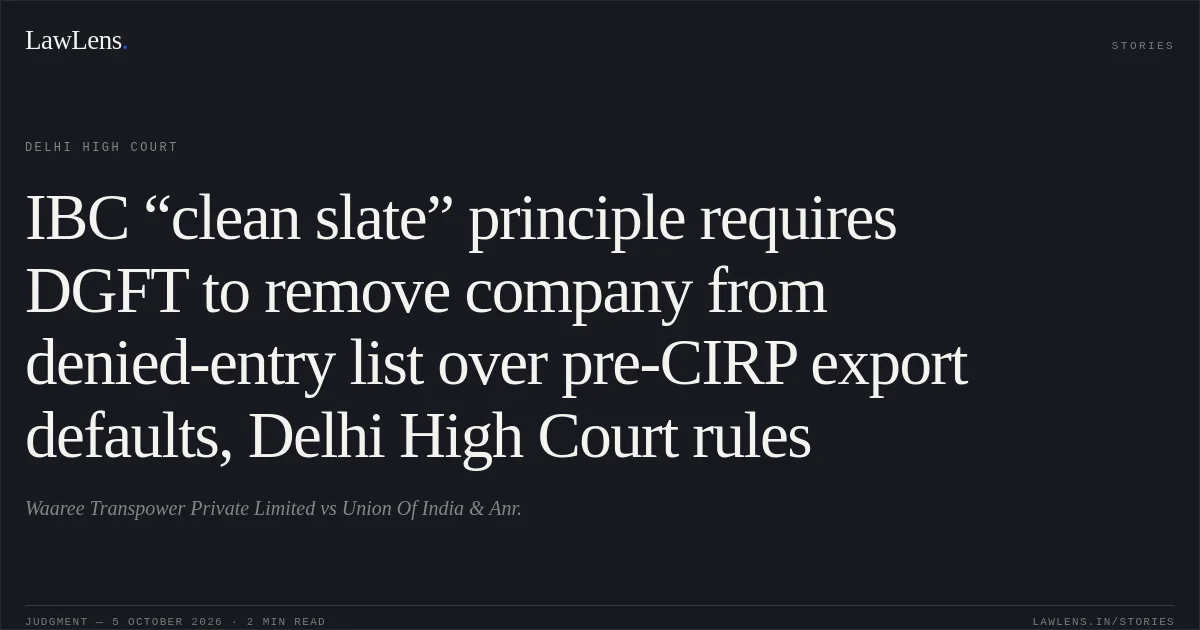
Section 14 of the Insolvency and Bankruptcy Code, 2016 (IBC) imposes a moratorium during CIRP; the Court held that coercive or adverse administrative orders passed against a corporate debtor in breach of that moratorium are void ab initio.
Source reference: para. 12Under Section 31(1) of the IBC, an approved resolution plan binds stakeholders, including government authorities.
Source reference: para. 16Applying the “clean slate” principle, the Court relied on Ghanshyam Mishra & Sons Private Limited v. Edelweiss Asset Reconstruction Company Limited, (2021) 9 SCC 657, for the rule that claims not forming part of an approved resolution plan stand extinguished and cannot be pursued thereafter.
Source reference: para. 18The Court also recognised that extinguishment of monetary claims does not bar fresh verification or action based on an independent, subsequent cause of action.
Source reference: para. 20Reasoning
The Court found that nine impugned orders were issued during the Section 14 moratorium and were therefore void ab initio.
Source reference: para. 12Independently, the government dues underlying the DEL status had been submitted as a claim in the CIRP and recorded in the approved resolution plan as payable at nil.
Source reference: para. 13–15Because the respondents had not challenged the NCLT’s approval order, continuing the DEL status to enforce those pre-CIRP defaults would undermine the binding effect of the plan and the IBC’s clean-slate principle.
Source reference: para. 16–18The Court rejected the preliminary objections, including territorial jurisdiction, noting that DGFT Headquarters in Delhi was seized of the matter and that the respondents’ counter-affidavit was filed through an officer of DGFT Kanpur.
Source reference: para. 9–11Holding
The Court set aside the impugned DEL orders and directed that the petitioner be removed from the DEL.
It clarified that the respondents may conduct fresh verification under applicable law and may take appropriate action if they identify an independent default or non-fulfilment of export obligations.
Source reference: para. 20The petition and pending application(s) were disposed of.
Source reference: para. 21Acts & Sections Cited
2 provisions across 1 statute referred to in this judgment. Each provision opens on LawLens.
Insolvency and Bankruptcy Code, 2016.2
Original Court PDF
Waaree Transpower Private LimitedvsUnion Of India & Anr.
Click to open original judgment
Original judgment, available to read, download and summarize on LawLens.in