Facts
The private respondents are retired Upper Division Clerks (UDCs) of Chennai Telephones and BSNL who originally served in the Department of Telecommunications and were substantially appointed as UDCs prior to 1992.
Source reference: p. 11-12In 1992, the Department introduced the Telephone Office Assistant (TOA) pattern, merging various clerical cadres.
Source reference: p. 12Litigation regarding pay scales and the "One Time Bound Promotion" (OTBP) / "Biennial Cadre Review" (BCR) schemes ensued, culminating in the Supreme Court decisions in Leelamma Jacob (2002) and Mythily (2016), which quashed departmental orders that denied certain higher pay scales.
Source reference: p. 15-16The respondents submitted representations in 2017 seeking similar benefits, which BSNL rejected on the grounds that they were not parties to the original court cases and their claims were barred by limitation.
Source reference: p. 14, 17The Central Administrative Tribunal (CAT) allowed their applications, citing the respondents as similarly situated pensioners; BSNL challenged these orders via Writ Petitions.
Source reference: p. 18Issues
1. Whether the original applications were barred by limitation under Section 21 of the Administrative Tribunals Act, 1985, given the respondents were "fence-sitters" who approached the court after significant delay.
Source reference: p. 18 / para. 3.12. Whether the disparity in pension between the respondents and their juniors (who benefited from earlier litigation) constitutes a continuing cause of action.
Source reference: p. 20-21 / para. 4.1, 10Law Applied
Section 21 of the Administrative Tribunals Act, 1985 regarding limitation.
Source reference: p. 18The principle from State of Uttar Pradesh v. Arvind Kumar Srivastava, which establishes that while similarly situated employees should generally be treated alike under Article 14, "fence-sitters" may be barred by laches/delay unless the judgment is in rem.
Source reference: p. 19, 26The doctrine from M.R. Gupta v. Union of India and K.C. Sharma v. Union of India, establishing that pay fixation and pension claims constitute a "continuing cause of action," where the right to correct computation subsists with each payment.
Source reference: p. 21-22, 25Reasoning
The Court noted that the departmental orders from 2004 and 2005, which denied the benefits, had already been quashed in their entirety by the Supreme Court in the Leelamma Jacob and Mythily litigations.
Source reference: p. 25While the petitioners argued the respondents were "fence-sitters," the Court held that since the issue pertains to pension—a deferred portion of wages—the disparity between the respondents and their juniors creates a recurring wrong.
Source reference: p. 25The Court distinguished between "one-time actions" and "continuing wrongs," finding that as long as the respondents receive a lesser pension than identically placed counterparts, their claim remains viable.
Source reference: p. 25Forcing retired employees to litigate individually for benefits already judicially settled is an unnecessary hardship, however, to balance equity regarding the delay, the Court determined that back-wages should be restricted.
Source reference: p. 28-29Holding
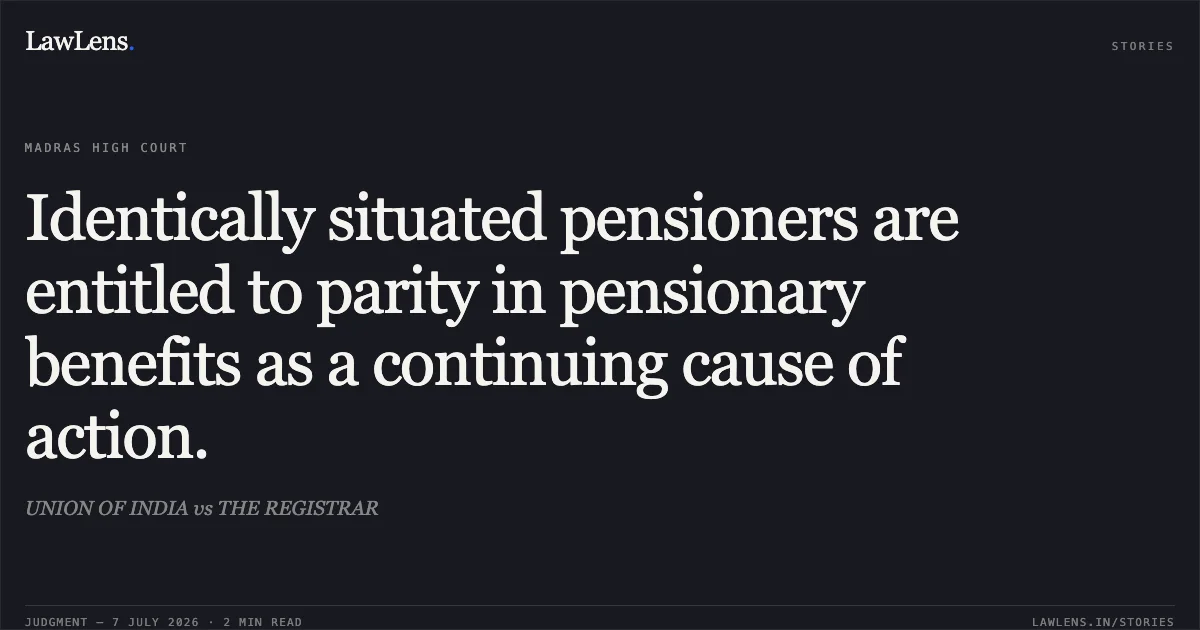
The Court upheld the CAT's decision, ruling that there can be no discrimination among a homogenous class of pensioners and pension is a continuing cause of action.
The Court modified the CAT's order: private respondents are entitled to the revision of pension and pay parity, but actual monetary benefits are restricted to the date of filing the Original Applications before the CAT; petitioners must complete the exercise within three months.
Source reference: p. 29Acts & Sections Cited
1 provisions across 1 statute referred to in this judgment. Each provision opens on LawLens.
Administrative Tribunals Act, 19851
Original Court PDF
UNION OF INDIAvsTHE REGISTRAR
Click to open original judgment
Original judgment, available to read, download and summarize on LawLens.in