Facts
The appellant, a Sri Lankan national, entered India in 2009 with a valid passport and tourist visa, registering as a non-camp refugee in Tamil Nadu.
Source reference: para. 5-6In 2021, while he awaited police clearance for a Swiss visa to join his family, he was arrested by the "Q Branch" Police.
Source reference: para. 7-8The police alleged he was "Sri" (Accused No. 5), an absconding militant who, in May 2015, supposedly conspired to revive the LTTE by handing over 75 cyanide capsules and GPS equipment to co-conspirators.
Source reference: para. 10-11Other accused persons were convicted in separate trials between 2018 and 2021.
Source reference: para. 15-16The appellant consistently maintained he was "Ranjan," not "Sri," and that this was a case of mistaken identity.
Source reference: para. 19The Trial Court and the Madras High Court convicted him under Section 120B of the IPC, the UAP Act, the Poisons Act, the Foreigners Act, and the Passport Act.
Source reference: para. 2Issues
1. Whether the prosecution established beyond reasonable doubt that the appellant "Ranjan" and the absconding accused "Sri" are the same individual.
Source reference: para. 41-432. Whether the testimonies of the star prosecution witnesses (PW-8 and PW-9) were reliable given material improvements and their own suspicious legal status in India.
Source reference: para. 44-48Law Applied
The Court primarily applied the principle of "Proof Beyond Reasonable Doubt" in criminal jurisprudence.
Source reference: no citationNecessity of reliable identification evidence, particularly when a suspect is a stranger to witnesses, as discussed in Vishwanatha v. State of Karnataka (2024 INSC 482) which mandates that in the absence of a Test Identification Parade (TIP), courts must look for prior descriptions in the FIR or statements.
Source reference: para. 55A complete silence on a crucial fact in earlier depositions cannot be brushed aside as a mere delay (distinguishing Abuthagir v. State (2009)).
Source reference: para. 49Assessment of the invocation of the Foreigners Act, 1946 and the Passport Act, 1967 against recognized refugees.
Source reference: para. 33Reasoning
The "star witnesses" (PW-8 and PW-9) were deemed unreliable; they were refugees holding various Indian identity documents illegally, yet were never prosecuted, suggesting a potential "bargain" to implicate the appellant.
Source reference: para. 45, 61Crucially, in two previous trials of other co-accused, these witnesses never mentioned the name "Ranjan" or linked the appellant to "Sri"; this identification surfaced only after the appellant’s arrest in 2021.
Source reference: para. 47-48No TIP was conducted, and the Investigating Officer (PW-29) admitted no record prior to 2021 contained the name "Ranjan".
Source reference: para. 29, 54The appellant’s conduct was inconsistent with an absconder; he resided openly at a registered address for over a decade and was actively engaging with the Swiss Embassy and local police for visa clearance.
Source reference: para. 58-59The court noted that witnesses like the landlady (PW-25) actually undermined the state’s case by confirming they only knew him as "Ranjan".
Source reference: para. 51-53Holding
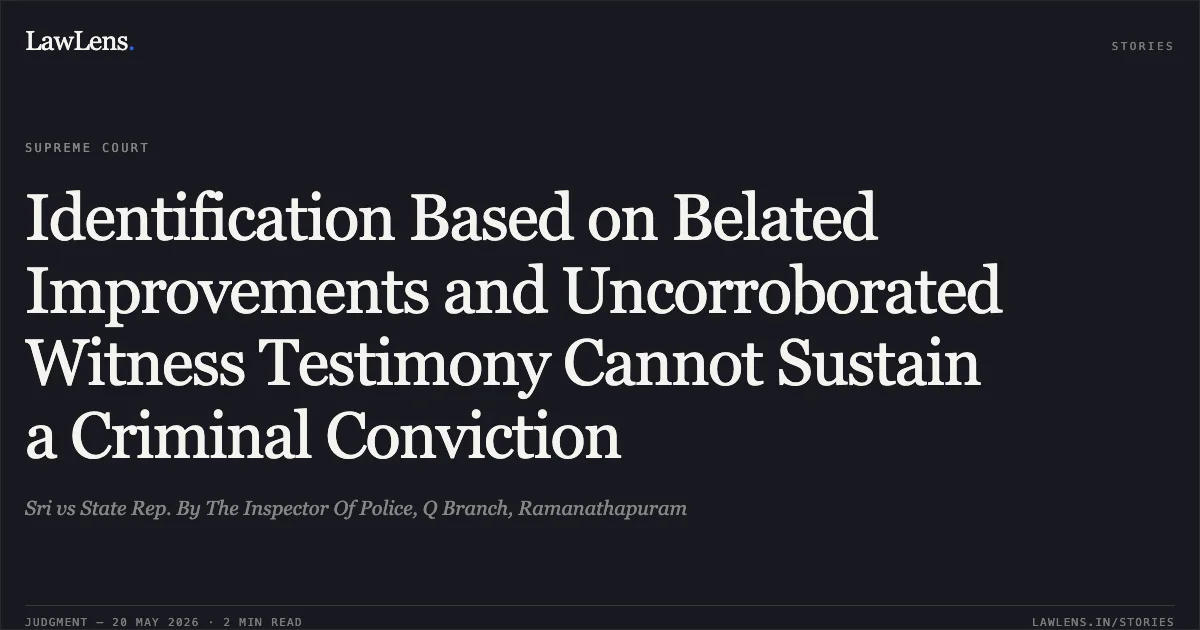
The Court held that the prosecution failed to prove the appellant's identity as the person mentioned in the FIR, characterizing it as a clear case of mistaken identity and false implication.
The Court allowed the appeal, set aside the judgments of the Trial Court and High Court, and acquitted the appellant of all charges.
Source reference: para. 63-64The Court further ordered his immediate release from the Special Camp, Trichy, and granted him liberty to pursue his relocation to Switzerland.
Source reference: para. 65Acts & Sections Cited
7 provisions across 4 statutes referred to in this judgment. Each provision opens on LawLens.
Unlawful Activities (Prevention) Act, 19672
Poisons Act, 19191
Passports Act, 19672
Code of Criminal Procedure, 19732
Original Court PDF
SrivsState Rep. By The Inspector Of Police, Q Branch, Ramanathapuram
Click to open original judgment
Original judgment, available to read, download and summarize on LawLens.in