Facts
On May 1, 1981, amid simmering communal tension in Alinagar Mohalla, Bihar Sharif, an unlawful assembly of 400–500 persons armed with deadly weapons attacked the Muslim community
Source reference: paras. 3, 56, 74The mob committed large-scale arson, looting, and brutally murdered at least eleven persons, including women and children
Source reference: paras. 3, 15Survivors took shelter in the houses of Mohammad Miyan and Ulfat Miyan, witnessing the violence through holes in walls and from rooftops
Source reference: paras. 55, 74, 82Following an investigation by the CID, 63 persons were charge-sheeted
Source reference: para. 8The Trial Court convicted the appellants (Ishwari Singh, Sunil Kumar, Nand Lal Yadav, Kisto Patwa, Ajay Singh, Laxman Ram, and Chhotey Kumhar) primarily and sentenced them to life imprisonment under Section 302/149 IPC
Source reference: paras. 5, 42The appellants challenged the conviction on grounds of delayed Test Identification Parades (TIP), non-examination of the Investigating Officer (IO), and lack of specific overt acts
Source reference: para. 97Issues
1. Whether the identification of the accused in court and through Test Identification Parades was reliable despite a delay of two and a half months
Source reference: para. 97(ii), 1112. Whether the non-examination (lack of cross-examination) of the Investigating Officer caused material prejudice to the defense
Source reference: para. 97(ix), 1403. Whether vicarious liability under Section 149 IPC could be fastened upon the appellants in a case involving a large, riotous mob
Source reference: para. 97(viii), 1284. Whether the High Court can suo motu initiate revision proceedings against acquitted co-accused in an appeal filed by convicted persons
Source reference: para. 169Law Applied
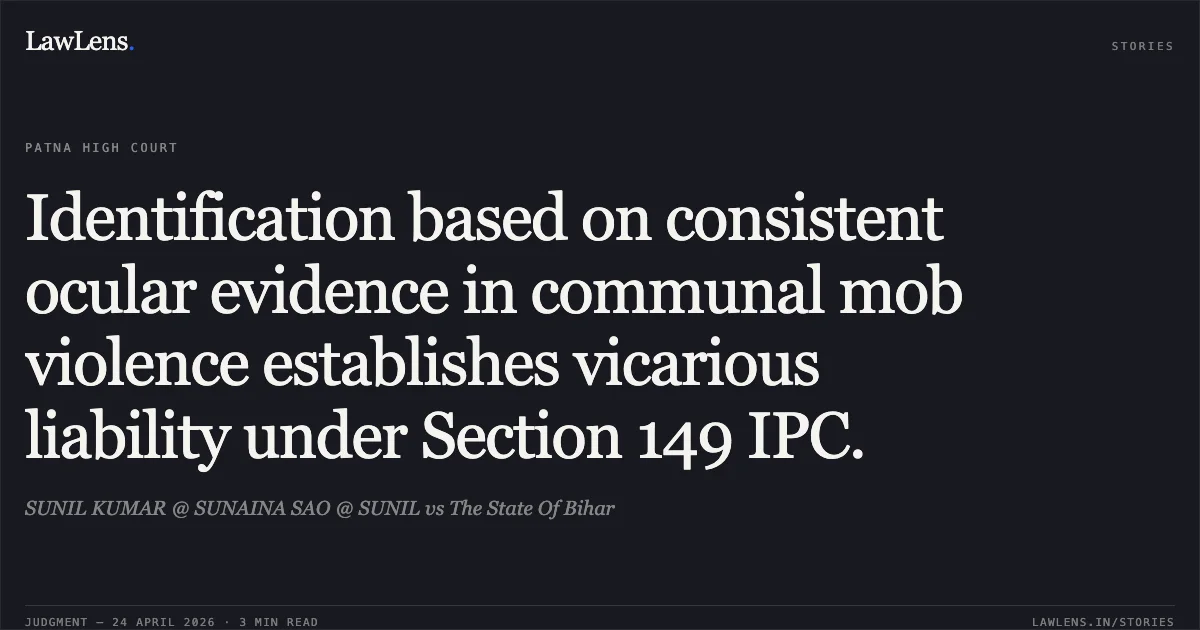
Section 149 of the IPC regarding vicarious liability of every member of an unlawful assembly for acts done in prosecution of a common object
Source reference: para. 129The Masalti v. State of U.P. rule, which mandates consistent testimony from multiple witnesses in cases of large-scale mob violence
Source reference: para. 58Principles from Dana Yadav v. State of Bihar regarding identification
Source reference: para. 65Laxman v. State of Maharashtra concerning dying declarations
Source reference: para. 49Behari Prasad v. State of Bihar, holding that non-examination of the IO does not per se vitiate a trial unless material contradictions are prejudiced
Source reference: para. 147Nadir Khan v. State (suo motu power to correct manifest illegality) and Nagarajan v. State of Tamil Nadu concerning revisional powers
Source reference: para. 155, 160Reasoning
The Court found that despite the riotous chaos, the survivors were natural witnesses who identified the perpetrators from close range as they were being dragged from shelters
Source reference: para. 131Applying the Masalti test, the Court noted that each appellant was identified by multiple witnesses (e.g., Sunil Kumar by PW-6, 10, 13, 16; Chhotey Kumhar by PW-4, 6, 10, 17)
Source reference: para. 133The Court rejected the challenge to the TIP, noting that TI parades are corroborative and the substantive identification occurred in court, where witnesses remained unshaken during cross-examination
Source reference: para. 132Regarding the IO's non-examination, the Court held that since the defense failed to bring out specific contradictions between the witnesses’ court testimony and their Section 161 CrPC statements during cross-examination, the IO’s absence was not fatal
Source reference: para. 146, 148The Court concluded that the common object to eliminate a particular community was evident from the mob’s slogans and the systematic arson and killings
Source reference: para. 125, 128Holding
The Court dismissed the appeals and upheld the conviction and life sentences of all appellants, holding that their participation in the unlawful assembly with a common object was proved beyond reasonable doubt
Invoking its inherent powers and revisional jurisdiction under Sections 401 and 482 CrPC, the Court issued suo motu show-cause notices to the acquitted persons, Raj Kishore Sao and Panna Lal, to explain why their acquittal should not be quashed
Source reference: para. 169-170Acts & Sections Cited
41 provisions across 3 statutes referred to in this judgment. Each provision opens on LawLens.
Code of Criminal Procedure, 1973
Indian Penal Code, 1860
Explosive Substances Act, 19081
Original Court PDF
SUNIL KUMAR @ SUNAINA SAO @ SUNILvsThe State Of Bihar
Click to open original judgment
Original judgment, available to read, download and summarize on LawLens.in


