Facts
The appellant claimed that, on 18 April 2013, he and his wife travelled from Etawah to Ahmedabad by an express train on a second-class ticket bearing No. AE-02199847. Due to heavy rush, he allegedly fell from the moving train near Agra Fort and sustained serious injuries. He was found injured near the railway track by Gangman Nawab Khan and was taken first to District Hospital, Agra, and thereafter to S.N. Medical College, Agra.
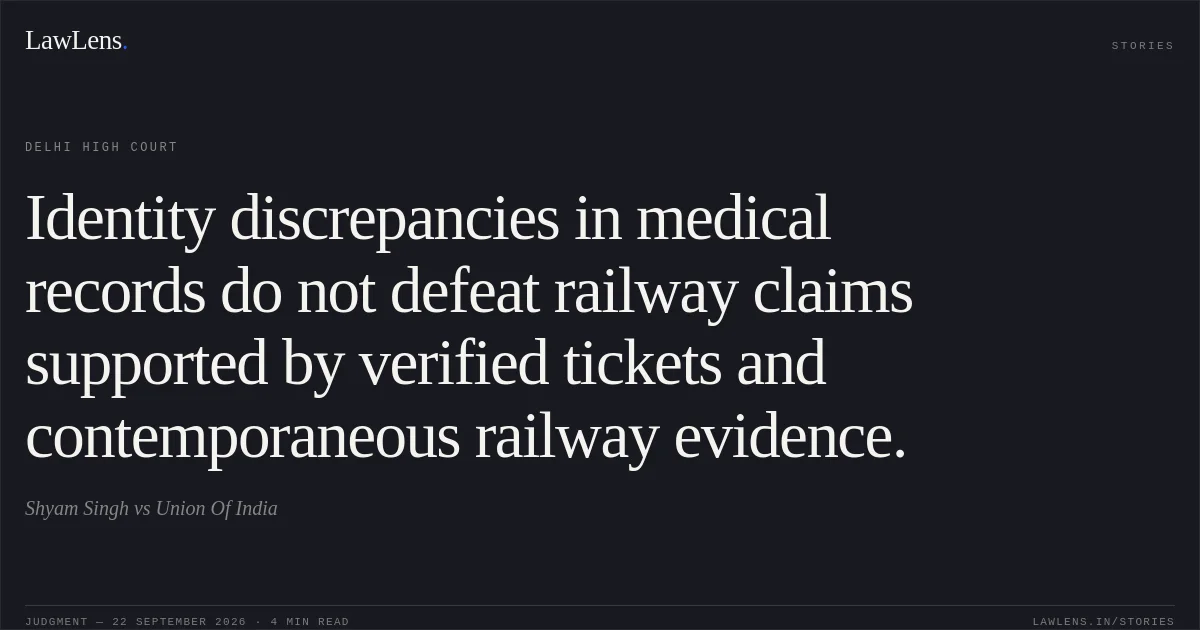
Source reference: p. 2The appellant relied on the journey ticket, its verification by the Chief Booking Supervisor, the statement of Gangman Nawab Khan, railway records, and the RPF enquiry. The railway records identified the injured person as “Shyam Singh son of Dharam Singh,” whereas the medical records described him as “Shyam Singh son of Rati Lal.”
Source reference: pp. 3–4The Railway Claims Tribunal held that it could not be established with certainty that the appellant was the person who had sustained the injuries and rejected the relevant issue against him.
Source reference: p. 4The appellant challenged the Tribunal’s judgment dated 17 December 2021 under Section 23 of the Railway Claims Tribunal Act, 1987. The appeal was filed with a delay of 775 days, which the High Court condoned considering the appellants’ economic hardship and the beneficial nature of the legislation.
Source reference: pp. 1–2Issues
Whether the delay of 775 days in filing the appeal should be condoned in the circumstances of the case?
Source reference: pp. 1–2Whether the appellant established that he was a bona fide passenger who had travelled on the relevant train?
Source reference: p. 4Whether the injuries suffered by the appellant resulted from an “untoward incident” attracting liability under Section 124-A of the Railways Act, 1989?
Source reference: pp. 5–6Whether the discrepancy in the father’s name in the medical records, the history of assault, and the subsequent DRM report defeated the appellant’s claim?
Source reference: pp. 4–7Law Applied
The Court applied Section 23 of the Railway Claims Tribunal Act, 1987, governing appeals from orders of the Railway Claims Tribunal, and Section 124-A of the Railways Act, 1989, which imposes statutory strict liability on the railway administration for death or injury caused by an “untoward incident,” subject to the statutory exceptions.
Source reference: p. 7The Court held that the beneficial and strict-liability scheme does not dispense with proof of foundational facts, including bona fide travel and the occurrence of the railway incident, but does not require an unrealistic or excessively technical standard of proof.
Source reference: p. 7The Court relied on Mohsina v. Union of India , 2017 SCC OnLine Del 10003, and Brijesh Kumar v. Union of India , FAO 49/2022, decided on 4 April 2026, in condoning substantial delay where financial hardship and surrounding circumstances constituted sufficient cause.
Source reference: p. 2It also relied on Reeta Devi v. Union of India for the principle that the nature of injuries or the condition in which an injured person is found cannot, by itself, conclusively establish the precise manner in which the person came to be on the railway track.
Source reference: p. 6Reasoning
The Court found that the appellant’s bona fide passenger status was supported not merely by his statement but by the recovered journey ticket, its verification by the Etawah Chief Booking Supervisor, and contemporaneous railway records identifying the injured person as Shyam Singh son of Dharam Singh.
Source reference: p. 4The discrepancy in the father’s name in the medical records was treated as a circumstance requiring assessment, but not as conclusive proof that the hospitalised person was someone else, particularly since there was no evidence of another injured person named Shyam Singh son of Rati Lal and the appellant had consistently given his father’s name as Dharam Singh.
Source reference: p. 4The evidence of Gangman Nawab Khan established that an injured person was found near the railway track shortly after the incident and stated that he had fallen from a train. Although Khan could not identify the particular train and was not an eyewitness to the fall, his evidence corroborated the appellant’s condition and the immediate account of the occurrence.
Source reference: pp. 5–6The Court held that the absence of an eyewitness to the fall was not fatal and that the evidence had to be assessed cumulatively. The uncorroborated reference to assault in the medical record could not displace the railway evidence, and the DRM report prepared and filed years after the occurrence could not prevail over the contemporaneous records and railway employee’s evidence.
Source reference: pp. 6–7In light of the strict-liability and beneficial statutory scheme, the appellant had established the foundational facts sufficiently to warrant interference with the Tribunal’s decision.
Source reference: p. 7Holding
The Court condoned the delay of 775 days in filing the appeal.
It held that the appellant’s bona fide travel and the occurrence of an untoward incident were sufficiently supported by the verified ticket, contemporaneous railway records, the evidence of Gangman Nawab Khan, and the surrounding circumstances.
Source reference: pp. 4–7The discrepancy in the father’s name, the medical history of assault, and the delayed DRM report did not defeat the claim.
Source reference: pp. 4–7The Tribunal’s judgment dated 17 December 2021 was set aside. The matter was remanded to the Tribunal to assess the compensation payable and direct its disbursement within two months from receipt of the High Court’s order. The matter was directed to be listed before the Tribunal on 21 October 2026.
Source reference: p. 7Acts & Sections Cited
1 provisions across 1 statute referred to in this judgment. Each provision opens on LawLens.
Railway Claims Tribunal Act, 19871
Original Court PDF
Shyam SinghvsUnion Of India
Click to open original judgment
Original judgment, available to read, download and summarize on LawLens.in