Facts
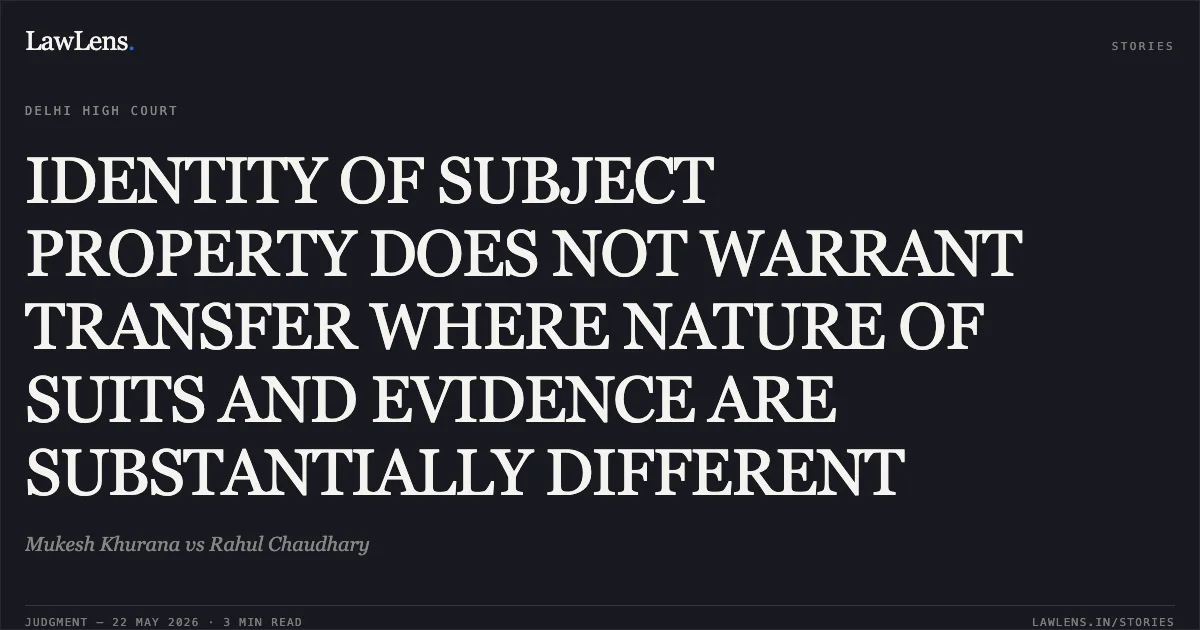
The Petitioner (Mukesh Khurana) sought the transfer of a suit for possession and mesne profits (CS No. 523/2022) pending before the Additional District Judge, Patiala House Courts, to the High Court of Delhi to be tried alongside his own suit for specific performance (CS(OS) No. 208/2025).
Source reference: p. 1-3The Respondent (landlord) had initially sued for eviction based on a terminated tenancy.
Source reference: p. 2The Petitioner initially filed a counter-claim in that suit alleging an oral collaboration agreement for redevelopment but later withdrew it to file a fresh suit in the High Court due to pecuniary jurisdiction limits.
Source reference: p. 3Meanwhile, the Trial Court had already passed a decree for possession under Order XII Rule 6 CPC against the Petitioner, which is currently under appeal.
Source reference: p. 4, 13The Petitioner argued that because both suits involve the same property, they should be tried together to avoid conflicting judgments.
Source reference: p. 4, 14Issues
1. Whether a suit for possession based on a landlord-tenant relationship and a suit for specific performance based on an oral collaboration agreement regarding the same property warrant transfer and consolidation under Section 24 of the CPC.
Source reference: p. 82. Whether the interest of justice and the advanced stage of the previously instituted suit outweigh the overlap in subject matter for the purpose of transfer.
Source reference: p. 24-25Law Applied
Section 24 of the CPC, which grants discretionary power to transfer suits at any stage in the "interest of justice".
Source reference: p. 18-19The Supreme Court’s decision in Chitivalasa Jute Mills v. Jaypee Rewa Cement, which held that transfers are appropriate when causes of action arise from the same transactions and require identical evidence.
Source reference: p. 15Kulwinder Kaur v. Kandi Friends Education Trust, establishing that transfer must consider the balance of convenience, issues raised, and the nature of evidence.
Source reference: p. 23-24The principle from Sunil Kapoor v. Himmat Singh, stating that an agreement to sell does not automatically entitle a tenant to retain possession, thus making the issues in an eviction suit distinct from a specific performance suit.
Source reference: p. 20-21Reasoning
The Court reasoned that the two suits are substantially different in nature despite involving the same property. In the Respondent's suit, the core requirements are proving tenancy, termination, and mesne profits, whereas the Petitioner’s suit requires proving a valid oral collaboration agreement and readiness for specific performance.
Source reference: para 28The Court observed that the Respondent’s suit was at an advanced stage—with a decree of possession already passed—while the Petitioner’s suit was at the preliminary stage of completion of pleadings.
Source reference: para 11, 35The Court noted the Petitioner’s conduct, including multiple failed challenges under the Arbitration Act and the late filing of the specific performance suit, suggested the transfer was sought to delay the eviction.
Source reference: para 17, 33Unlike Chitivalasa Jute Mills, where evidence was identical, here the evidence required for a tenancy dispute and a contract for redevelopment would not substantially overlap.
Source reference: para 36Holding
The Court dismissed the transfer petition, holding that no grounds for transfer were made out.
The Court answered that the mere similarity of the subject property does not necessitate consolidation when the legal issues and stages of the proceedings are vastly different.
Source reference: para 28, 35It directed that the suits be decided on their own merits and clarified that the findings in this order would not affect the merits of the pending litigations.
Source reference: para 40Acts & Sections Cited
7 provisions across 3 statutes referred to in this judgment. Each provision opens on LawLens.
Code of Civil Procedure, 19085
Indian Easements Act, 18821
Specific Relief Act, 19631
Original Court PDF
Mukesh KhuranavsRahul Chaudhary
Click to open original judgment
Original judgment, available to read, download and summarize on LawLens.in