Facts
The applicant (husband) filed a criminal revision petition challenging an order dated 26.11.2024 passed by the Family Court, Durg, which granted monthly maintenance of Rs. 3,000 to the non-applicant (wife)
Source reference: para. 2The revision was filed with a delay of 377 days
Source reference: para. 1The applicant sought condonation of delay (I.A. No. 02 of 2026) on the grounds that he is a laborer, lacked legal awareness, was mentally distressed, and bona fide believed his wife would return to him following a decree for restitution of conjugal rights in his favor
Source reference: para. 2Issues
Whether the delay of 377 days in preferring the criminal revision petition deserves to be condoned on the grounds of lack of legal awareness and a pending decree for restitution of conjugal rights.
Source reference: para. 4Law Applied
The Court primarily applied the principles governing the condonation of delay under the Limitation Act, as interpreted by the Supreme Court in State of Madhya Pradesh v. Ramkumar Choudhary (2024)
Source reference: para. 5It relied on the doctrine that "sufficient cause" requires an adequate reason preventing the party from approaching the court within the limitation period, and that discretion cannot be exercised liberally if negligence, inaction, or lack of bona fides is evident (Majji Sannemma v. Reddy Sridevi)
Source reference: para. 5The Court further applied the rule from Ajit Singh Thakur Singh v. State of Gujarat (1981), establishing that sufficient cause must be traced to a circumstance arising within the period of limitation, not after its expiry
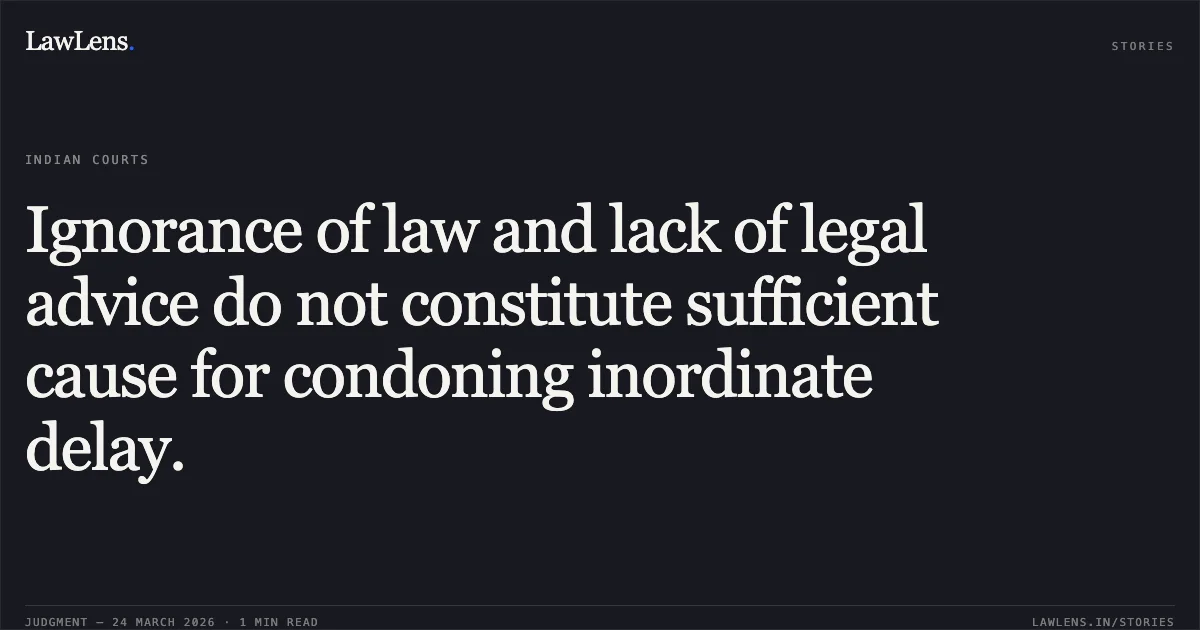
Source reference: para. 5.1the court noted that ignorance of law and lack of legal advice do not constitute sufficient cause to override the statutory rigors of limitation
Source reference: para. 6-7Reasoning
The Court observed that while the applicant’s status as a laborer and his belief regarding the restitution of conjugal rights were "plausible" reasons for sympathy, they did not satisfy the legal threshold for "sufficient cause"
Source reference: para. 7The Court emphasized that the delay of 377 days was "grossly inordinate" and that the applicant remained inactive for a long period without justifying why he could not approach the Court within the initial 90-day window
Source reference: para. 7-8Citing Union of India v. Jahangir Byramji Jeejeebhoy, the Court noted that limitation is founded on public policy and equity, and condoning such delays as a "matter of generosity" would cause undue prejudice to the opposite party who has gained a right through the finality of the lower court's order
Source reference: para. 5.1, 8The Court concluded that the applicant failed to prove reasonable diligence, rendering the delay non-deliberate but legally inexcusable
Source reference: para. 7-8Holding
The Court answered the issue in the negative, holding that no case for condonation of delay was established as the applicant failed to show sufficient cause within the limitation period
the Court rejected I.A. No. 02 of 2026 and dismissed the criminal revision petition as barred by limitation and laches
Source reference: para. 9Original Court PDF
NETRAM BANDHEvsSMT. GULAB BANDHE
Click to open original judgment
Original judgment, available to read, download and summarize on LawLens.in