Facts
Petitioner No.1 was the father of Petitioner No.2, whose wife was Respondent No.1. After the couple’s marriage and residence in England, Respondent No.1 lodged a complaint alleging offences under Section 498-A IPC, Sections 3 and 4 of the Dowry Prohibition Act, and Sections 323, 504 and 506 IPC. Crime No.76/2014 was registered, and the police subsequently filed a charge-sheet only against Petitioner No.2 and his mother, dropping proceedings against several other family members, including Petitioner No.1.
Source reference: paras. 2.1–2.9Petitioner No.2 obtained anticipatory bail on 10 June 2014. Nevertheless, a Look Out Circular (“LOC”) was issued while he was in the United Kingdom. On his arrival in India on 16 August 2014, he was detained at the airport and handed over to Respondent No.3, who took him into custody and produced him before the Magistrate.
Source reference: paras. 2.8, 2.13–2.17The petitioners further alleged that Respondent No.3 forcibly took Petitioner No.1, a senior citizen, to Malleshwaram Police Station, where he was allegedly assaulted and thereafter hospitalised. Respondent No.3 denied the assault and contended that Petitioner No.1 had merely been asked to attend a counselling centre.
Source reference: paras. 2.10–2.12; 4.10; 16.5–16.6A departmental enquiry was conducted against Respondent No.3. The petitioners relied on the enquiry report dated 25 April 2015, which recorded misconduct relating to the arrest. Despite repeated directions, the State failed to produce the LOC file and warrant records, ultimately stating that the records were unavailable.
Source reference: paras. 2.18–2.19; 6–9; 14.17Issues
Whether the issuance of the LOC, the arrest and detention of Petitioner No.2, and the seizure of his passport were lawful and consistent with the Cr.P.C., the Passports Act, 1967, and applicable executive instructions?
Source reference: para. 12(i)Whether Respondent No.3 complied with Sections 41 and 41-A Cr.P.C., the order granting anticipatory bail, and the principles laid down in Arnesh Kumar v. State of Bihar?
Source reference: para. 12(ii)Whether the allegations of illegal detention, assault and harassment of Petitioner No.1 were established on the record?
Source reference: para. 12(iii)Whether Respondent No.3 abused or exceeded his statutory powers, thereby violating the petitioners’ rights under Articles 19, 21 and 22 of the Constitution?
Source reference: para. 12(iv)Whether the departmental enquiry and punishment imposed on Respondent No.3 barred or affected the petitioners’ claim for public-law compensation?
Source reference: para. 12(v)Whether the petitioners were entitled to the reliefs sought, including compensation and further departmental action?
Source reference: para. 12(vi)Law Applied
The Court applied Sections 41 and 41-A Cr.P.C., which prohibit routine arrest in offences punishable up to seven years and require the officer to record the necessity and reasons for arrest; these safeguards were reinforced in Arnesh Kumar v. State of Bihar.
Source reference: paras. 15.1–15.3Under Section 438(3) Cr.P.C., a person protected by anticipatory bail must be released on bail upon arrest, and a subsequent warrant must be consistent with that protection.
Source reference: paras. 14.20–14.25A LOC is an exceptional coercive measure governed by the Ministry of Home Affairs instructions and may not be issued mechanically, particularly where the person is voluntarily entering India and is not evading the process of law.
Source reference: paras. 28.1–28.4Under Suresh Nanda v. CBI, the police may seize a passport in appropriate circumstances but cannot impound or retain it; that power lies with the passport authority under Section 10(3) of the Passports Act, 1967.
Source reference: paras. 14.26; 29.1–29.3The Court also relied on D.K. Basu, Nilabati Behera, Sube Singh, Hardeep Singh, Rini Johar and Saheli for the principles that violation of personal liberty and custodial safeguards may attract public-law compensation, and that departmental proceedings do not bar such constitutional relief.
Source reference: paras. 16.10; 18.5–18.8Reasoning
The Court held that the State failed to substantiate the legal basis of the LOC or the alleged non-bailable warrant because the relevant records were not produced despite repeated judicial directions; an adverse inference was therefore drawn against the State.
Source reference: paras. 14.17–14.19Petitioner No.2 was voluntarily entering India, had a known address, and was protected by anticipatory bail. The absence of recorded reasons showing that arrest was necessary under Section 41(1)(b)(ii) Cr.P.C., coupled with the admitted non-issuance of a Section 41-A notice, rendered the arrest contrary to Arnesh Kumar.
Source reference: paras. 15.10–15.16The Court further held that Section 438(3) required immediate release on bail and that a non-bailable warrant could not be used to defeat the anticipatory-bail protection.
Source reference: paras. 14.20–14.25The retention of Petitioner No.2’s passport by the Investigating Officer was likewise unauthorised under the Passports Act.
Source reference: para. 14.26As to Petitioner No.1, the Court found that the allegation of physical assault was a seriously disputed question of fact and was not established merely by the hospital record, which recorded the assault only as a history narrated by the patient and disclosed no external injuries.
Source reference: paras. 16.7–16.11However, Petitioner No.1 had already been excluded from the charge-sheet and could not lawfully be subjected to coercive police treatment or taken to a police station as though he were an accused. His illegal detention, harassment and resulting distress were therefore established.
Source reference: para. 16.9The Court consequently found an abuse of statutory power and a violation of Petitioner No.2’s Article 21 rights, while declining to record a positive finding of collusion between Respondent No.3 and the private respondents.
Source reference: paras. 17.7–17.12Departmental punishment was held not to extinguish the petitioners’ independent public-law claim for compensation.
Source reference: paras. 18.5–18.10Holding
The writ petition was allowed in part.
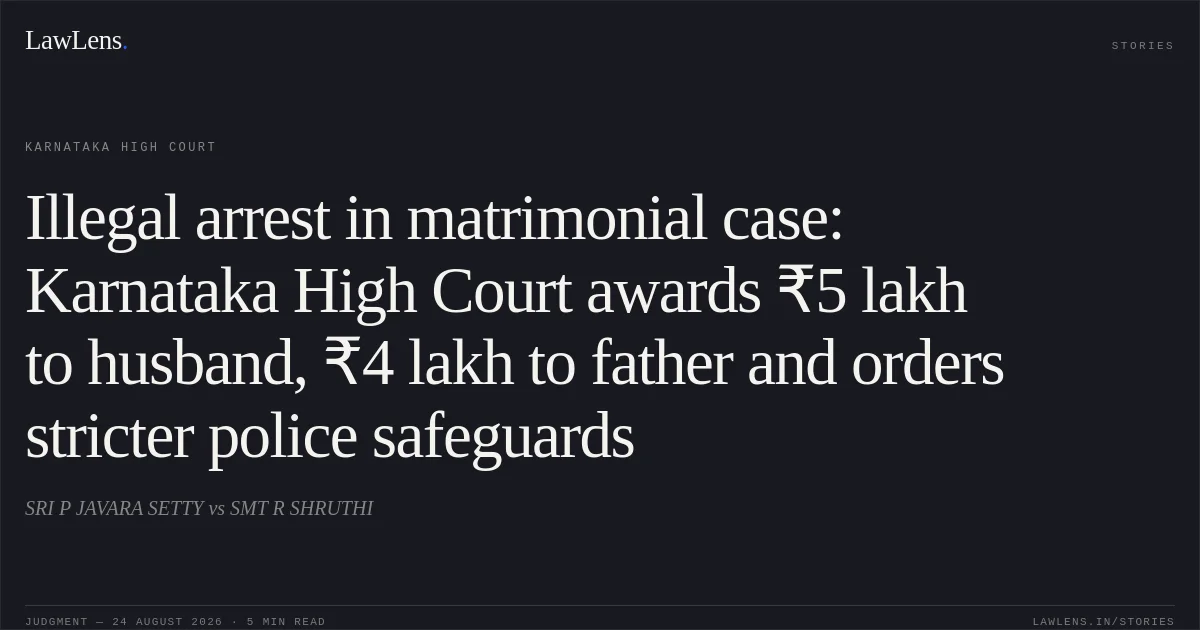
The Court declared that the LOC issued against Petitioner No.2, his arrest and detention on 16 August 2014, and the seizure of his passport were illegal and violated Sections 41, 41-A and 438(3) Cr.P.C., the Passports Act, 1967, and his fundamental right to personal liberty under Article 21.
Source reference: para. 40.1(ii)The State was directed to pay Rs.5,00,000 to Petitioner No.2 and Rs.4,00,000 to Petitioner No.1 within twelve weeks, with liberty to recover the amounts from Respondent No.3 after giving him a reasonable opportunity of hearing and following due process.
Source reference: paras. 19.5–19.6; 40.1(iii)–(iv)The State authorities were directed to reconsider whether further departmental action against Respondent No.3 was warranted in light of Arnesh Kumar.
Source reference: para. 40.1(v)The specific allegation of custodial assault against Petitioner No.1 was left open for adjudication before an appropriate forum, and the Court issued detailed directions concerning arrest safeguards, LOCs, passport seizure, treatment of senior citizens, maintenance of records, counselling in matrimonial disputes, and police training under the BNSS and corresponding provisions of the erstwhile Cr.P.C.
Source reference: paras. 22–39; 40.1(vi)–(ix)Acts & Sections Cited
65 provisions across 9 statutes referred to in this judgment. Linked provisions open on LawLens.
Code of Criminal Procedure, 1973
Bharatiya Nagarik Suraksha Sanhita, 2023
Bharatiya Nyaya Sanhita, 20231
Indian Penal Code, 18608
Dowry Prohibition Act2
Indian Evidence Act, 18721
Passports Act, 19671
Right to Information Act, 20051
Criminal Law (Amendment) Act, 20181
Original Court PDF
SRI P JAVARA SETTYvsSMT R SHRUTHI
Click to open original judgment
Original judgment, available to read, download and summarize on LawLens.in