Facts
Ratan Kashyap claimed that he joined M/s Indian Printing Works as a Helper in April 2008 and was transferred between its Delhi units. After taking leave from 18.12.2012 to 20.12.2012, he reported for duty on 21.12.2012 but was allegedly prevented from resuming work after being asked to explain his absence.
Source reference: pp.2–3The management denied terminating him, alleged habitual absenteeism, and asserted that he had voluntarily stopped attending duty despite repeated requests and offers to rejoin.
Source reference: p.3The workman issued a demand notice and the dispute was referred to the Labour Court on whether his services had been illegally and unjustifiably terminated.
Source reference: p.2The Labour Court found that the management had refused to permit him to resume work and held the termination illegal, but declined reinstatement and awarded lump-sum compensation of ₹1,20,000, with interest at 9% per annum in default of payment.
Source reference: pp.3–5The management challenged the finding of illegal termination in W.P.(C) No. 4906/2017, while the workman challenged the denial of reinstatement and the quantum of compensation in W.P.(C) No. 5196/2018.
Source reference: pp.1–2Issues
Whether the Labour Court was justified in finding that the management had effectively terminated the workman’s services by refusing to permit him to resume duty on 21.12.2012?
Source reference: paras. 14–18; pp.6–8Whether the Labour Court erred in denying reinstatement and awarding ₹1,20,000 as compensation in lieu of reinstatement?
Source reference: paras. 19–20; pp.8–10Whether either writ petition disclosed grounds for interference under Articles 226 and 227 of the Constitution?
Source reference: paras. 13, 20–22; pp.6, 10Law Applied
The Court applied the principle that the jurisdiction of a High Court under Articles 226 and 227 over a Labour Court award is supervisory, not appellate; interference is warranted only where the decision is without jurisdiction, perverse, affected by a patent error of law, or violates natural justice, as stated in Syed Yakoob v. K.S. Radhakrishnan, International Airport Authority of India v. International Air Cargo Workers’ Union, and Ritz Theatre Pvt. Ltd. v. Ramesh Chandra.
Source reference: para. 13; p.6The Court also applied the principle in The Workmen of Firestone Tyre & Rubber Co. of India (P) Ltd. v. The Management that, where no domestic enquiry has been held, alleged misconduct may be proved before the adjudicating forum.
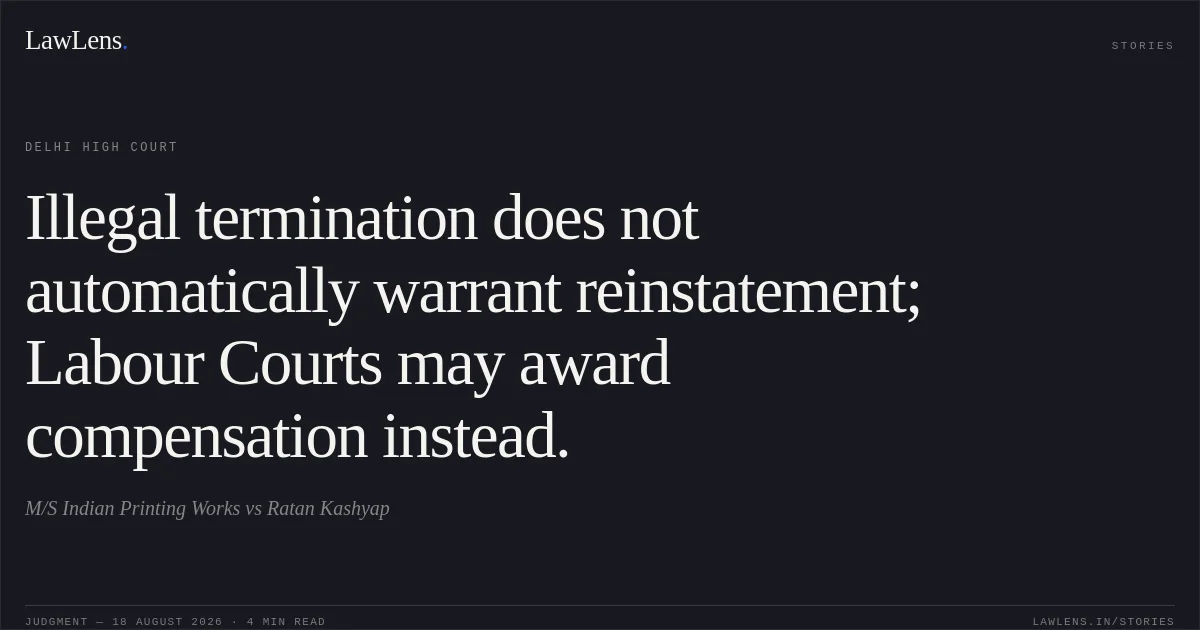
Source reference: para. 17; pp.7–8Further, reinstatement with back wages is not an automatic consequence of a finding of illegal termination; the Labour Court may mould relief by awarding compensation after considering the circumstances of the case, including the workman’s service, experience, conduct, employability, and refusal of an offer to rejoin, following Nehru Yuva Kendra Sangathan v. Union of India, Municipal Council, Sujanpur v. Surinder Kumar, Talwara Cooperative Credit & Service Society Ltd. v. Sushil Kumar, and Jagbir Singh v. Haryana State Agriculture Marketing Board.
Source reference: para. 19; pp.8–10Reasoning
The Court declined to interfere with the Labour Court’s factual finding that the workman had reported for duty on 21.12.2012, had worked for some time, and was thereafter asked to explain his absence; the management’s witness admitted this sequence.
Source reference: para. 15; p.7The Labour Court had also considered the leave application relating to 19.12.2012 and 20.12.2012 and reasonably concluded that, after an explanation had been furnished, the management ought not to have refused work without following a proper disciplinary process.
Source reference: paras. 7–8, 15; pp.3–4, 7The management’s reliance on the workman’s initial complaint, alleged absenteeism, and subsequent offers to rejoin did not establish perversity, particularly since the offers could affect the relief but did not erase the earlier refusal to permit him to continue working.
Source reference: para. 16; p.7As to relief, the Court held that the Labour Court had considered relevant factors: absence of a specific pleading or evidence of unemployment, the workman’s approximately four years and eight months of experience, his employability in comparable work, and his refusal to rejoin unless back wages were paid.
Source reference: para. 19; pp.8–10The challenge to ₹1,20,000 essentially sought reassessment of the quantum, which was impermissible in the limited supervisory jurisdiction absent perversity or illegality.
Source reference: para. 20; p.10Holding
The Court held that the Labour Court’s finding of illegal termination was supported by the evidence and did not suffer from perversity or jurisdictional error.
It further held that denial of reinstatement and award of ₹1,20,000 as lump-sum compensation were valid exercises of the Labour Court’s discretion and did not warrant interference.
Source reference: paras. 18–21; pp.8–10Accordingly, both cross-writ petitions were dismissed and the Labour Court’s award was upheld.
Source reference: para. 22; p.10The interim order staying the award was vacated, and the ₹1,20,000 deposited with the Registrar General, together with accrued interest, was directed to be released to Ratan Kashyap in accordance with the award.
Source reference: paras. 23–24; p.11Pending applications were disposed of as infructuous.
Source reference: para. 25; p.11Original Court PDF
M/S Indian Printing WorksvsRatan Kashyap
Click to open original judgment
Original judgment, available to read, download and summarize on LawLens.in