Facts
Raj Kumar Gupta was appointed as a Retainer Crew Conductor with the Delhi Transport Corporation (“DTC”) on 9 March 1982 and was placed on monthly-rated pay from 8 January 1983. He had adverse service entries arising from unauthorised leave and, after remaining absent for 66 days between January and May 1992, was charge-sheeted, subjected to a domestic enquiry, and removed from service on 22 October 1992.
Source reference: p.3, para. 5.1–5.2DTC filed an approval application under Section 33(2)(b) of the Industrial Disputes Act, 1947 (“ID Act”), which was dismissed by the Labour Court. Gupta independently challenged his removal in an industrial dispute. The Labour Court initially directed reinstatement with 60% back wages, and, after remand by the High Court, again held the termination illegal and directed reinstatement with full back wages and statutory benefits.
Source reference: pp.3–5, paras. 5.3–5.10The learned Single Judge upheld the finding that the enquiry violated principles of natural justice and that no misconduct had been established. Since Gupta had superannuated in 2016, reinstatement was not granted; instead, he was awarded lump-sum compensation of ₹20,00,000, along with statutory and pensionary benefits.
Source reference: pp.5–6, para. 5.13DTC challenged the compensation and pensionary directions in LPA Nos. 296/2022 and 352/2022, while Gupta sought reinstatement, full back wages, and consequential benefits in LPA No. 547/2022.
Source reference: p.6, para. 5.14During the proceedings, DTC paid ₹10,00,000 towards 50% of the compensation, ₹10,032.69 towards gratuity, and ₹33,463 towards provident fund. A further sum of ₹3,36,056 had earlier been deposited before the Court pursuant to an interim order.
Source reference: p.6, para. 5.15; p.8, para. 11Issues
Whether the domestic enquiry and the consequent removal of Gupta were legally sustainable when he had submitted leave applications and medical certificates covering the period of absence, and DTC had neither rejected the leave nor produced the relevant leave register?
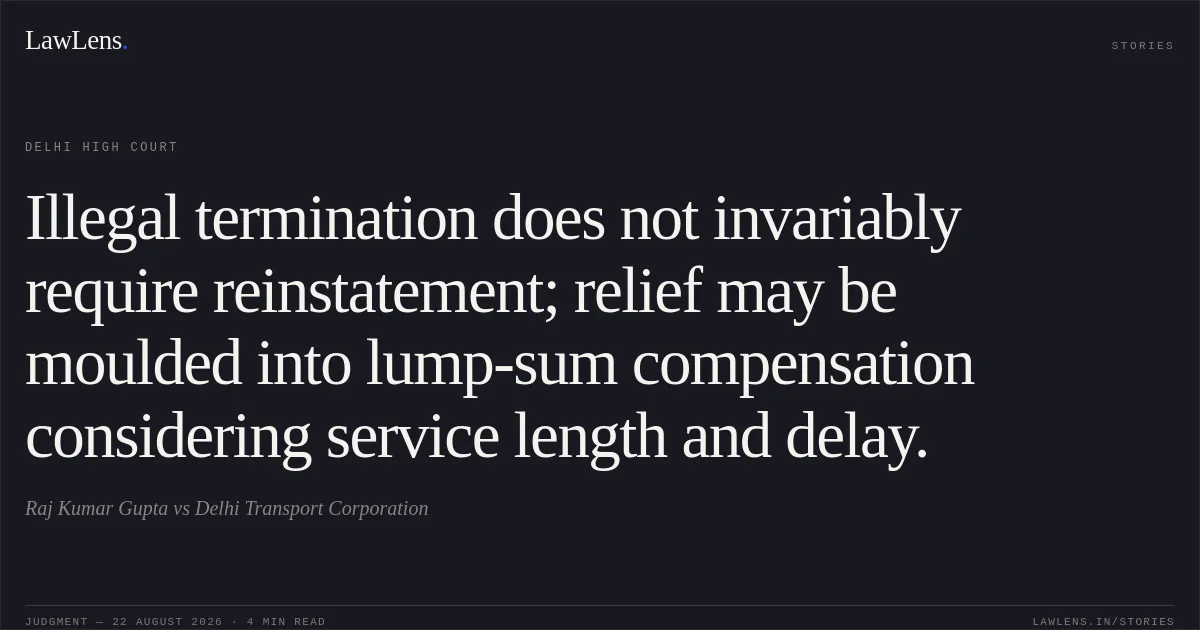
Source reference: p.9, para. 16Whether, despite the finding that the termination was illegal, Gupta was entitled to reinstatement with full back wages until superannuation, or whether the relief could properly be moulded into lump-sum compensation?
Source reference: pp.10–11, paras. 17–18Whether the award of ₹20,00,000 as compensation, together with statutory benefits, was excessive or unwarranted in the circumstances of the case?
Source reference: pp.7–8, paras. 7–11; p.10, para. 18Whether Gupta had completed the requisite “qualifying service” under the applicable pension rules so as to be entitled to pensionary benefits?
Source reference: pp.7–8, paras. 8, 10; p.11, para. 20Law Applied
The Court applied Section 33(2)(b) of the ID Act concerning the employer’s application for approval of a dismissal or removal during the pendency of industrial proceedings, and Section 17B concerning payment of wages during the pendency of proceedings challenging an award of reinstatement.
Source reference: pp.3–4, paras. 5.3, 5.7It relied on DTC v. Sardar Singh, (2007) 7 SCC 574, under which unauthorised absence must be assessed in light of whether the employee has established a genuine and bona fide reason for the absence.
Source reference: pp.8–10, paras. 13, 16The Court further applied the principle in Allahabad Bank v. Krishan Pal Singh and Ranbir Singh v. Executive Engineer, PWD that, although termination may be illegal, reinstatement and full back wages are not automatic and relief may be moulded into compensation considering the length of service, passage of time, and superannuation.
Source reference: p.10, para. 17The entitlement to pension was governed by the applicable Central Civil Services (Pension) Rules, 1972, including the concept of “qualifying service” under Rule 3(1)(q), read with Rules 21 and 49.
Source reference: p.7, para. 8The Court also recognised that disputed factual questions regarding qualifying service should ordinarily be determined by the competent authority in the first instance.
Source reference: p.11, para. 20Reasoning
The Court found that Gupta had submitted leave applications supported by medical certificates for the entire period of 66 days’ absence. DTC had not communicated rejection of the leave and had failed to produce the leave register despite being given an opportunity to do so. Applying Sardar Singh, the Court held that Gupta had discharged the burden of showing that his absence was attributable to a genuine reason. The concurrent findings that the enquiry was vitiated and that misconduct was not established therefore required no interference.
Source reference: p.9, para. 16Although the illegal termination ordinarily attracted reinstatement-related relief, nearly three decades had elapsed during the litigation and Gupta had already reached superannuation. Reinstatement was consequently no longer practicable. Applying the principles governing moulding of relief, the Court held that ₹20,00,000 in lump-sum compensation, together with statutory benefits, was reasonable and proportionate. The Court rejected DTC’s reliance on cases awarding lower compensation because those cases were factually distinguishable.
Source reference: pp.10–11, para. 17–18The Court declined to decide Gupta’s pension entitlement itself because the issue of qualifying service had not been adjudicated by the learned Single Judge and involved disputed factual questions. DTC was therefore directed to determine, after hearing Gupta, whether he had completed the qualifying service prescribed under the Pension Rules.
Source reference: p.11, para. 20Holding
The Division Bench upheld the finding that Gupta’s removal was illegal and affirmed the award of ₹20,00,000 as lump-sum compensation in lieu of reinstatement and full back wages, together with statutory benefits such as provident fund and gratuity for the period of service rendered.
DTC was directed to pay the balance ₹10,00,000 with interest at 6% per annum from the date of the learned Single Judge’s judgment until payment.
Source reference: p.12, para. 21(b)The Registry was directed to release to Gupta the deposited amount of ₹3,36,056 together with accrued interest.
Source reference: p.12, para. 21(c)As to pension, DTC was directed to pass a reasoned decision on Gupta’s entitlement within six weeks after granting him an opportunity of hearing. If he was found to have completed the requisite qualifying service, pensionary benefits and arrears from the date of superannuation were to be released forthwith.
Source reference: p.12, para. 21(d)The connected appeals were accordingly disposed of, with no order as to costs.
Source reference: p.13, para. 22Acts & Sections Cited
2 provisions across 1 statute referred to in this judgment. Linked provisions open on LawLens.
Industrial Disputes Act, 19472
Original Court PDF
Raj Kumar GuptavsDelhi Transport Corporation
Click to open original judgment
Original judgment, available to read, download and summarize on LawLens.in