Facts
The petitioners were engaged as daily-wage employees in 2010 and 2013 on Collector rates.
Source reference: para. 2They challenged orders dated January 29, 2026, which transferred their services to a private outsourcing agency, Kamthen Security Service, to be absorbed as Multi-Skilled Group-D workers.
Source reference: para. 2The petitioners argued this transfer illegally deprived them of their rights as daily-wage employees.
Source reference: para. 2The State contended that the petitioners were "back-door entrants" appointed without public advertisement or employment exchange sponsorship, thus lacking any legal right to regularization.
Source reference: para. 3Issues
1. Whether the petitioners are entitled to seek regularization of their services under the prevailing constitutional scheme.
Source reference: para. 52. Whether the services of the petitioners can be legally transferred to a private agency.
Source reference: para. 5Law Applied
The Court primarily applied the principles established by the Constitutional Bench of the Supreme Court in Secretary, State of Karnataka v. Uma Devi (2006) 4 SCC 1.
Source reference: para. 5This precedent distinguishes between "illegal appointments" (made in violation of Article 14 and recruitment rules) and "irregular appointments" (where some procedure was followed but with minor lapses).
Source reference: para. 5The rule mandates that only irregular appointments of qualified persons in sanctioned posts who served for over ten years without court intervention may be considered for a one-time regularization measure.
Source reference: para. 6It further holds that daily-wage or contractual employees do not acquire a vested right to permanency solely through the passage of time.
Source reference: para. 5Reasoning
The Court analyzed the petitioners' employment history against the Uma Devi framework and found that their initial appointments did not follow any procedure known to law, such as public competition or adherence to recruitment rules.
Source reference: para. 7Consequently, the Court classified their engagements as "illegal appointments" rather than "irregular" ones.
Source reference: para. 7Since the petitioners failed to meet the criteria for "irregular" status—specifically the requirement of being appointed against sanctioned posts through a transparent selection process—they were found to have no legal standing to demand regularization or to block the State's administrative decision to move them to an outsourcing model.
Source reference: para. 7-8Holding
The Court held that the petitioners' claims lacked merit as they did not fall within the parameters for regularization set by the Supreme Court.
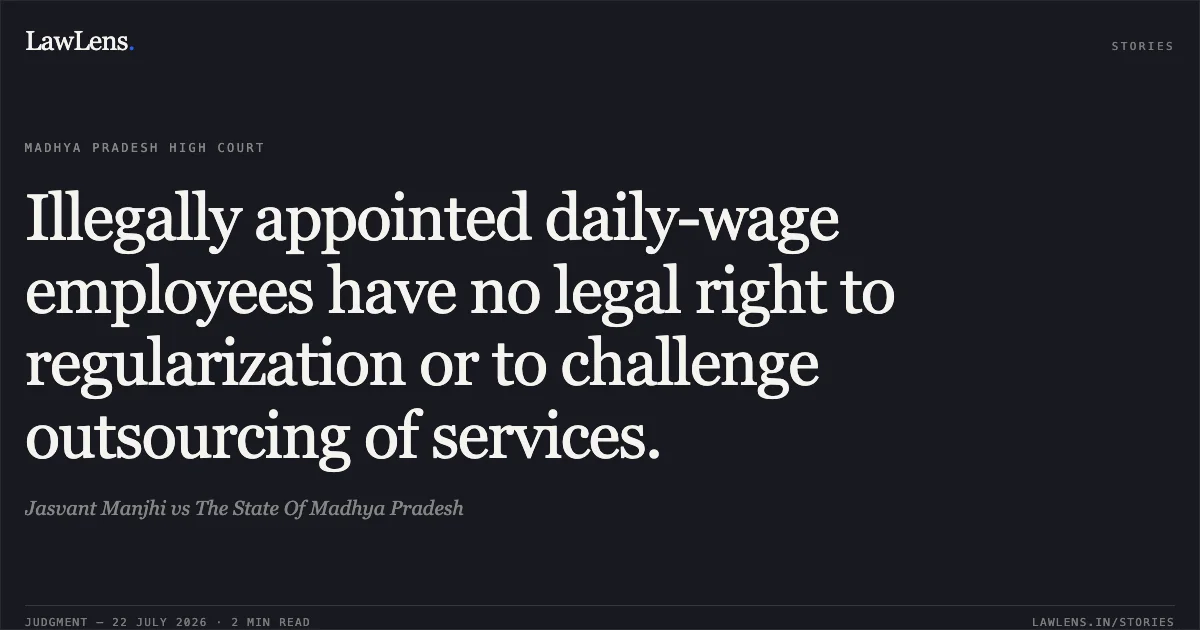
The Court answered both issues in the negative, affirming that illegally appointed daily wagers have no right to permanency or to challenge a transfer to a private agency.
Source reference: para. 7The writ petition was dismissed.
Source reference: para. 8Original Court PDF
Jasvant ManjhivsThe State Of Madhya Pradesh
Click to open original judgment
Original judgment, available to read, download and summarize on LawLens.in


