Facts
The plaintiff (1st respondent) and 4th defendant are daughters of the 1st defendant (Lakshmana Gounder) by his first wife, Valliammal.
Source reference: p.3The 1st defendant subsequently lived with/married the 4th appellant (Mani), resulting in the birth of defendants 2 and 3.
Source reference: p.3The plaintiff filed a suit for partition claiming the suit properties were ancestral, whereas the 1st defendant contended they were self-acquired via government assignment and independent business.
Source reference: p.4The Trial Court granted 1/4th share each to the plaintiff, 1st defendant, 3rd defendant, and 4th defendant.
Source reference: p.5On appeal, the First Appellate Court modified this to 1/3rd share each for the plaintiff and 4th defendant, ruling that defendants 2 and 3 were illegitimate and thus excluded from ancestral property.
Source reference: p.6Pending the first appeal, the 1st defendant died.
Source reference: p.2Issues
1. Whether the suit properties were ancestral/joint family properties or the self-acquired properties of the 1st defendant.
Source reference: p.82. Whether defendants 2 and 3, as children born of a second marriage during the subsistence of the first, are entitled to a share in the property.
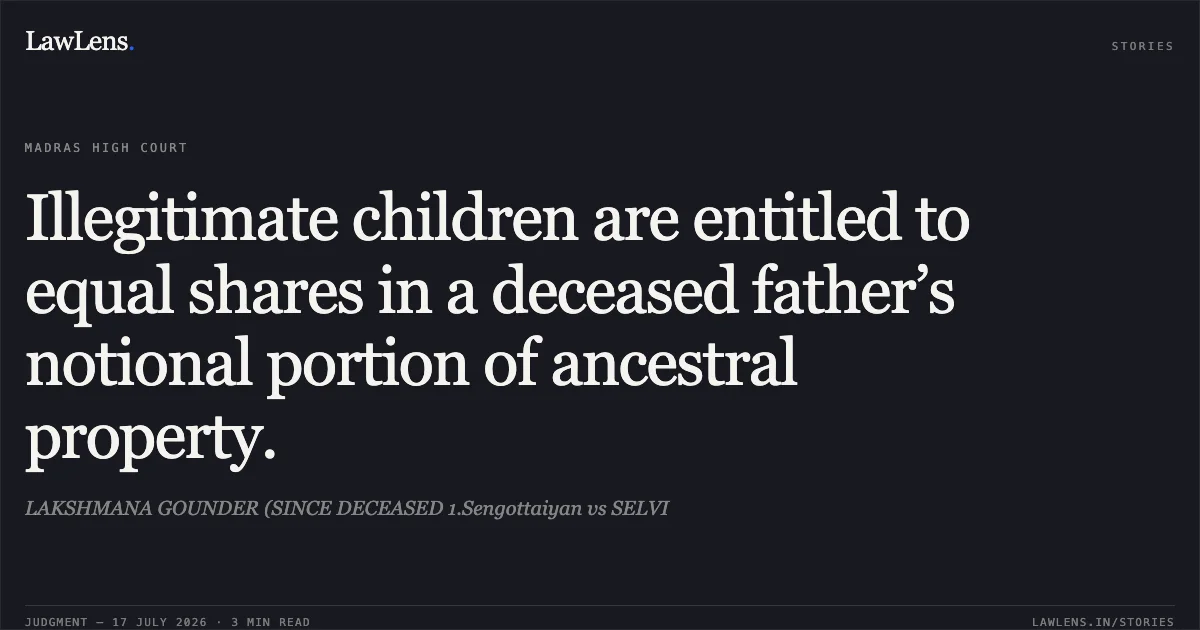
Source reference: p.7/para. 93. Whether illegitimate children are entitled to a share in the father's portion of ancestral property upon his death.
Source reference: p.11/para. 18Law Applied
The Court applied the doctrine of blending, where separate property (government assignment) is treated as joint family property through common enjoyment and partition.
Source reference: p.8Section 16 of the Hindu Marriage Act regarding the legitimacy of children of void/voidable marriages.
Source reference: no citationThe Court relied on the precedent set by the Hon’ble Supreme Court in Revanasiddappa & Another v. Mallikarjun & Others, 2023 SCC OnLine SC 1087, which establishes that children of void or voidable marriages (illegitimate children) are entitled to a share in their parents' property, including their parent's share in ancestral property via notional partition.
Source reference: p.12/para. 18The Court also exercised its power under Order 41 Rule 33 of the C.P.C. to modify a decree in favor of parties who did not appeal to ensure justice and consistency.
Source reference: p.13/para. 19Reasoning
The Court affirmed the ancestral nature of the property, noting that a 1986 Partition Deed (Ex.A1) and the 1st defendant’s own admissions (DW.1) proved the government-assigned lands were blended into the joint family pool.
Source reference: p.8-9Regarding legitimacy, since the 1st defendant failed to prove his second marriage occurred after his divorce in 1978, the Court upheld the finding that defendants 2 and 3 were illegitimate.
Source reference: p.10Following Revanasiddappa, the Court held that while these children could not claim a share in the coparcenary directly, they were entitled to an equal share in their father’s 1/3rd portion upon his death through notional partition.
Source reference: p.12Consequently, the 1/3rd share of the deceased father must be divided equally among his four children (5/12 for the two daughters; 1/12 for the two sons).
Source reference: p.12-13Holding
The High Court held that the suit properties were ancestral, entitling the plaintiff and 4th defendant to 1/3rd each initially. Upon the father's death, his 1/3rd share (4/12) was distributed equally among the plaintiff, 2nd, 3rd, and 4th defendants.
The High Court partly allowed the Second Appeal and modified the decree grants the plaintiff (1st respondent) and the 4th defendant 5/12 share each, and defendants 2 and 3 (appellants) 1/12 share each. No order as to costs was made.
Source reference: p.13-14Acts & Sections Cited
1 provisions across 1 statute referred to in this judgment. Each provision opens on LawLens.
Code of Civil Procedure, 19081
Original Court PDF
LAKSHMANA GOUNDER (SINCE DECEASED 1.SengottaiyanvsSELVI
Click to open original judgment
Original judgment, available to read, download and summarize on LawLens.in