Facts
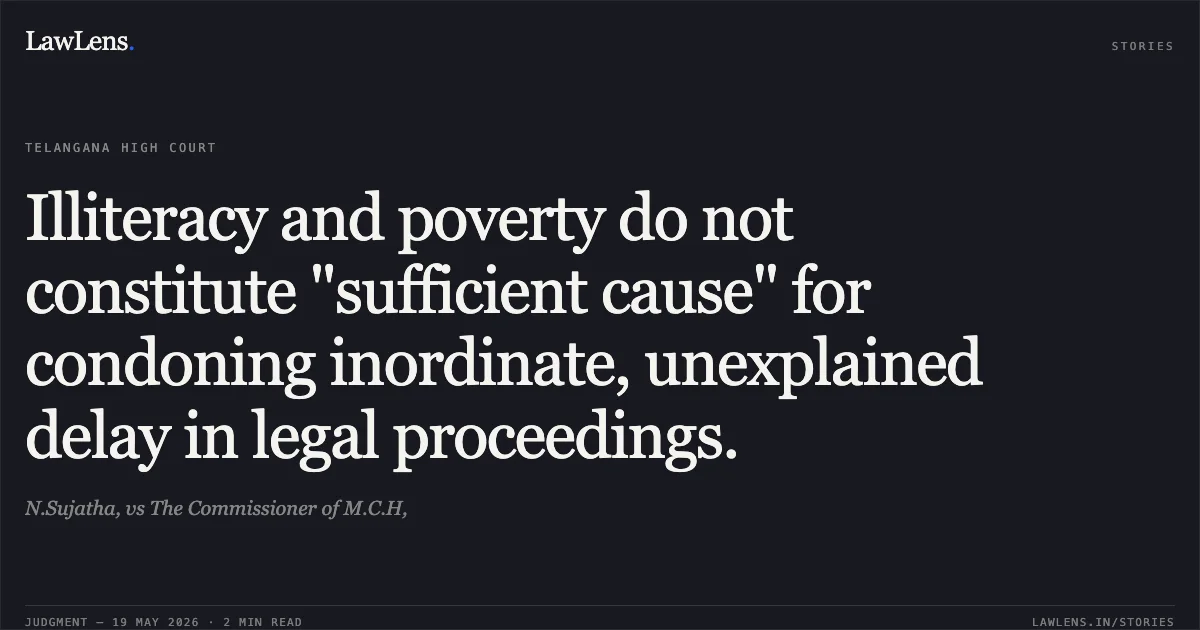
The Appellants/Petitioners sought to condone a delay of 6918 days (nearly 19 years) in filing an appeal against a Trial Court judgment dated 22.10.2003, which dismissed their suit (O.S. No. 75 of 2001) for a declaration of legal heirship and release of service benefits of the deceased, N. Yadagiri.
Source reference: para. 2The suit was dismissed primarily because Appellant No. 1 failed to present herself for cross-examination despite multiple adjournments.
Source reference: para. 13The Appellants claimed that due to illiteracy, poverty, and a lack of communication from their previous counsel, they only learned of the dismissal on 24.10.2022 when approaching authorities for terminal benefits.
Source reference: para. 4Issues
1. Whether the Appellants established "sufficient cause" under Section 5 of the Limitation Act, 1963, to condone an inordinate delay of 6918 days
Source reference: para. 7, 102. Whether the circumstances of illiteracy, poverty, and negligence of counsel are sufficient to override the statutory mandate of limitation after a lapse of nearly two decades
Source reference: para. 12, 14Law Applied
Section 5 of the Limitation Act, 1963, which requires the applicant to satisfy the court that there was "sufficient cause" for the delay.
Source reference: para. 7The court relied on the principles from Esha Bhattacharjee v. Managing Committee of Raghunathpur Nafar Academy, emphasizing that while a liberal approach is preferred for short delays, inordinate delays require strict scrutiny and cannot be condoned if there is gross negligence or lack of bona fides.
Source reference: para. 9H. Dohil Constructions Co. P. Ltd. v. Nahar Exports Limited regarding the duty of litigants to exercise due diligence.
Source reference: para. 17Basawaraj v. Special Land Acquisition Officer, which held that courts cannot condone inordinate delay without adequate justification as it violates statutory provisions.
Source reference: para. 22Reasoning
The court found the Appellants' explanation for the 19-year delay "wholly unsatisfactory" and lacking credibility.
Source reference: para. 11The court reasoned that while courts may be sympathetic to illiterate or indigent litigants, such status does not provide a "blanket licence" to ignore the law of limitation.
Source reference: para. 12, 14The record proved that the Appellants were active during the trial stage, meaning they were capable of pursuing the matter and had a duty to inquire about the status of the case.
Source reference: para. 13, 15The court noted an absence of any contemporaneous evidence showing efforts to track the case between 2003 and 2017.
Source reference: para. 16, 23Furthermore, since the Appellants had received a part-payment of benefits in 2000, their claim of total ignorance for two decades was deemed an afterthought.
Source reference: para. 18-19The court emphasized that the principle of finality of litigation (interest reipublicae ut sit finis litium) prevents reopening settled matters after such a long period.
Source reference: para. 26Holding
The court concluded that a strong case on merits cannot compensate for a complete failure to explain an inordinate delay, and the Appellants' prolonged inaction amounted to an abandonment of their legal remedy.
It held that the Appellants failed to establish "sufficient cause" for the delay of 6,918 days.
Source reference: para. 31The Court dismissed I.A. No. 1 of 2023 and consequently dismissed Appeal Suit No. 16 of 2023.
Source reference: para. 32Acts & Sections Cited
3 provisions across 2 statutes referred to in this judgment. Each provision opens on LawLens.
Limitation Act, 19632
Code of Civil Procedure, 19081
Original Court PDF
N.Sujatha,vsThe Commissioner of M.C.H,
Click to open original judgment
Original judgment, available to read, download and summarize on LawLens.in


