Facts
M/s Xerox India Ltd. imported photocopier, printer and multifunction-machine components and modules in complete knocked-down (CKD) or semi-knocked-down (SKD) form, after payment of customs duty and countervailing duty.
Source reference: paras. 5–7At its Hyderabad and Rampur warehouses, the Assessee unpacked, grouped, pinned and plugged the modules into sets corresponding to particular customer specifications, describing the activity as “kitting”.
Source reference: paras. 5–7The Revenue alleged that the Assessee assembled incomplete machines into functional photocopiers and printers, including through the fitting of components such as the High Capacity Feeder and Duplex Automatic Document Feeder, and that this amounted to manufacture under Section 2(f) of the Central Excise Act, 1944, read with Note 6 to Section XVI of the Central Excise Tariff Act, 1985.
Source reference: paras. 6.1–6.4The Commissioner confirmed a central-excise and cess demand of Rs. 17,86,47,382 for the period April 2002 to November 2006 and imposed penalties on two company executives.
Source reference: para. 8The CESTAT set aside the demand, finding that the components were cleared in their original packing, that no assembly occurred at the warehouses, and that the activity was merely kitting.
Source reference: para. 9The Revenue appealed to the Supreme Court in both sets of civil appeals, which were heard together because the facts and legal issue were substantially similar.
Source reference: paras. 1–4Issues
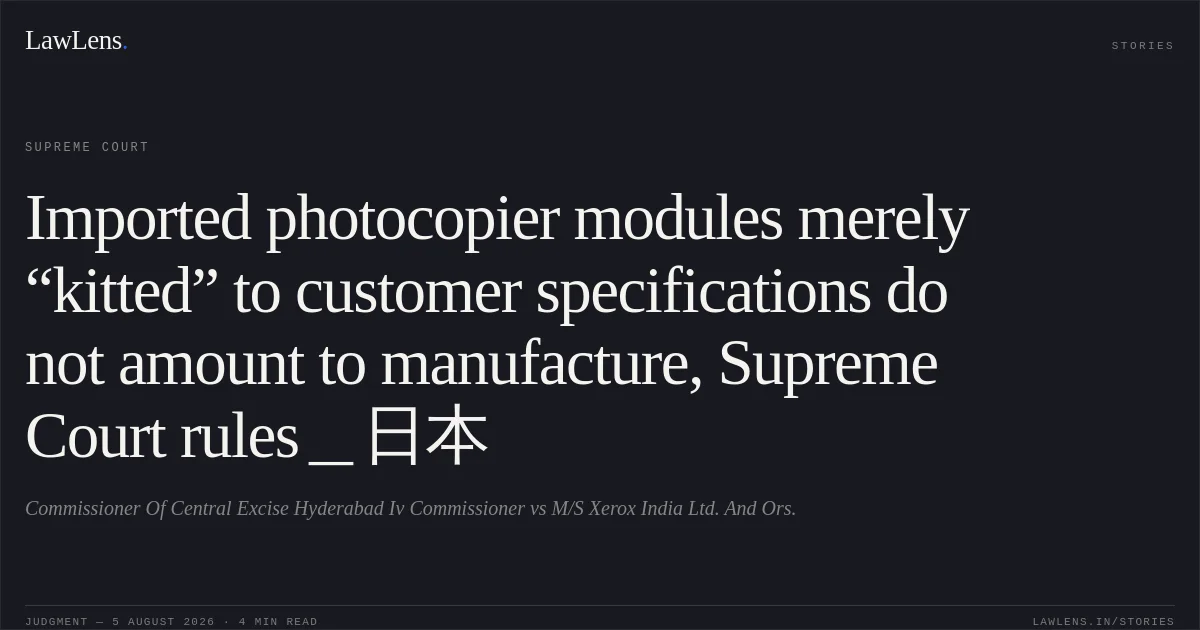
Whether the Assessee’s activity of grouping, pinning and plugging imported CKD/SKD modules at its warehouses, according to customer specifications, amounted to “manufacture” under Section 2(f) of the Central Excise Act, 1944.
Source reference: para. 4Whether Note 6 to Section XVI of the Central Excise Tariff Act, 1985 applied on the basis that the imported goods were incomplete or unfinished articles having the essential character of complete photocopiers or printers, and were converted into complete articles by the Assessee.
Source reference: paras. 4, 18Whether the Revenue could treat the goods as complete machines for customs and countervailing-duty purposes while treating them as incomplete articles for invoking Note 6 to Section XVI.
Source reference: para. 18Law Applied
Section 2(f) of the Central Excise Act, 1944 contains an inclusive definition of “manufacture” and includes processes incidental or ancillary to the completion of a manufactured product; however, manufacture ordinarily requires that a new and distinct commercial article emerge with a distinctive name, character or use.
Source reference: paras. 13–15The Court relied on Union of India v. Delhi Cloth & General Mills Co. Ltd., which established the transformation and marketability tests; Narne Tulaman Manufacturers Pvt. Ltd. v. CCE, which held that assembly of components may amount to manufacture where a distinct commercial product emerges; BPL India Ltd. v. CCE, concerning expert assembly of SKD kits into functional goods; Satnam Overseas Ltd. v. CCE, which held that an increase in value or processing is insufficient without transformation of identity; Servo-Med Industries Pvt. Ltd. v. CCE, which formulated the essential-character and commercial-use tests; and Quippo Energy Ltd. v. CCE, where substantial fitting of essential components transformed a genset into a distinct marketable “Power Pack”.
Source reference: paras. 13–18The Court also applied Note 6 to Section XVI, which deems conversion of an incomplete or unfinished article possessing the essential character of the complete article into the complete article to be manufacture; both the incomplete/unfinished character and the conversion must be established.
Source reference: para. 18Rule 2(a) of the General Rules for Interpretation is a rule of tariff classification and does not, by itself, determine whether a process constitutes manufacture.
Source reference: para. 18Reasoning
The Court held that the decisive question was not the Assessee’s description of the activity as “kitting”, but whether the activity produced a new, distinct and marketable article.
Source reference: para. 16The Tribunal had found, on examining the purchase orders, bills of entry, storage records and employee statements, that the imported goods had been classified and assessed as complete machines under Heading 8471, were cleared from the warehouses in their original packing, and were merely grouped or configured according to customer requirements.
Source reference: paras. 17, 20The Revenue failed to prove that physical assembly occurred at the warehouses or that components such as the HCF and DADF were fitted there; the Tribunal also found that those components had been factory-fitted abroad.
Source reference: para. 20In these circumstances, unpacking, plugging, pinning and grouping modules did not establish a transformation into a distinct commercial product and did not satisfy the requirements of Section 2(f).
Source reference: paras. 17, 20Note 6 was likewise inapplicable because the Revenue failed to establish either that the imported goods were incomplete or unfinished or that the Assessee converted them into complete machines.
Source reference: para. 18The Court further held that the Revenue could not simultaneously treat the goods as complete machines for customs and CVD purposes and as incomplete articles for applying Note 6.
Source reference: para. 18Since the Tribunal’s findings were based on evidence and were not perverse, they were not liable to be disturbed.
Source reference: para. 20Holding
The Supreme Court answered the issues against the Revenue.
The activity undertaken by Xerox India at its warehouses—grouping, pinning and plugging imported modules in accordance with customer specifications—did not amount to manufacture under Section 2(f) of the Central Excise Act, 1944.
Source reference: paras. 17, 21Note 6 to Section XVI of the Central Excise Tariff Act was also not attracted because no incomplete article was shown to have been converted into a complete article.
Source reference: para. 18The Tribunal’s orders setting aside the excise demand and penalties were upheld.
Source reference: no citationCivil Appeal Nos. 5939–5941 of 2010 and Civil Appeal Nos. 11870–11872 of 2018 were dismissed, with pending applications disposed of accordingly.
Source reference: paras. 21–22Original Court PDF
Commissioner Of Central Excise Hyderabad Iv CommissionervsM/S Xerox India Ltd. And Ors.
Click to open original judgment
Original judgment, available to read, download and summarize on LawLens.in