01Facts
The Petitioner was the director of a company that allegedly owed Respondent No. 2 approximately Rs. 22.68 crores for goods sold. To discharge this debt, 60 cheques were issued, all of which were dishonored in July 2014.
¶ 2.1The Respondent filed 17 separate complaints under Section 138 of the Negotiable Instruments Act.
¶ 2.1On May 9, 2017, the Metropolitan Magistrate convicted the Petitioner in all 17 cases, sentencing him to 15 months of simple imprisonment per case (to run concurrently) and awarding compensation with a default sentence of 12 months in each case to run consecutively.
¶ 2.2This meant the Petitioner faced 17 years of imprisonment if he failed to pay compensation.
¶ 6The Sessions Court dismissed the appeals in January 2025.
¶ 2.3The Petitioner approached the High Court seeking a declaration that the sentences be modified or deemed served.
¶ 202Issues
i.1. Whether the Magistrate exceeded his jurisdiction by awarding a 12-month default sentence for an offence with a maximum two-year punishment.
¶ 25 & 30ii.2. Whether sentences in default of payment of compensation can be directed to run concurrently.
¶ 25 & 34iii.3. Whether the consecutive nature of the default sentences, totaling 17 years, was justifiable and proportionate under Article 21 of the Constitution.
¶ 25 & 4203Law Applied
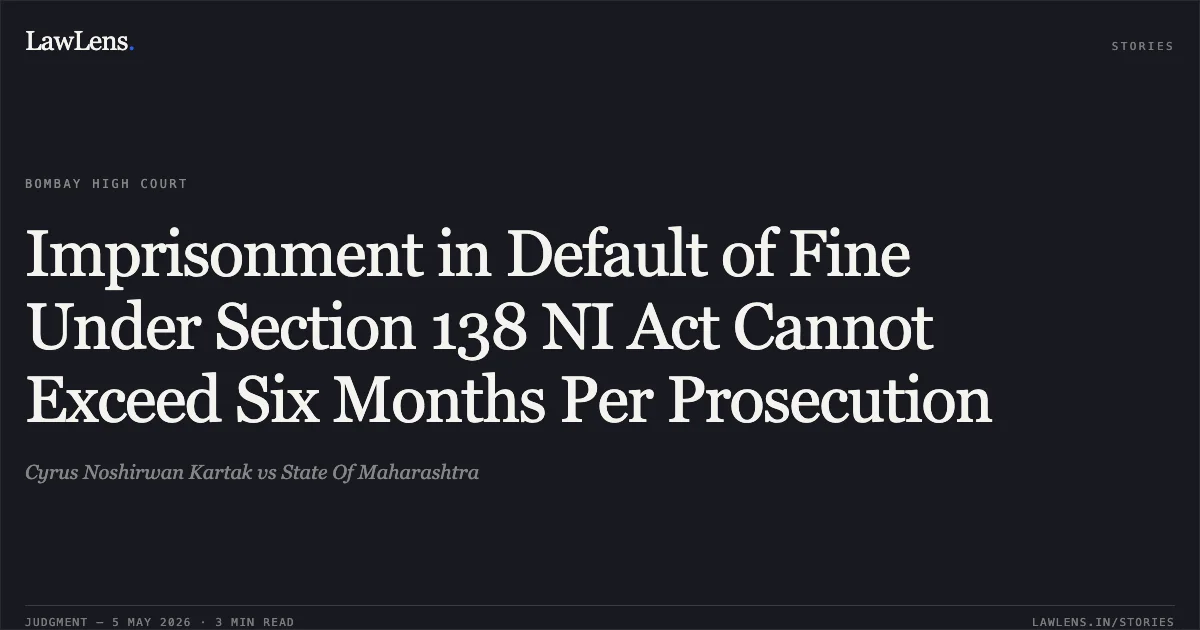
The court primarily applied Section 30 of the CrPC and Section 65 of the IPC, which mandate that imprisonment in default of fine shall not exceed one-fourth of the maximum term prescribed for the offence.
¶ 27-28As Section 138 of the N.I. Act provides a maximum of two years, the default limit is six months.
¶ 30The court relied on Sharad Hiru Kolambe v. State of Maharashtra, which establishes that default sentences cannot run concurrently.
¶ 35Jolly George Varghese v. The Bank of Cochin, which emphasizes that incarcerating a person for inability to pay debts due to poverty violates Article 21 unless there is "willful failure" despite having means.
¶ 43Provisions in the judgment · 20 · Linked ones open on LawLens
Negotiable Instruments Act, 1881 Section 138Section 141
Code of Criminal Procedure, 1973 Section 29Section 30Section 357Section 421Section 427Section 428Section 482
Indian Penal Code, 1860 9 provisions
Section 63Section 64Section 65Section 66Section 67Section 68Section 69Section 70Section 326Bharatiya Nagarik Suraksha Sanhita, 2023 Section 528
Code of Civil Procedure, 1908 Section 51
04Reasoning
The Court found the trial court’s order of 12 months’ default imprisonment per case "clearly illegal" as it doubled the statutory limit of six months permitted under Section 65 IPC.
¶ 30-31While acknowledging that default sentences must legally run consecutively, the Court noted that a cumulative default sentence of 17 years for a 15-month substantive sentence was "shockingly disproportionate" and "manifestly illegal".
¶ 34-35, 42-44Applying the principles of Sanjay Vasudeva v. State of NCT of Delhi, the Court observed that the Petitioner had already served over seven and a half years (reaching nine years with remissions), which far exceeded the substantive sentence.
¶ 44-46The Court reasoned that since Section 421 CrPC allows for the recovery of compensation even after a default sentence is served, further detention served no punitive purpose and violated the Petitioner’s right to personal liberty under Article 21.
¶ 45-4705Holding
The Court answered the issues by holding that the 12-month default sentences were unauthorized by law and that the total period of incarceration was unconstitutional.
¶ 30, 42The High Court allowed the petition and modified the 12-month default sentences in all 17 complaints to the period of sentence "already undergone" by the Petitioner. The Court ordered the Petitioner to be released forthwith, provided he was not required in any other case, effectively treating the nine-plus years already served as sufficient punishment for the defaults.
¶ 48(ii), 48(iv)Original Court PDF
Cyrus Noshirwan KartakvsState Of Maharashtra
Click to open original judgment
Original judgment, available to read, download and summarize on LawLens.in