01Facts
The petitioner challenged an order dated 18.09.2026 passed by the IV Additional Senior Civil Judge and JMFC, Mysuru, in O.S. No. 1651 of 2026, by which the Trial Court issued emergent notice on I.A. No. 1 under Order XXXIX Rules 1 and 2 CPC.
¶ 1The suit is for partition and separate possession of family properties.
¶ 2Along with the suit, the plaintiff filed I.A. No. 1 seeking to restrain the defendants from alienating the suit schedule properties or creating third-party rights in them.
¶ 2The petitioner contended that the Trial Court did not grant an ex parte temporary injunction and merely issued notice.
¶ 2.1The petitioner contended that the defendants were attempting to alienate the properties in the interim.
¶ 2.2Service on all defendants was stated to be complete and they were represented.
¶ 2.3The Court noted that the defendants are family members claiming coparcenary rights and that no third-party rights are claimed in the suit properties.
¶ 502Issues
i.1. Whether, in a partition suit among family members where no third-party rights are claimed, the Trial Court was required to preserve the status of the suit properties pending adjudication of the interlocutory application under Order XXXIX Rules 1 and 2 CPC.
¶ 6ii.2. Whether the High Court, in exercise of its supervisory jurisdiction under Article 227 of the Constitution, should interfere with the Trial Court's order merely issuing emergent notice on I.A. No. 1 and direct status quo pending its disposal.
¶ 4, 703Law Applied
The Court relied on Order XXXIX Rules 1 and 2 CPC, which empower the court to grant temporary injunctions to preserve property that is the subject of litigation, as the framework for the interlocutory application.
¶ 2, 5The Court applied the principle that, in a partition suit between family members with no third-party claims, the nature of the properties and title must be preserved pending determination of shares so that the eventual decree remains capable of enforcement.
¶ 6The Court invoked its supervisory power under Article 227 of the Constitution, exercised in a limited manner, to dispense with notice to respondents where the interference sought is limited.
¶ 4No precedent was cited in the order.
04Reasoning
The Court treated the suit as a family partition dispute in which the defendants, being coparceners, claimed no third-party rights.
¶ 5Applying the principle that title must be preserved to keep a future partition decree enforceable, the Court held that the risk of alienation during the pendency of I.A. No. 1 warranted interim protection.
¶ 6Rather than quashing the Trial Court's notice order or itself deciding the injunction, the Court confined its intervention to a narrow measure: mutual status quo as to title pending disposal of the application.
¶ 7This approach addressed the alienation risk identified by the petitioner without prejudging the merits of the injunction.
¶ 2.2The Court expressly directed the Trial Court to decide the application independently of its observations.
¶ 8(IV)05Holding
The writ petition was allowed in part.
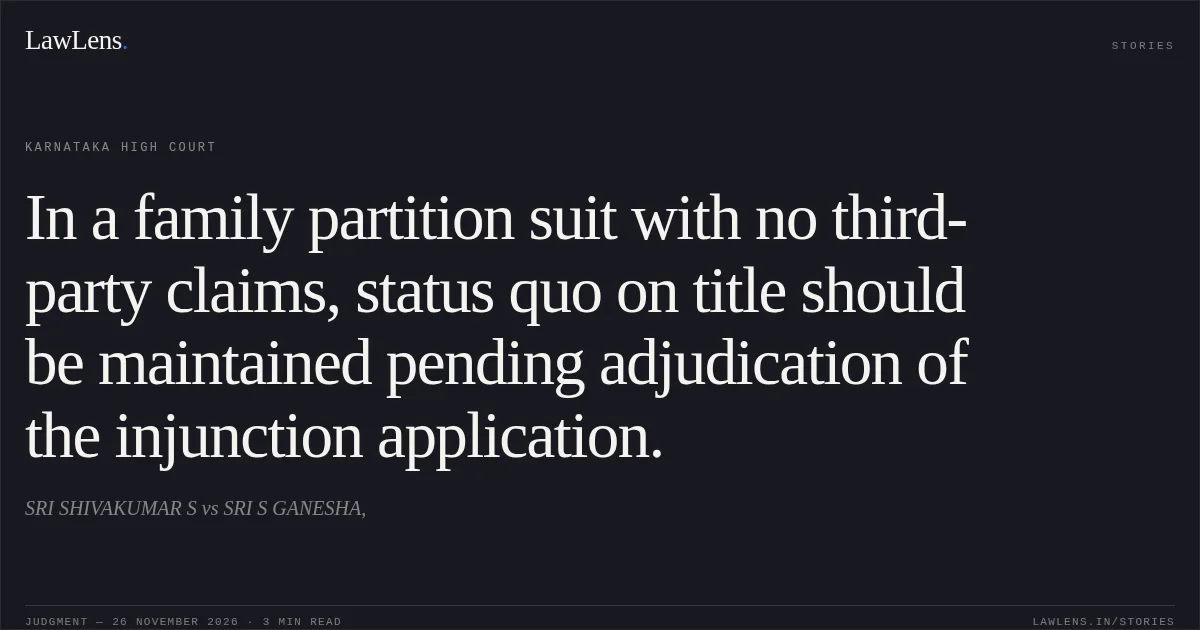
¶ 8(I)The Court held that, in a family partition suit where no third-party rights are claimed, status quo as to title to the suit schedule properties must be maintained pending adjudication of I.A. No. 1 under Order XXXIX Rules 1 and 2 CPC.
¶ 6, 7 · ¶ 8(II)The Trial Court was directed to expedite the hearing and dispose of the application within an outer limit of two months from the next date of hearing, and to decide it independently of the High Court's observations.
¶ 8(III) · ¶ 8(IV)The order does not expressly quash the emergent-notice order dated 18.09.2026.
¶ 8The scope of "title" in the status quo direction is not further elaborated.
¶ 8(II)Original Court PDF
SRI SHIVAKUMAR SvsSRI S GANESHA,
Click to open original judgment
Original judgment, available to read, download and summarize on LawLens.in



