Facts
The complainant, Mohanbhai Naranbhai Makwana (P.W. 16), a bank cashier, was accused of creating a deficit of ₹4,50,000.
Source reference: p. 6In connection with the bank's FIR, the complainant and one Pravin Dhamecha (P.W. 10) were taken to Pradhyumannagar Police Station on October 18, 2004. It was alleged that the respondent police officers beat them with sticks to extract a confession.
Source reference: p. 2A complaint was subsequently filed under Sections 330 and 114 of the IPC and Section 3(1)(x) of the Atrocity Act.
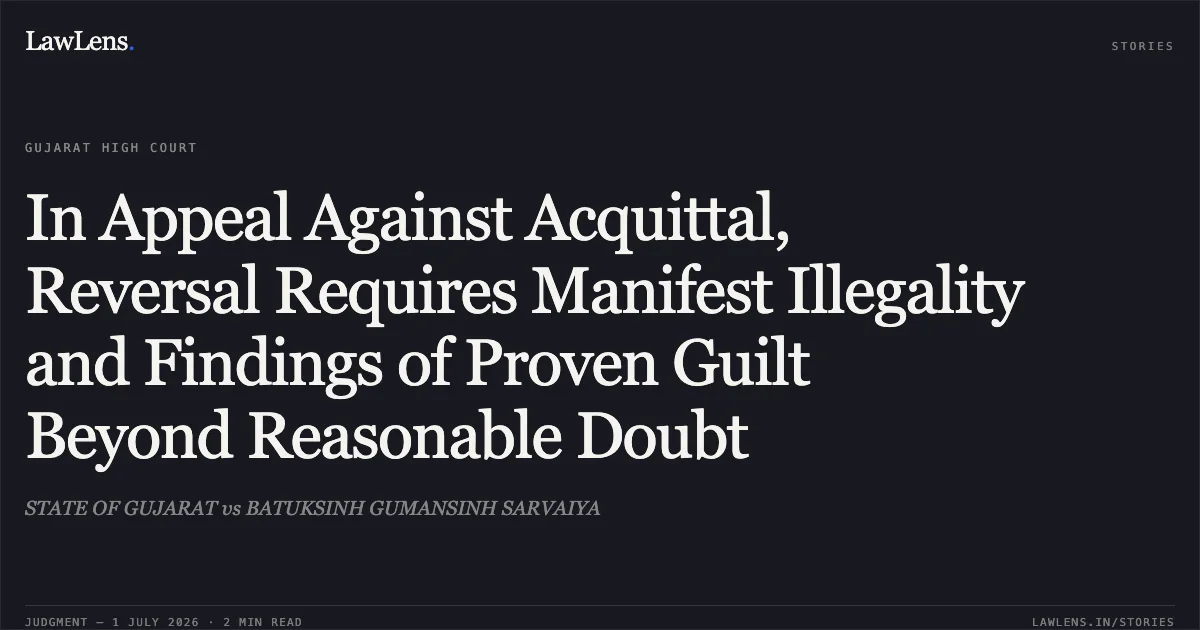
Source reference: p. 2The Trial Court (Rajkot) acquitted the accused on November 30, 2010, citing a lack of credible evidence and contradictions in witness testimonies. The State appealed this acquittal in the High Court of Gujarat.
Source reference: p. 1Issues
1. Whether the Trial Court failed to properly appreciate the evidence of the witnesses, specifically P.W. 16, P.W. 3, and P.W. 9, in light of the facts of the case.
Source reference: p. 5/62. Whether the conclusions arrived at by the Trial Court were perverse or suffered from manifest illegality requiring interference under Section 378 of the Cr.P.C.
Source reference: p. 6-8Law Applied
The Court applied Section 330 (voluntarily causing hurt to extort confession) and Section 114 (abettor present when offence committed) of the Indian Penal Code.
Source reference: p. 2The Court further considered Section 3(1)(x) of the Scheduled Castes and the Scheduled Tribes (Prevention of Atrocities) Act regarding intentional insults.
Source reference: p. 2Procedurally, the Court relied on the principles governing appeals against acquittal established in Chandrappa v. State of Karnataka, emphasizing the "double presumption of innocence".
Source reference: p. 9The Court relied on Babu Sahebagouda Rudragoudar v. State of Karnataka, which dictates that if two reasonable views exist, the appellate court must not disturb an acquittal.
Source reference: p. 10Reasoning
The Court observed that the testimony of the complainant’s wife (P.W. 9) was highly exaggerated and contradicted the complainant’s own testimony (P.W. 16).
Source reference: p. 7Crucially, P.W. 16 admitted in cross-examination that the alleged atrocities under Section 3(1)(x) were not committed and that he had no opportunity to meet his wife during the night of the incident, thereby falsifying her claim of being an eyewitness to the assault.
Source reference: p. 7The High Court found that the Trial Court had analyzed these contradictions in detail (from para 10 onwards of the original judgment) and determined that the independent witnesses failed to support the State's case.
Source reference: p. 8Since the prosecution failed to prove the charges beyond a reasonable doubt, the High Court held that the Trial Court's view was a "reasonable conclusion".
Source reference: p. 11Holding
The High Court held that the prosecution miserably failed to connect the accused to the crime with credible evidence.
The High Court dismissed the appeal and confirmed the judgment and order of acquittal. The bail bonds were cancelled, and the Record and Proceedings were ordered to be returned to the Trial Court.
Source reference: p. 12Acts & Sections Cited
4 provisions across 2 statutes referred to in this judgment. Each provision opens on LawLens.
Code of Criminal Procedure, 19732
Indian Penal Code, 18602
Original Court PDF
STATE OF GUJARATvsBATUKSINH GUMANSINH SARVAIYA
Click to open original judgment
Original judgment, available to read, download and summarize on LawLens.in