Facts
The petitioner, appointed as a Physical Education Teacher in 2004, was suspended following an incident on February 27, 2009
Source reference: para. 1(i-ii)A charge-sheet was issued on June 10, 2009, by an Assistant Commissioner holding the post of Deputy Commissioner on an "in-charge" basis
Source reference: para. 1(iv) & 1(xiv)Following an inquiry report dated June 18, 2010, the Disciplinary Authority imposed a penalty of removal from service, which was upheld by the Appellate Authority on January 31, 2012
Source reference: para. 1(vii-x)The Central Administrative Tribunal (CAT) subsequently set aside the removal, holding that while an in-charge officer could issue a charge-sheet, they lacked the competence to impose the penalty of removal
Source reference: para. 1(xiv)Both the teacher and the management challenged the CAT's order
Source reference: para. 4Issues
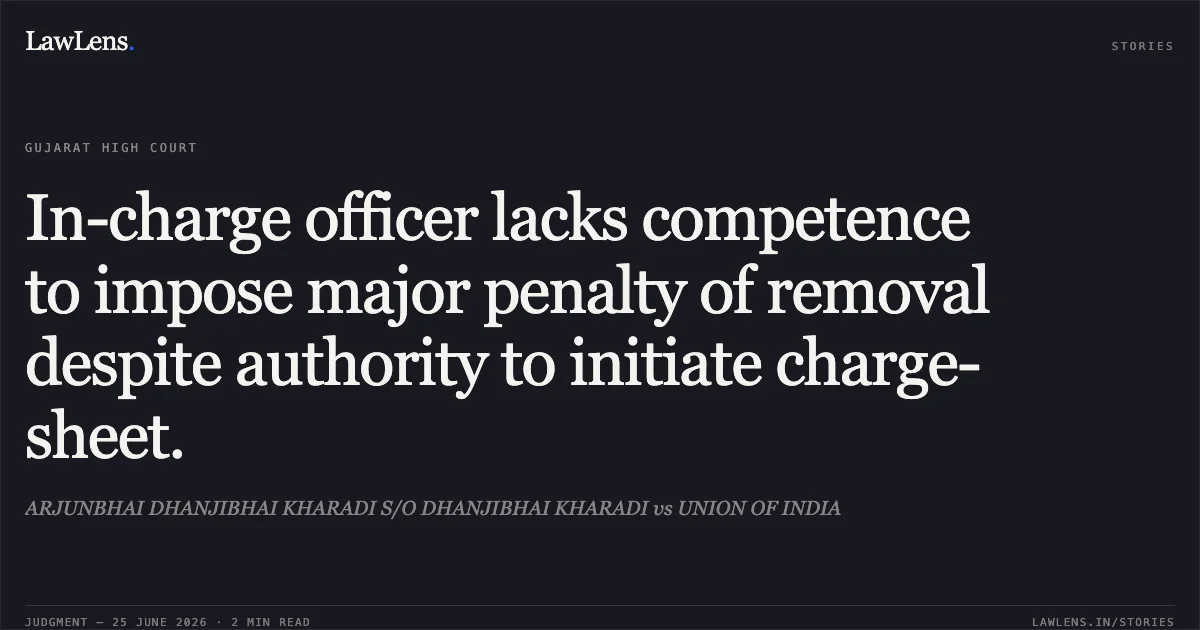
Whether an officer holding a post on an "in-charge" basis is competent to impose the major penalty of removal from service.
Source reference: para. 1(xiv) / p. 3Whether an officer lower than the rank of the appointing authority is competent to initiate disciplinary proceedings and issue a charge-sheet.
Source reference: para. 3 / p. 4Law Applied
powers exercised by a "personal designate" or specific statutory functions cannot be exercised by an in-charge officer unless specifically allotted under a statute
Source reference: para. 1(xv) & 2an officer lower in rank than the appointing authority is legally empowered to issue a charge-sheet
Source reference: para. 3provisions of the CCS (CCA) Rules
Source reference: para. 1(xv)Reasoning
The High Court affirmed the Tribunal's distinction between ministerial/procedural acts and statutory/quasi-judicial powers.
Source reference: para. 2-3It reasoned that while the initiation of a charge-sheet is a valid exercise of power even by a lower-ranked or in-charge officer per T. Abdul Razak, the actual imposition of a penalty like removal requires a specific legal mandate.
Source reference: para. 2-3Since the Deputy Commissioner (In-charge) was not a "personally designated" authority under the statute to dismiss an employee, the penalty was void.
Source reference: para. 2the court observed that since the incident occurred 16 years prior and the teacher had been out of work since 2010 without pay until 2016, he had suffered "adequate punishment," making a de novo inquiry unnecessary.
Source reference: para. 8-9Holding
The High Court dismissed both writ petitions and upheld the Tribunal’s order
It held that the penalty of removal was illegal due to the incompetence of the in-charge Disciplinary Authority
Source reference: para. 6The court directed the management to reinstate the teacher forthwith and pay the entire arrears of salary from the date of the CAT's order (March 31, 2016) until the date of actual reinstatement, to be completed within two months
Source reference: para. 6-7The court ordered the disciplinary matter be treated as closed due to the lapse of time and existing hardship
Source reference: para. 8-9Original Court PDF
ARJUNBHAI DHANJIBHAI KHARADI S/O DHANJIBHAI KHARADIvsUNION OF INDIA
Click to open original judgment
Original judgment, available to read, download and summarize on LawLens.in