Facts
On 3 November 2018, the minor claimant was travelling as a pillion rider on Motorcycle No. GJ-17-S-9965 when it collided with Rickshaw No. GJ-07-AT-1680 near Village Juni-Dhari, Narmada Canal, Mahisagar Bridge. The claimant sustained grievous injuries and fracture, allegedly due to the rash and negligent driving of both vehicles.
Source reference: p.1He filed MACP No. 95 of 2019 claiming compensation of ₹6,50,000. The Motor Accident Claims Tribunal awarded ₹4,15,409 with interest at 9% per annum, but held the rickshaw driver solely negligent and dismissed the claim against the motorcycle driver, owner and insurer.
Source reference: pp.1–2The claimant challenged the exoneration of those respondents before the High Court under Section 173 of the Motor Vehicles Act, 1988.
Source reference: p.1Issues
1. Whether the Tribunal erred in holding the rickshaw driver solely negligent and in exonerating the motorcycle driver, owner and insurer, despite the accident involving both vehicles.
Source reference: paras. 4, 7–102. Whether the accident constituted a case of composite negligence, making the tortfeasors jointly and severally liable to the innocent minor pillion rider.
Source reference: paras. 8–103. Whether the compensation awarded by the Tribunal required alteration, apart from modifying the liability of the respondents.
Source reference: para. 11Law Applied
The Court exercised appellate jurisdiction under Section 173 of the Motor Vehicles Act, 1988.
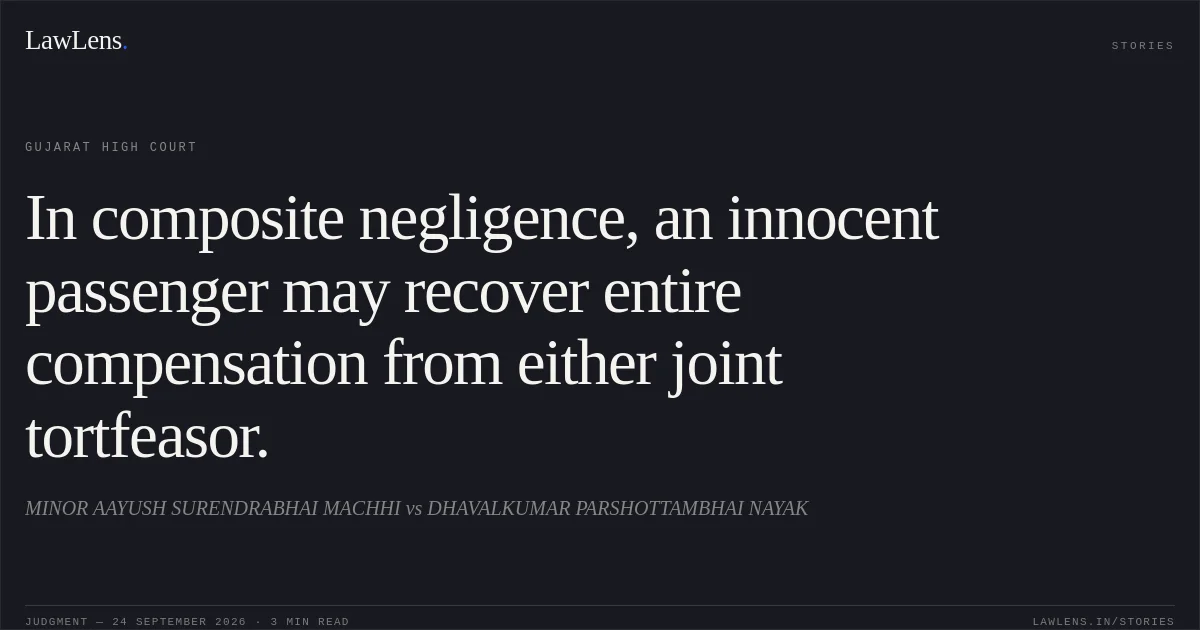
Source reference: para. 1It applied the doctrine of composite negligence, under which the claimant may recover the entire compensation from any one or all joint tortfeasors because their liability is joint and several; apportionment cannot be enforced against the claimant.
Source reference: para. 9Relying on Khenyei v. New India Assurance Co. Ltd., 2015 (9) SCC 273, the Court held that inter se apportionment between tortfeasors is relevant only for subsequent recovery between them and does not reduce the claimant’s right to recover the whole award.
Source reference: para. 9The Court also relied on Sushma v. Nitin Ganapati Rangole, AIR 2024 SC 4627, and the principle stated in Union of India v. United India Insurance Co. Ltd., (1997) 8 SCC 683, that negligence of the driver cannot be imputed to an innocent passenger or pillion rider.
Source reference: paras. 9.1–9.2Manomati Chouhan v. Oriental Insurance Co. Ltd., 2026 ACJ 742, was also cited as reaffirming the principle of composite negligence.
Source reference: para. 9.1Reasoning
The High Court found that the accident involved two vehicles and that neither driver entered the witness box to rebut the claimant’s case.
Source reference: para. 7The Tribunal had relied primarily on the claimant’s evidence, the complaint and the panchnama to attribute sole negligence to the rickshaw driver, but had not properly established that the motorcycle driver was free from negligence.
Source reference: para. 7In the absence of adequate evidence justifying exclusive liability, the Tribunal’s conclusion was based on conjectures and surmises.
Source reference: para. 8Since the claimant was a minor pillion rider and was not himself responsible for the accident, the motorcycle driver’s alleged negligence could not be imputed to him.
Source reference: paras. 8–10The collision between the two vehicles therefore constituted composite negligence, rendering the concerned tortfeasors jointly and severally liable to satisfy the award.
Source reference: paras. 8–10The Court did not disturb the quantum of compensation determined by the Tribunal.
Source reference: para. 11Holding
The appeal was partly allowed.
The Tribunal’s finding exonerating Opponents Nos. 2 to 4 was quashed and set aside.
Source reference: para. 11.1All opponents were declared jointly and severally liable to pay ₹4,15,409 with interest at 9% per annum from the date of the claim petition until realization.
Source reference: para. 11.2The insurance company was directed to deposit the decretal amount, including accrued interest, within eight weeks.
Source reference: para. 11.3The Tribunal was directed to disburse the amount to the claimant after due verification and compliance with applicable procedure, subject to deduction of court fees, if payable.
Source reference: paras. 11.4–11.5Acts & Sections Cited
1 provisions across 1 statute referred to in this judgment. Each provision opens on LawLens.
Motor Vehicles Act, 19881
Original Court PDF
MINOR AAYUSH SURENDRABHAI MACHHIvsDHAVALKUMAR PARSHOTTAMBHAI NAYAK
Click to open original judgment
Original judgment, available to read, download and summarize on LawLens.in