Facts
Jai Singh Mohne complained that Prafulla Paranjpe, a bank branch manager, had demanded a bribe in connection with a loan.
Source reference: para. 1A Lokayukta trap followed; phenolphthalein-treated currency notes were recovered from a table in the accused’s cabin, and his hands tested positive for phenolphthalein.
Source reference: para. 1The Special Judge acquitted Paranjpe of offences under Sections 7 and 13(1)(d), read with Section 13(2), of the Prevention of Corruption Act, 1988.
Source reference: para. 2The Special Police Establishment sought leave to appeal against the acquittal under Section 419 of the Bharatiya Nagarik Suraksha Sanhita, 2023.
Source reference: para. 2Issues
1. Whether the application raised a prima facie or arguable case requiring leave to appeal against the acquittal.
Source reference: para. 6–72. Whether the evidence of demand and acceptance or obtainment of illegal gratification was sufficient to warrant appellate interference with the acquittal.
Source reference: para. 14–16, 25–30Law Applied
Under Section 419 of the Bharatiya Nagarik Suraksha Sanhita, 2023, leave to appeal against acquittal is appropriate where a prima facie or arguable case requires deeper scrutiny; the leave court should not undertake a full merits determination, but must consider the relevant material and give reasons.
Source reference: para. 6An appellate court may review and reappreciate the evidence, but an acquittal strengthens the presumption of innocence, and a plausible view should not ordinarily be disturbed.
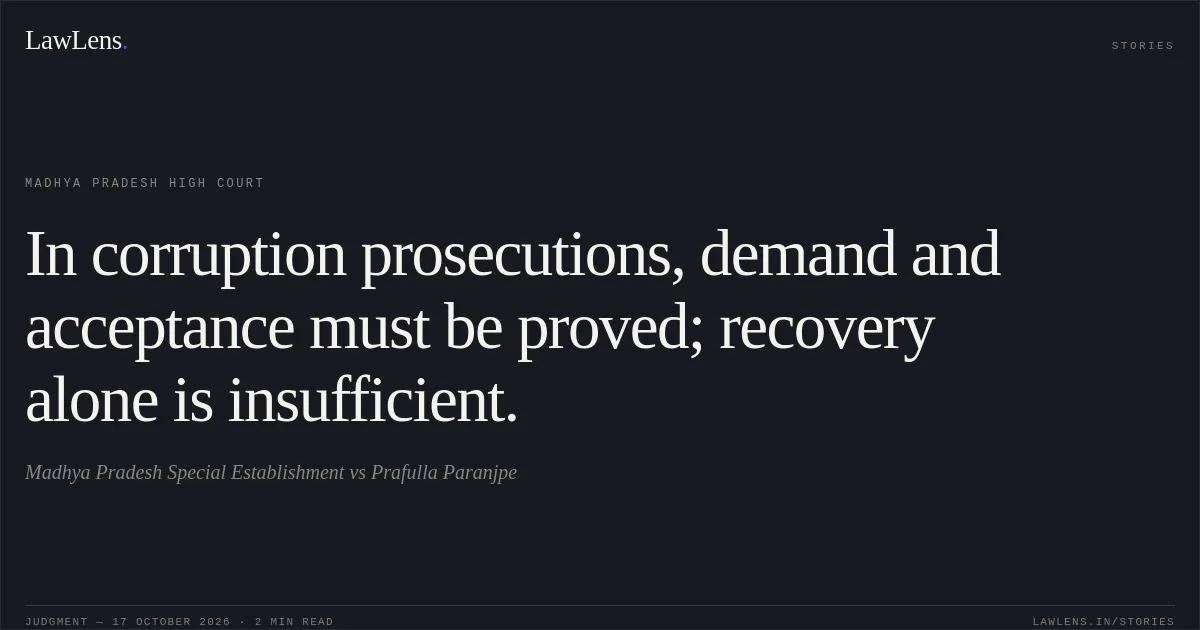
Source reference: para. 7For offences under Sections 7 and 13(1)(d)(i)–(ii) of the Prevention of Corruption Act, proof of demand and acceptance or obtainment is essential; those facts may be proved by direct or circumstantial evidence, but mere recovery is insufficient without proof of the relevant offer or demand and receipt.
Source reference: para. 14; para. 9–10Where the prosecution relies on circumstantial evidence, the circumstances must form a complete chain consistent only with guilt.
Source reference: para. 28Reasoning
The Court found material inconsistencies in the complainant’s account of the alleged demand and transfer of money.
Source reference: para. 19–23The initial complaint and preliminary panchnama concerned a loan under the Acharya Vidya Sagar Go Samvardhan Yojna, but the evidence did not establish that the complainant had applied for such a loan; the recorded conversation did not refer to that scheme, and the complainant and his son admitted they had not applied.
Source reference: para. 19–23The evidence also undermined the alleged connection to the KCC loan, which had already been sanctioned and partly withdrawn.
Source reference: para. 24The complainant resiled from his allegation of demand, the shadow witness did not hear the relevant conversation, and the evidence about who placed or handed over the currency notes was inconsistent; the son admitted placing the notes on the table.
Source reference: para. 25, 29In those circumstances, recovery of the tainted notes and phenolphthalein traces did not establish demand and voluntary acceptance or obtainment.
Source reference: para. 26, 29–31The trial court’s view was plausible and disclosed no material error warranting interference.
Source reference: para. 26, 29–31Holding
The Court declined leave to appeal, holding that the application did not demonstrate a sufficient basis to disturb the acquittal.
The application for leave was dismissed, and the criminal appeal was disposed of.
Source reference: para. 31–32Acts & Sections Cited
5 provisions across 3 statutes referred to in this judgment. Each provision opens on LawLens.
Bharatiya Nagarik Suraksha Sanhita, 20231
Prevention of Corruption Act, 19883
Code of Criminal Procedure, 19731
Original Court PDF
Madhya Pradesh Special EstablishmentvsPrafulla Paranjpe
Click to open original judgment
Original judgment, available to read, download and summarize on LawLens.in