Facts
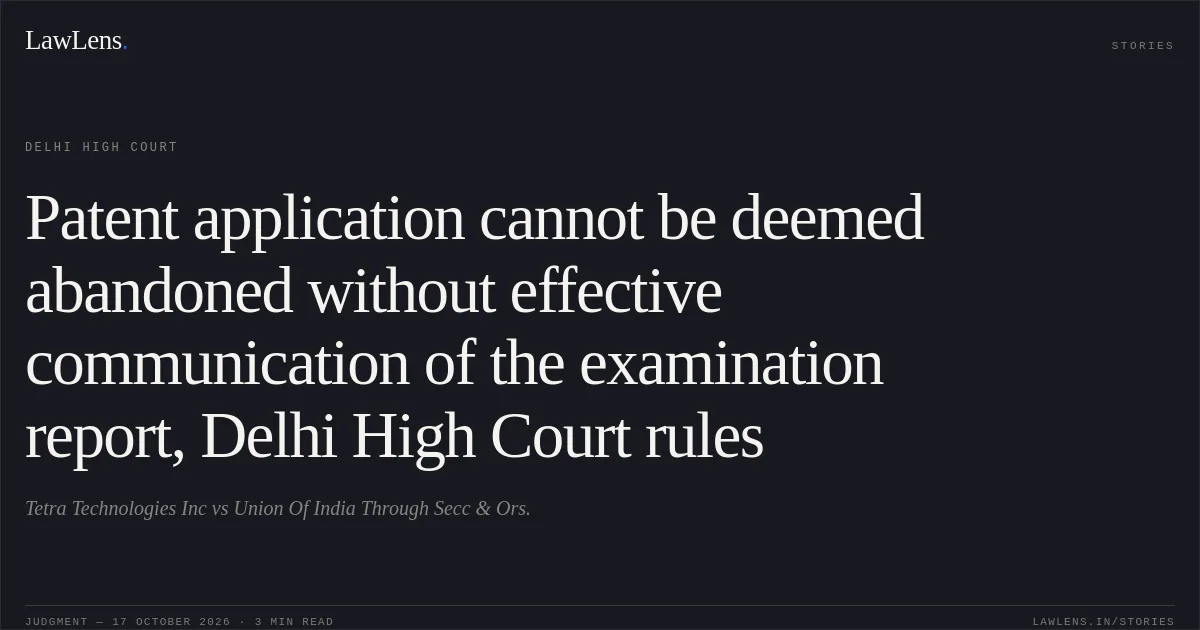
Tetra Technologies’ Indian national-phase patent application was treated as abandoned under Section 21(1) of the Patents Act, 1970, after the applicant did not respond to a First Examination Report (FER) said to have been issued by email on 28 October 2021.
Source reference: para. 2–4, 15, 19The petitioner denied receiving the FER and relied on screenshots of the relevant email inbox.
Source reference: para. 2–4, 15, 19After discovering the abandonment on 25 April 2023, it pursued the matter with the Patent Office and filed a petition seeking re-issuance of the FER, which remained undecided.
Source reference: para. 2–4, 15, 19The respondents relied on their IT records showing dispatch to the email address provided in the application and argued that the prescribed period for responding had expired.
Source reference: para. 5–7Issues
1. Whether the application could be treated as deemed abandoned under Section 21(1) when the petitioner disputed receipt of the FER and the respondents showed dispatch but not delivery.
Source reference: para. 11, 14–16, 212. Whether the petitioner was entitled to revival of the application and a fresh opportunity to respond to the FER.
Source reference: para. 18–22Law Applied
Section 21(1) of the Patents Act provides for deemed abandonment if the applicant fails to meet the applicable requirements within the prescribed period, which runs from the date the first statement of objections is forwarded to the applicant.
Source reference: para. 9Rules 5 and 6(3) of the Patents Rules, 2003 require an address for service, including postal and email addresses, and permit authenticated electronic communication; Rule 6(4) treats dispatch as the date of communication, while Rule 6(5) recognises that a communication may be delayed in reaching its recipient.
Source reference: para. 10, 14Rules 24B(5) and 24B(6) provide the response period and a limited extension.
Source reference: para. 5, 18The Court applied the principle that a legal fiction must not be extended beyond its purpose (Bengal Immunity Co. Ltd. v. State of Bihar); that abandonment requires conduct supporting the inference of an intention to abandon (Telefonaktiebolaget LM Ericsson (Publ) v. Union of India and Ferid Allani v. Union of India); and that notice is a fundamental element of natural justice (Uma Nath Pandey v. State of U.P., quoting Canara Bank v. V.K. Awasthy).
Source reference: para. 11–13, 18It also relied on Saurav Chaudhary v. Union of India for the proposition that website availability alone may not establish notice of an FER, and The European Union v. Union of India concerning the Court’s limited power to grant relief in exceptional cases involving alleged abandonment.
Source reference: para. 17, 20Reasoning
The Court held that Section 21(1)’s deemed-abandonment consequence presupposes that the FER was effectively communicated to the applicant; proof that an email was dispatched did not, in the circumstances, establish that it reached the address for service.
Source reference: para. 11, 14–16The petitioner had supplied both postal and email addresses, and its inbox screenshots supported its claim of non-receipt.
Source reference: para. 15–17The respondents did not establish delivery or show that the FER had also been sent by post; the dispatch record and system-generated email, which contained a disclaimer that its information was not valid for legal proceedings, were insufficient to justify abandonment.
Source reference: para. 15–17The petitioner’s timely entry into the national phase, request for examination, and subsequent efforts to pursue the application were also inconsistent with an intention to abandon it.
Source reference: para. 20In these circumstances, the unresolved request for re-issuance and the absence of an effective opportunity to respond reinforced the need to set aside the abandonment decision.
Source reference: para. 18–21Holding
The Court set aside the decision treating the application as abandoned and directed its revival on the respondents’ records.
The respondents were directed to furnish the FER dated 28 October 2021 to the petitioner’s patent agent, or another address notified by the petitioner, by both postal and email service within one week.
Source reference: para. 22–24The petitioner was granted eight weeks from the date of judgment to respond; if it did so, the application was to be processed to its conclusion expeditiously and in accordance with law.
Source reference: para. 22–24The Court expressed no opinion on the merits of the patent application.
Source reference: para. 22–24Acts & Sections Cited
2 provisions across 1 statute referred to in this judgment. Each provision opens on LawLens.
Patents Act, 19702
Original Court PDF
Tetra Technologies IncvsUnion Of India Through Secc & Ors.
Click to open original judgment
Original judgment, available to read, download and summarize on LawLens.in