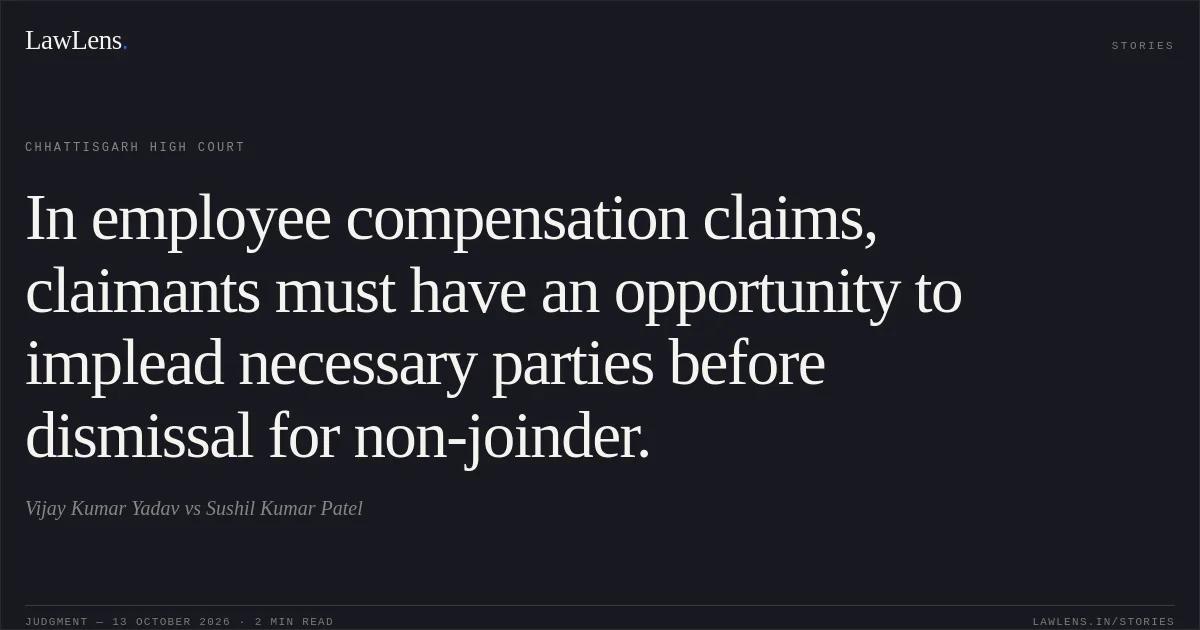
Facts
The appellants sought compensation under Section 22 of the Employees’ Compensation Act, 1923, alleging that their son, Sahdev Yadav, died after coming into contact with a temporary electricity wire while working on school toilet construction for respondent No. 1.
Source reference: para. 3–4Respondent No. 1 denied employing the deceased or holding the construction contract.
Source reference: para. 5The Commissioner dismissed the claim, finding that the Public Health Engineering Department and the alleged contractor, Harishankar Patel, had not been joined, and that the claimants had not established the employment connection or examined eyewitnesses.
Source reference: paras. 6, 10–11The claimants appealed under Section 30 of the Act.
Source reference: para. 1Issues
Whether the Commissioner was justified in dismissing the claim for non-joinder of the Public Health Engineering Department and the alleged contractor, without giving the claimants an opportunity to implead them?
Source reference: paras. 2, 10Whether the Commissioner was justified in finding that the claimants had failed to prove that the death occurred in the course of and arising out of the deceased’s employment, including because no eyewitnesses were examined?
Source reference: paras. 2, 11Law Applied
Section 22 of the Employees’ Compensation Act, 1923, provides the basis for an application claiming compensation, while Section 30 provides for an appeal on a substantial question of law.
Source reference: paras. 1, 3The Court treated the Act as beneficial legislation and held that, where the Commissioner considers additional parties necessary for proper adjudication, the claimants should be afforded an opportunity to implead them.
Source reference: paras. 10–11Similarly, where the evidence is considered insufficient to establish the claim, the claimants may be afforded an opportunity to adduce the necessary evidence.
Source reference: paras. 10–11Reasoning
The Commissioner relied on correspondence and exhibits indicating that the construction contract had been awarded to Harishankar Patel, but had not framed a specific issue on non-joinder or mis-joinder.
Source reference: paras. 10–11Given the beneficial nature of the legislation, the Court held that the claimants should have been given an opportunity to add the parties considered necessary.
Source reference: paras. 10–11The Court also held that the absence of eyewitness testimony did not justify dismissing the claim without first allowing the claimants an opportunity to adduce evidence on whether the death arose out of and in the course of employment.
Source reference: para. 11Holding
The Court answered both substantial questions of law in the negative, in favour of the appellants, set aside the Commissioner’s order, and remitted the matter for fresh consideration.
The parties were permitted to amend their pleadings, file documents, and lead evidence; they were directed to appear before the Commissioner on 09.12.2026.
Source reference: para. 11The appeal was partly allowed.
Source reference: para. 11Acts & Sections Cited
2 provisions across 1 statute referred to in this judgment. Linked provisions open on LawLens.
Employee2
Original Court PDF
Vijay Kumar YadavvsSushil Kumar Patel
Click to open original judgment
Original judgment, available to read, download and summarize on LawLens.in
![Higher-post pay under FR 49 requires appointment; performing the duties alone does not confer entitlement.. M SUBBA RAO vs Comptroller And Auditor-general Of India. CAT - ['Hyderabad']. LawLens](/stories/thumbnails/higher-post-pay-under-fr-49-requires-appointment-performing-the-duties-alone-does-not-conf-d680f3ed2bbe47a5ac4b36f310e6adcc.webp)
![Incorrect OMR bubbling cannot justify rejection after the answer sheet has been evaluated.. Diksha Mathur vs Delhi Subordinate Services Selection Board. CAT - ['Delhi']. LawLens](/stories/thumbnails/incorrect-omr-bubbling-cannot-justify-rejection-after-the-answer-sheet-has-been-evaluated-8aaaf281b9554255b48062e842c86777.webp)