Facts
The complainant, M/s ADS Dhalli, alleged that Rajinder Chauhan, proprietor of Rajinder Orchard & Co., purchased apples from it in 2011 and issued three cheques of ₹5,00,000 each towards the amount due.
Source reference: paras. 5–10The cheques were dishonoured for insufficient funds; after service of statutory notice and non-payment, the complainant filed a complaint under Section 138 of the Negotiable Instruments Act (NI Act).
Source reference: paras. 5–10The Trial Court convicted the accused and ordered six months’ simple imprisonment and compensation of ₹15,20,000.
Source reference: paras. 1–3The Sessions Court acquitted him, finding no legally enforceable debt because the bills were in the name of M/s V.K. Traders.
Source reference: paras. 1–3The complainant appealed.
Source reference: paras. 1–3The High Court considered the ledgers, folios, bills, an agreement permitting ADS to conduct business using V.K. Traders’ licence, and the accused’s admission that he had transferred money to the complainant.
Source reference: paras. 15–30Issues
1. Whether the complainant proved that the dishonoured cheques were issued in discharge of a legally enforceable debt or liability
Source reference: paras. 32–35, 39–412. Whether the accused rebutted the statutory presumptions under Sections 118(a) and 139 of the NI Act by claiming that the cheques were security cheques given to M/s V.K. Traders
Source reference: paras. 36–40Law Applied
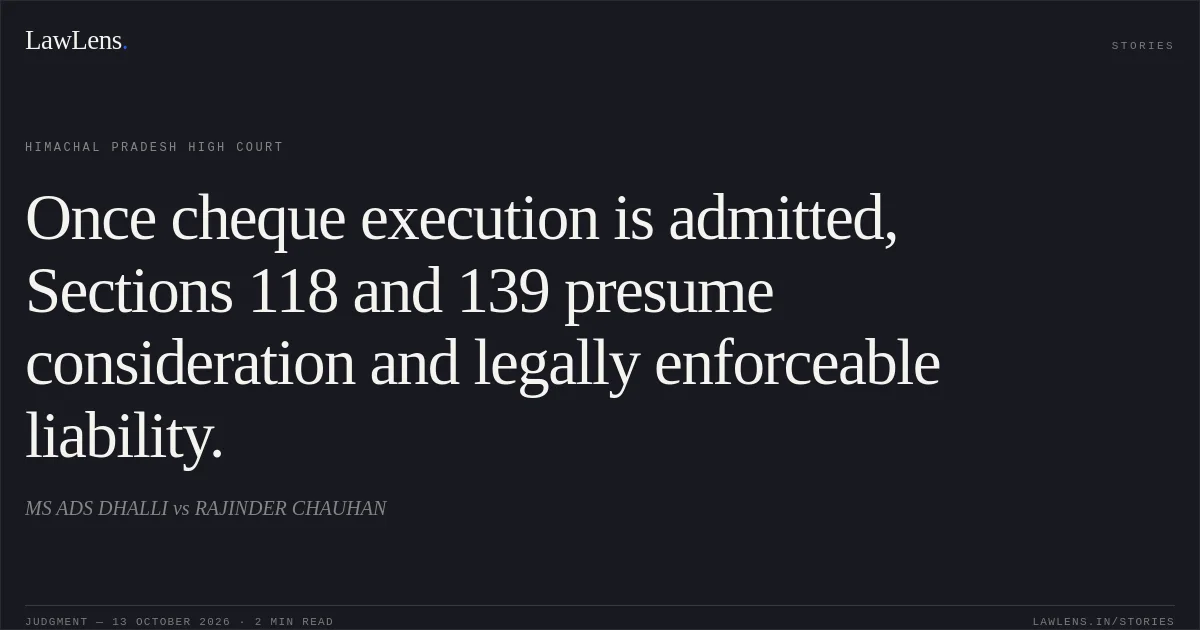
Section 118(a) of the NI Act requires the Court to presume, unless the contrary is proved, that a negotiable instrument was made or drawn for consideration; Section 139 requires the presumption that the holder received the cheque in discharge of a debt or liability.
Source reference: paras. 36–39Both presumptions are rebuttable, and the accused may rebut them by raising a probable defence, including on a preponderance of probabilities.
Source reference: paras. 36–39The Court relied on Mallavarapu Kasivisweswara Rao v. Thadikonda Ramulu Firm & Ors., (2008) 7 SCC 655, on rebutting the presumption of consideration, and N. Vijay Kumar v. Vishwanath Rao N., 2025 SCC OnLine SC 873, and Sanjabij Tari v. Kishore S. Borcar, 2025 SCC OnLine SC 2069, on the presumptions arising upon admission of cheque execution.
Source reference: paras. 36–39Reasoning
The accused did not dispute his signatures or execution of the cheques, so the statutory presumptions arose.
Source reference: paras. 22–35, 40–41The complainant’s ledgers and folios corresponded with the bills, which bore ADS’s insignia; the agreement showed that ADS operated using V.K. Traders’ licence during the relevant period.
Source reference: paras. 22–35, 40–41The accused also admitted transferring money to the complainant in 2011.
Source reference: paras. 22–35, 40–41Against this documentary and admitted evidence, his assertion that the cheques were given to V.K. Traders as security remained unsupported; he did not call its proprietor to substantiate that defence.
Source reference: paras. 22–35, 40–41The Court therefore found that the accused had not rebutted the presumptions and that the evidence supported a debt arising from apple transactions with the complainant.
Source reference: paras. 22–35, 40–41Holding
The High Court held that the cheques were issued towards a legally enforceable debt and that the accused had failed to rebut the presumptions under the NI Act.
It set aside the Sessions Court’s acquittal and upheld the Trial Court’s findings of conviction and sentence; it directed the Trial Court to take steps to ensure that the accused underwent the sentence imposed.
Source reference: paras. 42–43Acts & Sections Cited
3 provisions across 1 statute referred to in this judgment. Each provision opens on LawLens.
Negotiable Instruments Act, 18813
Original Court PDF
MS ADS DHALLIvsRAJINDER CHAUHAN
Click to open original judgment
Original judgment, available to read, download and summarize on LawLens.in