Facts
The petitioners were named in an FIR alleging that they and others assaulted the informant’s wife, who was five months pregnant.
Source reference: p. 2, para. 3After investigation, the police filed a charge-sheet against three co-accused and exonerated the petitioners; the Magistrate did not take cognizance against them.
Source reference: p. 2, para. 3; p. 3, para. 4During the Sessions trial, the informant applied under Section 319 CrPC to summon the petitioners.
Source reference: p. 2, para. 2The trial court allowed the application on 27 September 2018, summoning them to face trial for offences under Sections 147, 149, 341, 504 and 314 IPC.
Source reference: p. 2, para. 2The petitioners challenged that order before the High Court.
Source reference: p. 2, para. 2Issues
1. Whether the evidence recorded at trial satisfied the standard required to summon the petitioners under Section 319 CrPC, notwithstanding their exoneration during investigation.
Source reference: pp. 3–5, paras. 4–5; pp. 7–8, paras. 9–102. Whether the trial court’s summoning order should be quashed in light of the nature of the evidence relied upon.
Source reference: p. 8, paras. 10–11Law Applied
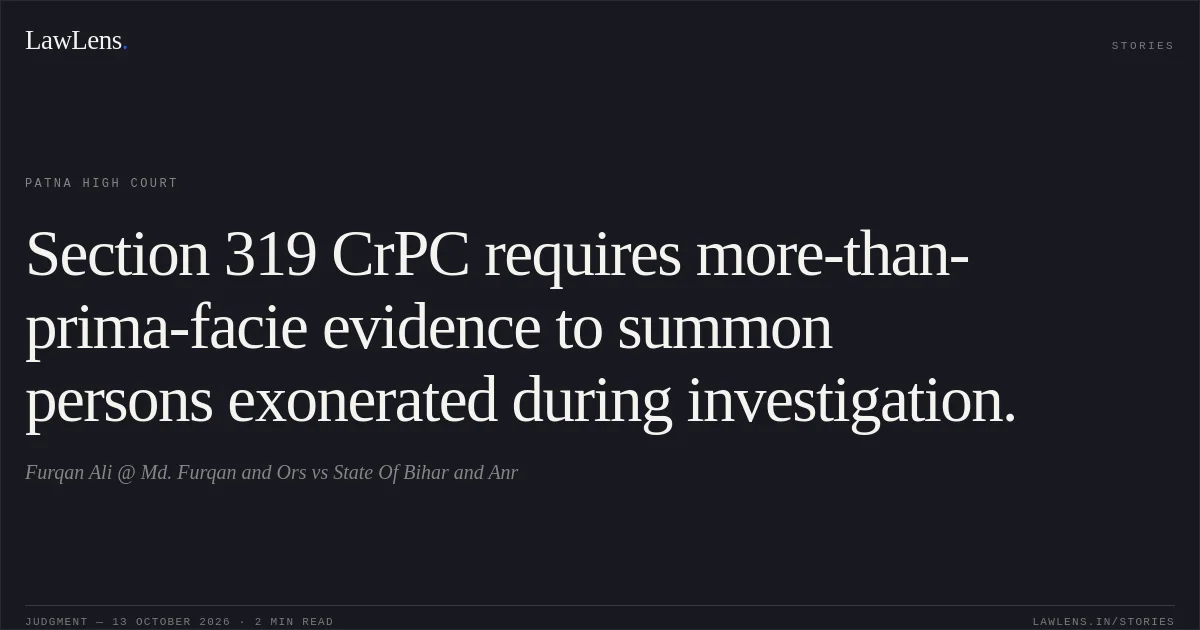
Section 319 CrPC confers an extraordinary and discretionary power to summon a person who is not an accused where evidence before the court indicates that the person may have committed an offence triable with the accused.
Source reference: pp. 3–4, para. 4Under Hardeep Singh v. State of Punjab, (2014) 3 SCC 92, the power must be exercised sparingly: the evidence must be stronger than that required to establish a prima facie case at the charge-framing stage, though it need not establish guilt as if conviction were inevitable.
Source reference: pp. 3–4, para. 4Sukhpal Singh Khaira v. State of Punjab, (2023) 1 SCC 289, was cited on the availability of the Section 319 power before pronouncement of judgment.
Source reference: pp. 5–7, para. 9Reasoning
The High Court considered the victim’s testimony that, after regaining consciousness at a clinic, she had not told the doctor that the petitioners assaulted her, together with PW-5’s admission that he had come to testify at the informant’s instance.
Source reference: pp. 4–5, para. 5; p. 8, para. 10Although the opposite parties relied on the victim’s and other witnesses’ trial testimony identifying the petitioners, the Court held that the cited omissions and circumstances rendered the ocular evidence tainted and contradictory and insufficient to meet the Hardeep Singh threshold for summoning persons previously exonerated by the police.
Source reference: pp. 5, 7–8, paras. 7, 10It concluded that continuing proceedings against the petitioners under the impugned order would amount to an abuse of process.
Source reference: p. 8, para. 10Holding
The High Court held that the evidence did not justify exercising the extraordinary power under Section 319 CrPC against the petitioners.
It quashed the trial court’s order dated 27 September 2018 and allowed the application.
Source reference: p. 8, paras. 10–12Acts & Sections Cited
6 provisions across 2 statutes referred to in this judgment. Each provision opens on LawLens.
Code of Criminal Procedure, 19731
Indian Penal Code, 18605
Original Court PDF
Furqan Ali @ Md. Furqan and OrsvsState Of Bihar and Anr
Click to open original judgment
Original judgment, available to read, download and summarize on LawLens.in
![Pension must be recalculated on the Passenger Attendant Grade-I scale, not merely the Group-C Porter scale.. DINESHWAR PRASAD TIWARI vs NORTH CENTRAL RAILWAY. CAT - ['Allahabad']. LawLens](/stories/thumbnails/pension-must-be-recalculated-on-the-passenger-attendant-grade-i-scale-not-merely-the-group-97c58c85243d433bb520084af94a02bd.webp)
![Delayed IPR filing cannot independently disqualify an employee from promotion absent an applicable rule.. Bhupendra Kumar vs DELHI DEVELOPMENT AUTHORITY. CAT - ['Delhi']. LawLens](/stories/thumbnails/delayed-ipr-filing-cannot-independently-disqualify-an-employee-from-promotion-absent-an-ap-da80816741284e10afeaa1e45c382f9b.webp)