Facts
On 13 February 2008, Abbal/Awwal Singh was travelling in Tata Scorpio Gold bearing registration No. UA-07P-5337 when it met with an accident at Village Sarkanda, Tehri Garhwal.
Source reference: para. 2He suffered grievous spinal injuries and was treated at several hospitals.
Source reference: para. 2He was subsequently assessed as having 80% permanent disability.
Source reference: para. 2He filed M.A.C. Case No. 27 of 2010 claiming ₹11,16,000 in compensation.
Source reference: para. 2The Motor Accident Claims Tribunal awarded ₹9,74,000 with interest at 6% per annum, fastening liability on New India Assurance Company Ltd.
Source reference: para. 2The Insurance Company appealed against the finding fastening liability, while the claimant filed a connected appeal seeking enhancement.
Source reference: paras. 1–2Although the Tribunal found that rash and negligent driving had not been proved, it nevertheless accepted the accident and injuries, assessed 80% permanent disability, and awarded compensation.
Source reference: para. 7; para. 12Issues
Whether the Insurance Company could be held liable when the Tribunal had found that rash and negligent driving by the vehicle’s driver was not proved?
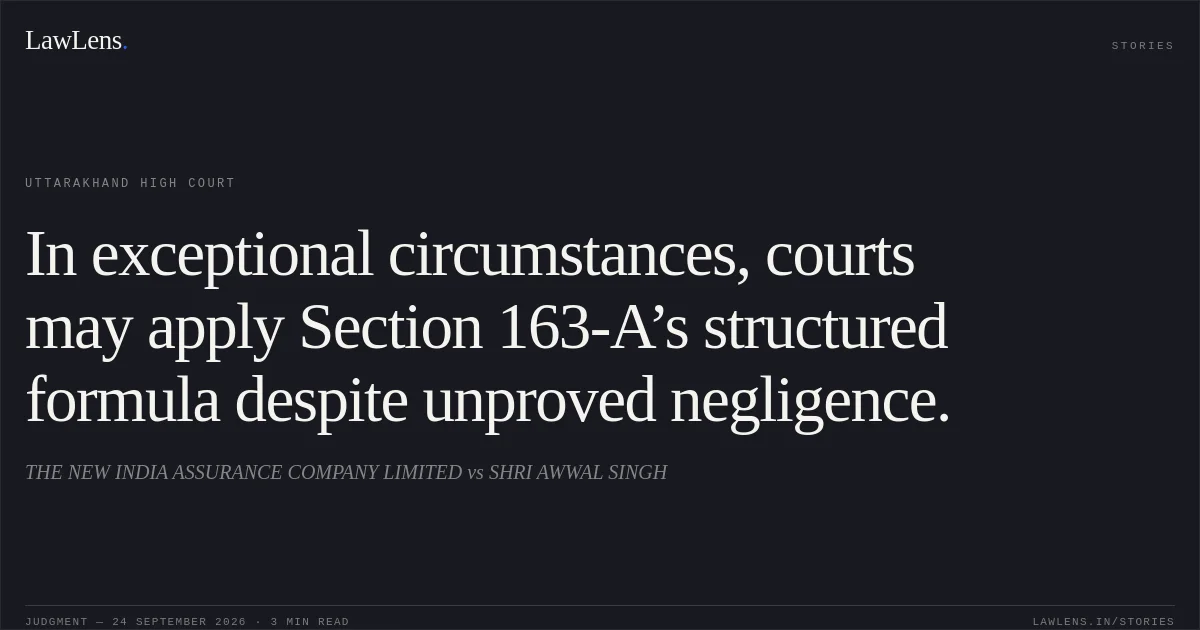
Source reference: para. 8; para. 12Whether the compensation should be determined under the structured formula contemplated by Section 163-A read with the Second Schedule to the Motor Vehicles Act, 1988, despite the claim having been adjudicated in the existing proceedings?
Source reference: paras. 13–15Whether the claimant was entitled to enhancement beyond the ₹9,74,000 awarded by the Tribunal?
Source reference: paras. 9, 15–18Law Applied
Section 166 of the Motor Vehicles Act, 1988 is founded on fault liability and ordinarily requires proof of wrongful act, neglect, or default.
Source reference: no citationSection 163-A creates a distinct no-fault compensation mechanism based on the structured formula in the Second Schedule, dispensing with the requirement of proving wrongful act, neglect, or default.
Source reference: para. 13In Oriental Insurance Co. Ltd. v. Hansrajbhai V. Kodala, (2001) 5 SCC 175, the Supreme Court held that Section 163-A provides compensation on a structured-formula basis without protracted adjudication on fault.
Source reference: para. 13In Deepal Girishbhai Soni v. United India Insurance Co. Ltd., (2004) 5 SCC 385, the Supreme Court distinguished Section 163-A from Section 166 and held that Section 163-A provides an independent statutory scheme for compensation under the structured formula.
Source reference: para. 14Sarla Verma v. Delhi Transport Corporation, (2009) 6 SCC 121, was relied upon for the distinction between the Second Schedule multiplier and the multiplier applicable to Section 166 claims; the Second Schedule prescribes a multiplier of 17 for a claimant aged 21–25 years.
Source reference: para. 15Reasoning
The Court noted the Tribunal’s internally inconsistent approach: it recorded that rash and negligent driving had not been established but nevertheless proceeded to award compensation and fasten liability on the Insurance Company.
Source reference: paras. 7, 12Since the accident, injuries, and 80% permanent disability were established, and the claimant had already undergone prolonged treatment, the Court held that it would be inequitable to require him to initiate fresh proceedings under Section 163-A.
Source reference: para. 14In the peculiar appellate circumstances, it therefore applied the Section 163-A structured formula to determine compensation.
Source reference: no citationThe claimant’s monthly income was accepted as ₹5,000, resulting in an annual income of ₹60,000; 80% disability produced an annual loss of ₹48,000, which, multiplied by 17, yielded ₹8,16,000 for permanent partial disablement.
Source reference: para. 15The Court additionally awarded ₹60,000 for loss of income for 52 weeks, ₹15,000 for medical expenses, and ₹5,000 for grievous injury, totalling ₹8,96,000.
Source reference: paras. 15–16Although negligence was not proved, the Court declined to completely exonerate the Insurance Company because the Tribunal had ultimately proceeded in favour of the claimant and the Court itself had determined compensation under the no-fault structured formula.
Source reference: para. 16Holding
The Insurance Company’s appeal, A.O. No. 47 of 2012, was partly allowed.
The Tribunal’s award was modified from ₹9,74,000 to ₹8,96,000, while the Insurance Company’s liability to satisfy that amount was maintained.
Source reference: para. 17The claimant’s appeal for enhancement, A.O. No. 103 of 2012, was dismissed.
Source reference: para. 18The sum of ₹7,50,000 deposited by the Insurance Company and ₹25,000 deposited by way of FDR were directed to be adjusted against the modified award.
Source reference: para. 19The balance of ₹1,21,000, together with interest at 6% per annum, was directed to be deposited before the Tribunal within one month, with directions for release of the awarded amount and accrued interest to the claimant.
Source reference: para. 19Acts & Sections Cited
4 provisions across 1 statute referred to in this judgment. Each provision opens on LawLens.
Motor Vehicles Act, 19884
Original Court PDF
THE NEW INDIA ASSURANCE COMPANY LIMITEDvsSHRI AWWAL SINGH
Click to open original judgment
Original judgment, available to read, download and summarize on LawLens.in