Facts
The petitioner-wife sought transfer under Section 24 of the Code of Civil Procedure, 1908, of Case No. 542/2026, filed by the respondent-husband under Section 11 of the Hindu Marriage Act, 1955, from the Principal Judge, Family Court, Raipur, to the Family Court, Kawardha.
Source reference: para. 1–2The parties married on 13 May 2022. The wife alleged cruelty and dowry-related harassment, following which she left the matrimonial home on 20 December 2024 and began residing with her parents at Kawardha.
Source reference: para. 2She had also lodged FIR No. 83/2025 against the husband and his family members at Police Station Kabirdham, with proceedings pending before the Judicial Magistrate First Class, Kabirdham (Kawardha).
Source reference: para. 2, 8The wife contended that the approximately 240-kilometre distance between Kawardha and Raipur, coupled with her lack of independent income, made it difficult for her to attend proceedings at Raipur.
Source reference: para. 3The husband opposed the transfer on the ground that he was employed in a private bank and posted at Raipur, making travel to Kawardha inconvenient.
Source reference: para. 4Issues
Whether, in the circumstances of the matrimonial dispute, Case No. 542/2026 should be transferred from the Family Court, Raipur, to the Family Court, Kawardha under Section 24 CPC.
Source reference: para. 1, 9Whether the wife’s convenience, including her financial circumstances, residence at Kawardha, and the pendency of related criminal proceedings there, should be preferred over the husband’s employment-related inconvenience at Raipur.
Source reference: para. 3–4, 6–9Law Applied
The Court applied Section 24 CPC, under which proceedings may be transferred when the ends of justice so require.
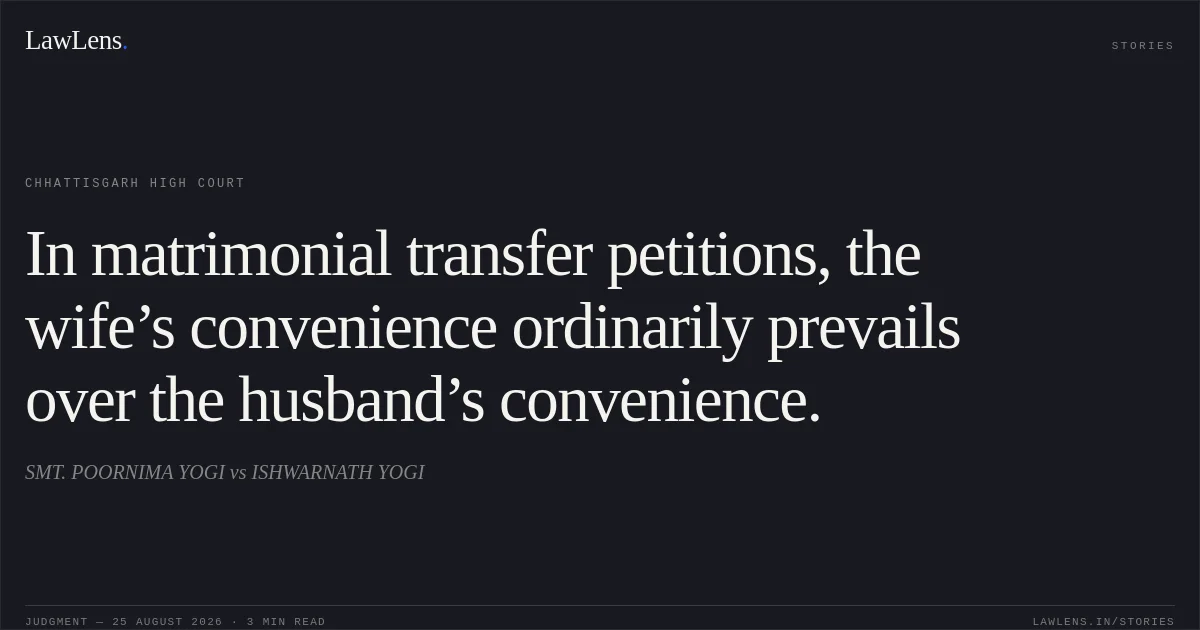
Source reference: para. 1, 6Relying on N.C.V. Aishwarya v. A.S. Saravana Karthik, 2022 SCC OnLine SC 1199, the Court held that matrimonial transfer applications require consideration of the parties’ economic position, social circumstances, lifestyle, behavioural circumstances, and means of livelihood, and that, in the prevailing socio-economic context, the wife’s convenience will generally receive preference.
Source reference: para. 6The Court further relied on Sumita Singh v. Kumar Sanjay, (2001) 10 SCC 41, and Rajani Kishor Pardeshi v. Kishore Babulal Pardeshi, (2005) 12 SCC 237, for the principle that, where a husband institutes proceedings against the wife, the wife’s convenience is ordinarily to be preferred.
Source reference: para. 7Reasoning
The Court found that the wife was residing with her parents at Kawardha, had no independent income, and would face difficulty travelling approximately 240 kilometres to Raipur for each hearing.
Source reference: para. 2–3Her criminal case against the husband was already pending before the competent Magistrate at Kawardha, making transfer convenient not only for her but also for the husband, who would otherwise have to attend proceedings at both locations.
Source reference: para. 8Although the husband was employed at Raipur and claimed difficulty travelling to Kawardha, the Court held that this inconvenience did not outweigh the wife’s circumstances or the established principle favouring her convenience in matrimonial proceedings.
Source reference: para. 4, 6–9The Court therefore concluded that the ends of justice warranted transfer.
Source reference: para. 9Holding
The transfer petition was allowed.
Case No. 542/2026, Ishwarnath Yogi v. Poornima Yogi, was ordered to be transferred from the Principal Judge, Family Court, Raipur, to the Family Court, Kawardha, District Kabirdham, for trial and disposal in accordance with law.
Source reference: para. 10The Family Court, Raipur, was directed to transmit the record within 15 days, and the Family Court, Kawardha, was directed to conclude the matter expeditiously, preferably within four months of receiving the record.
Source reference: paras. 10–11The parties were directed to cooperate, and the husband could be permitted to appear through video conferencing where personal appearance was unnecessary.
Source reference: para. 11Pending applications, if any, were disposed of, with no order as to costs.
Source reference: para. 12Acts & Sections Cited
7 provisions across 3 statutes referred to in this judgment. Linked provisions open on LawLens.
Code of Civil Procedure, 19081
Bharatiya Nyaya Sanhita, 20235
Hindu Marriage Act, 19551
Original Court PDF
SMT. POORNIMA YOGIvsISHWARNATH YOGI
Click to open original judgment
Original judgment, available to read, download and summarize on LawLens.in
![Courts will not interfere with transfers absent mala fides or violation of statutory rules.. M Ramya vs EMPLOYEES STATE INSURANCE CORPORATION (ESIC). CAT - ['Chennai']. LawLens](/stories/thumbnails/courts-will-not-interfere-with-transfers-absent-mala-fides-or-violation-of-statutory-rules-a6845e9ca6f548fca284c51c8351957f.webp)
![Courts cannot direct one-time recruitment age relaxation absent authority in the governing rules or advertisement.. UT OF PUDUCHERRY vs M ANDAL. CAT - ['Chennai']. LawLens](/stories/thumbnails/courts-cannot-direct-one-time-recruitment-age-relaxation-absent-authority-in-the-governing-895d78fde47143e2a8ed0207c4b6a44f.webp)
![A review cannot correct an allegedly erroneous decision absent an error apparent on the record.. Ajit Kumar Jha vs RAILWAY BOARD. CAT - ['Delhi']. LawLens](/stories/thumbnails/a-review-cannot-correct-an-allegedly-erroneous-decision-absent-an-error-apparent-on-the-re-8ac952fd4eba470c92f7da20af72a220.webp)