01Facts
The parties married according to Hindu rites on 06.03.2025. Their relationship deteriorated within 11 days, after which the wife left the matrimonial home at Bilaspur and began residing at her parental home in Durg.
¶ 4The husband instituted proceedings under Section 9 of the Hindu Marriage Act for restitution of conjugal rights, registered as Civil Suit No. 736A/2025, before the Family Court, Bilaspur. The wife subsequently filed an application for maintenance under Section 144 of the Bharatiya Nagarik Suraksha Sanhita, 2023, registered as MJC (Criminal) No. 1157/2025, before the Family Court, Durg.
¶ 4The husband sought transfer of the wife’s maintenance proceedings from Durg to Bilaspur, asserting difficulty in travelling because he cared for his 78-year-old ailing father and had no available assistance.
¶ 5The wife sought transfer of the husband’s restitution proceedings from Bilaspur to Durg, alleging harassment, misuse of CCTV recordings, threats to circulate private footage, and apprehension of danger to her life.
¶ 6Both parties acknowledged that, despite direct bus and train connectivity, the distance between Durg and Bilaspur was approximately 300 kilometres, making frequent travel burdensome.
¶ 702Issues
i.Whether the wife’s maintenance proceedings pending before the Family Court, Durg should be transferred to the Family Court, Bilaspur on the ground of the husband’s alleged hardship and responsibility towards his ailing father?
¶ 2, 5, 11–12ii.Whether the husband’s restitution-of-conjugal-rights proceedings pending before the Family Court, Bilaspur should be transferred to the Family Court, Durg, having regard primarily to the wife’s convenience and the fact that her maintenance proceedings were already pending at Durg?
¶ 3, 6–1203Law Applied
The Court applied Section 24 of the Code of Civil Procedure, 1908, under which proceedings may be transferred where the ends of justice so require.
¶ 2–3, 8In matrimonial transfer matters, the Court relied on Sumita Singh v. Kumar Sanjay, (2001) 10 SCC 41, and Rajani Kishor Pardeshi v. Kishore Babulal Pardeshi, (2005) 12 SCC 237, for the principle that the wife’s convenience ordinarily deserves preference when the husband institutes proceedings against her.
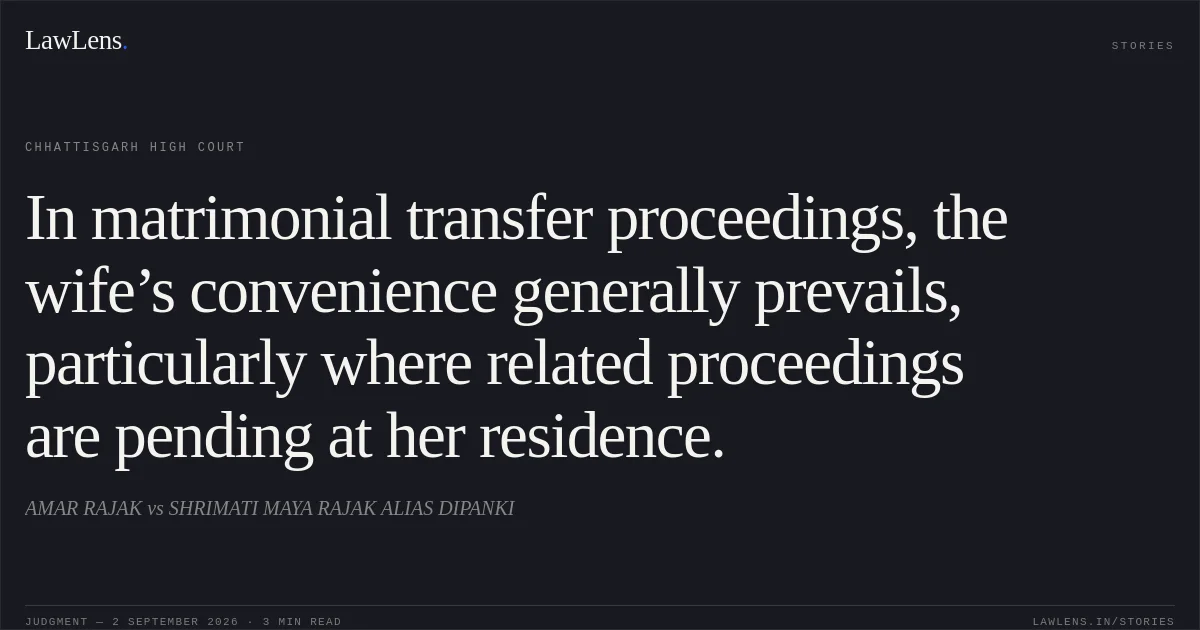
¶ 9The Court further relied on N.C.V. Aishwarya v. A.S. Saravana Karthik, 2022 SCC OnLine SC 1199, which holds that the governing consideration under Section 24 is the demand of the ends of justice and that courts should consider the parties’ economic position, social circumstances, standard of living, livelihood, and sources of support; in the prevailing socio-economic context, the wife’s convenience generally receives primary consideration.
¶ 10The proceedings themselves arose under Section 9 of the Hindu Marriage Act and Section 144 of the BNSS.
¶ 2–4Provisions in the judgment · 3 · Linked ones open on LawLens
Code of Civil Procedure, 1908 Section 24
Bharatiya Nagarik Suraksha Sanhita, 2023 Section 144
Hindu Marriage Act, 1955 Section 9
04Reasoning
The Court acknowledged the husband’s contention that travel to Durg would be difficult because of his responsibility towards his ailing father, but found that the wife’s convenience was the predominant consideration in the matrimonial transfer proceedings.
¶ 5, 11The wife was residing at Durg, had alleged serious matrimonial harassment and threats, and would face substantial hardship in attending proceedings at Bilaspur, particularly given the approximately 300-kilometre distance between the two places.
¶ 6–7, 11The Court also considered that the wife’s maintenance case was already pending before the Family Court, Durg. Transferring the husband’s restitution proceedings to Durg would therefore reduce the wife’s hardship and enable both matters to be heard at one location.
¶ 11On this basis, the Court found no justification to transfer the maintenance proceedings to Bilaspur and instead ordered transfer of the restitution proceedings to Durg.
¶ 1105Holding
The Court allowed TPC No. 200 of 2025 filed by the wife and rejected TPC No. 48 of 2026 filed by the husband.
¶ 12Civil Suit No. 736A/2025, instituted by the husband under Section 9 of the Hindu Marriage Act, was transferred from the Family Court, Bilaspur to the Family Court, Durg.
¶ 13The Family Court, Bilaspur was directed to transmit the complete record within 15 days of receiving or being communicated the order.
¶ 14The Family Court, Durg was directed to expedite both proceedings and preferably conclude them within four months from communication of the order, with both parties required to cooperate.
¶ 15The husband was permitted to appear through video conferencing on dates when his physical presence was not specifically required.
¶ 16Original Court PDF
AMAR RAJAKvsSHRIMATI MAYA RAJAK ALIAS DIPANKI
Click to open original judgment
Original judgment, available to read, download and summarize on LawLens.in