Facts
The respondent filed a private complaint (PCR No. 67/2020) against the petitioner for offences under Sections 406, 420, 504, and 506 of the IPC
Source reference: p. 7Following a police investigation and a subsequent ‘B’ report, the Trial Court recorded the sworn statements of the complainant and witnesses, took cognizance, and issued process
Source reference: p. 7On July 16, 2025, the Trial Court proceeded to frame charges by treating the earlier sworn statements as "evidence before charge" without recording fresh evidence under Section 244 of the Cr.P.C.
Source reference: p. 1-2, 7The petitioner challenged this order, seeking discharge on the grounds of procedural illegality
Source reference: p. 2Issues
1. Whether the Trial Court committed a reversible error by proceeding to frame charges in a warrant case instituted on a private complaint without recording evidence before charge as mandated by the Cr.P.C.
Source reference: p. 6, para. 10(i)2. Whether the omission to record evidence before charge warrants the discharge of the accused or constitutes a curable defect
Source reference: p. 8-9, para. 13Law Applied
The court primarily applied the procedure for warrant cases instituted otherwise than on a police report under Sections 244, 245, and 246 of the Cr.P.C. (Sections 267-269 of the BNSS)
Source reference: p. 4, para. 5It relied on the principle that a sworn statement recorded for taking cognizance is not "evidence" for the purpose of framing charges
Source reference: p. 2-3, para. 3The court evaluated the precedent from Rajanna v. Chayapathi (ILR 1988 KAR 198), which suggests discharge if no evidence is led
Source reference: p. 2The Court followed the Apex Court’s rulings in Ajoy Kumar Ghose v. State of Jharkhand (2009) 14 SCC 115 and Sunil Mehta v. State of Gujarat (2013) 9 SCC 209, which establish that such procedural lapses are curable defects necessitating a remand rather than an automatic discharge
Source reference: p. 4-5, para. 6-7Reasoning
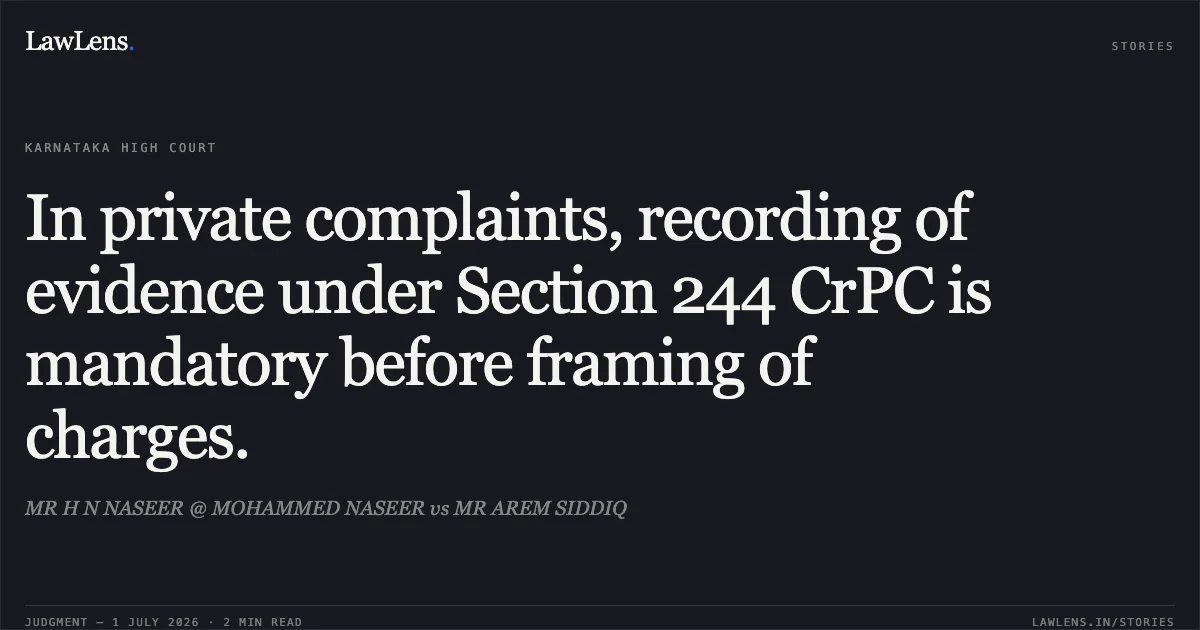
The High Court observed that in private complaint warrant cases, the Magistrate must follow a distinct three-stage process: recording evidence of the prosecution under Section 244, considering discharge under Section 245, and framing charges under Section 246
Source reference: p. 4The Trial Court erred by erroneously substituting the complainant's "sworn statement" (recorded at the pre-cognizance stage) for "evidence before charge"
Source reference: p. 7, para. 11While the petitioner argued for discharge based on older precedents, the Court held that modern jurisprudence from the Supreme Court dictates that procedural irregularities involving the omission of evidence before charge are "curable defects"
Source reference: p. 9, para 13-14Consequently, the proper remedy is not to discharge the accused, which would be an extreme measure, but to set aside the flawed order and restore the proceedings to the correct legal stage
Source reference: p. 10, para. 15Holding
The Court answered the issue in the affirmative, holding that the Trial Court committed a procedural error
The Criminal Revision Petition was allowed, and the impugned order dated July 16, 2025, was set aside. The matter was remitted back to the Trial Court with a direction to record "evidence before charge" in accordance with law and then proceed to determine whether charges should be framed based on the material available
Source reference: p. 10, para. 15Acts & Sections Cited
1 provisions across 1 statute referred to in this judgment. Each provision opens on LawLens.
Code of Criminal Procedure, 19731
Original Court PDF
MR H N NASEER @ MOHAMMED NASEERvsMR AREM SIDDIQ
Click to open original judgment
Original judgment, available to read, download and summarize on LawLens.in


