01Facts
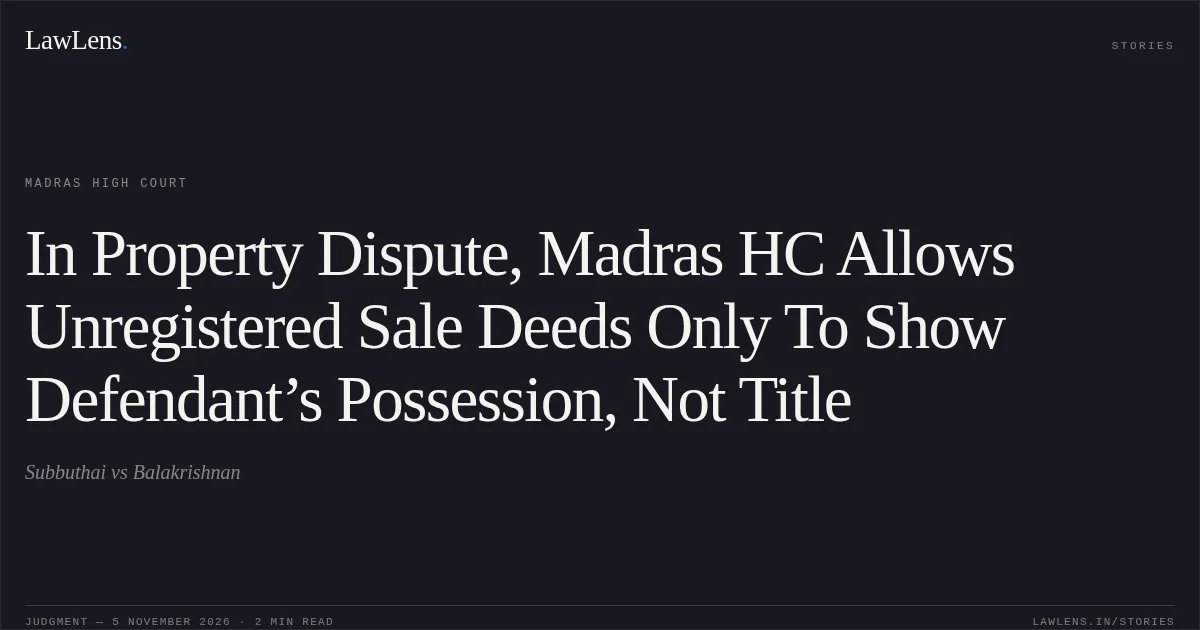
The plaintiff sought permanent injunction, claiming title under a registered sale deed dated 22 July 2008. The defendant claimed under two unregistered sale deeds dated 27 July 2000 and 5 October 2005.
¶ 2 · pp. 2–3After the trial court directed payment of stamp duty and penalty on those deeds, the defendant sought to mark them to support his claim of possession. The trial court permitted their admission to prove the nature and character of the property; the plaintiff challenged that order under Article 227 of the Constitution.
¶ 2 · pp. 2–302Issues
i.Whether the unregistered sale deeds could be received in evidence for a collateral purpose in the suit.
¶ 3–4 · pp. 3–6ii.Whether the deeds could be used to prove the nature and character of the property, or only the defendant’s possession.
¶ 3, 7–8 · pp. 3–703Law Applied
Section 49 of the Registration Act, 1908, bars an unregistered document that requires registration from being received as evidence of a transaction affecting immovable property, while permitting its use to prove a collateral transaction not requiring registration. Order XIII Rule 3 of the Code of Civil Procedure, 1908, was invoked in the challenge to admissibility.
¶ 3 · p. 3Relying on R. Munusamy v. G. Krishttappillai and Ramachandran v. Guruvi Reddy, and the authorities discussed in those decisions, including Bondar Singh v. Nihal Singh, the Court treated proof of the nature of possession as a permissible collateral purpose, but not proof of title.
¶ 4, 7 · pp. 4–6Provisions in the judgment · 1 · Linked ones open on LawLens
Registration Act, 1908 Section 49
04Reasoning
The Court accepted that the deeds could not establish the defendant’s title or any right in the property. It nevertheless found that receiving them for the limited purpose of showing the defendant’s possession would cause no prejudice to the plaintiff, consistent with the cited authorities permitting an unregistered sale deed to be considered for that collateral purpose.
¶ 7 · p. 6The trial court’s permission to use the deeds to prove the property’s nature and character went beyond that permissible scope and therefore required modification.
¶ 7–8 · pp. 6–705Holding
The Court modified the trial court’s order, setting aside the permission to mark the deeds to prove the nature and character of the property. The defendant was permitted to mark them only to prove his possession, and not for any other purpose.
¶ 8–9 · p. 7The Civil Revision Petition was disposed of without costs, and the connected miscellaneous petition was closed.
¶ 8–9 · p. 7Original Court PDF
SubbuthaivsBalakrishnan
Click to open original judgment
Original judgment, available to read, download and summarize on LawLens.in