01Facts
The wife and minor child sought maintenance under Section 144(2) of the Bharatiya Nagarik Suraksha Sanhita, 2023.
¶ 1–2 · pp. 1–3The Judicial Magistrate granted interim maintenance of ₹10,000 per month to each respondent, payable from the date of filing, directed arrears to be paid within three months, and awarded ₹15,000 towards litigation and incidental expenses.
¶ 1–2 · pp. 1–3The husband challenged the order, relying on his take-home salary of approximately ₹94,000 per month, EMI commitments of approximately ₹35,000, other expenses, the alleged lack of proof of additional income, and his dispute over the child’s biological paternity.
¶ 3–6 · pp. 3–5His application seeking DNA testing had been dismissed by the Magistrate.
¶ 3–6 · pp. 3–502Issues
i.Whether the Magistrate’s award of interim maintenance of ₹20,000 per month, together with ₹15,000 in litigation expenses, disclosed an error warranting revision
¶ 7 · p. 5 · ¶ 15–17 · pp. 9–10ii.Whether the direction making interim maintenance payable from the date of filing, with arrears payable within three months, warranted interference
¶ 5, 12 · p. 4, 7iii.Whether the husband’s challenge to the child’s paternity, in light of the dismissal of his DNA-testing application, justified interference with the interim maintenance order
¶ 6, 13 · pp. 4–5, 803Law Applied
Section 144(2) of the Bharatiya Nagarik Suraksha Sanhita, 2023, was the provision under which interim maintenance was sought.
¶ 1–2 · pp. 1–2Interim maintenance is intended to provide financial support during the pendency of the main proceedings and is not a final determination of the parties’ rights and liabilities.
¶ 8 · p. 5A person’s loan commitments and other financial liabilities are relevant to quantum but do not, by themselves, displace the obligation to maintain a wife and minor child; the nature and necessity of those commitments must be considered.
¶ 9 · p. 6The date from which maintenance is payable lies within the court’s judicial discretion, and revisional interference is ordinarily warranted only for patent illegality, perversity, jurisdictional error, or material irregularity.
¶ 12, 15 · p. 7, 9The judgment cites no specific precedent.
Provisions in the judgment · 2 · Linked ones open on LawLens
Bharatiya Nagarik Suraksha Sanhita, 2023 Section 144
Bharatiya Sakshya Adhiniyam, 2023 Section 116
04Reasoning
The Court found that the Magistrate had material showing the husband’s admitted take-home income of approximately ₹94,000 per month and had awarded substantially less than the respondents’ claim of ₹75,000 per month.
¶ 9–11 · pp. 5–7The husband’s EMIs and other expenses did not, without more, establish that the award was excessive or legally irregular; nor did the dispute over additional income negate the admitted salary evidence.
¶ 9–11 · pp. 5–7The Court held that payment from the filing date was not unlawful merely because the main proceedings remained pending.
¶ 12 · p. 7The paternity allegation did not automatically defeat the child’s interim claim, and the revision was not the forum to determine biological paternity; that question remained for consideration by the competent court in accordance with law.
¶ 13 · p. 8The Court found no ground meeting the threshold for revisional intervention.
¶ 15–16 · pp. 9–1005Holding
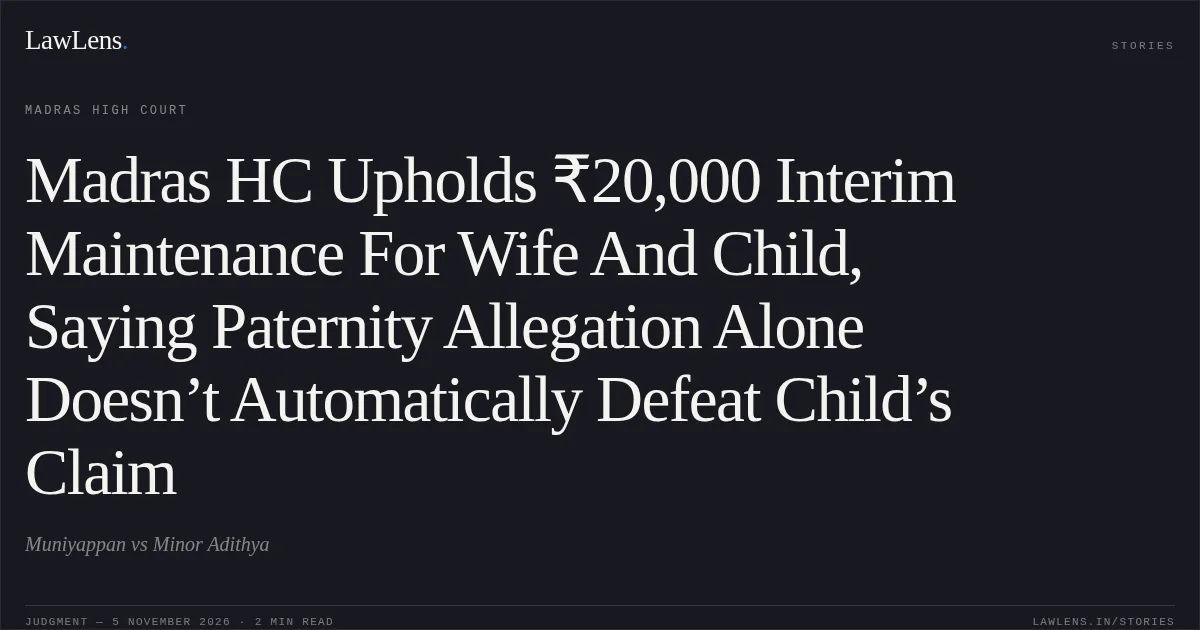
The High Court dismissed the criminal revision and confirmed the order granting ₹10,000 per month to the wife and ₹10,000 per month to the minor child, together with ₹15,000 towards litigation and incidental expenses.
¶ 17–18 · pp. 10–11The connected miscellaneous petition was closed, with no order as to costs.
¶ 18–20 · pp. 10–12The Magistrate was directed to decide the main maintenance proceedings independently on the evidence and contentions of both parties; the High Court’s observations were confined to the interim order.
¶ 18–20 · pp. 10–12Original Court PDF
MuniyappanvsMinor Adithya
Click to open original judgment
Original judgment, available to read, download and summarize on LawLens.in