01Facts
The plaintiffs, successors-in-interest of the mortgagees, sued for a declaration of ownership in possession of 44 bighas 6 biswas in village Toran, Tehsil Ghanaur, and for a permanent injunction against the State.
¶ 3The plaintiffs relied on a usufructuary mortgage dated 26 Sawan 1950 BK, for Rs.300, by Rullia, the original owner, in favour of Hissa Ram, Devi Dayal and Shankar Lal, whose successors were the plaintiffs and defendant Nos. 2 and 3.
¶ 4Consolidation changed the khasra numbers, but the plaintiffs contended that the mortgage was never redeemed and that the mortgagors' right of redemption expired on 26 Sawan 2010 BK (10.08.1953) under Section 28 of the Limitation Act, 1908.
¶ 5–7The State, relying on a Nazool declaration and Mutation No. 30, pleaded that the mortgage had been redeemed, filed a counterclaim for possession, and contested limitation.
¶ 8–10The trial court decreed the suit, dismissed the counterclaim, and the first appellate court dismissed the State's appeal.
¶ 15, 20The State then filed these regular second appeals.
¶ 1502Issues
i.1. Whether the mortgagors' right to redeem a usufructuary mortgage, created in 1950 BK, was extinguished after 60 years, vesting ownership in the mortgagees' successors.
¶ 16, 18, 20ii.2. Whether, in a usufructuary mortgage with no fixed term for redemption, limitation runs from the date of mortgage or only from the date the mortgage money is paid or deposited.
¶ 16, 21iii.3. Whether the State's failure to file a separate appeal against dismissal of its counterclaim bars its claim to possession by res judicata.
¶ 17, 2403Law Applied
Article 61 of the Limitation Act, 1963 (corresponding to Article 48 of the 1908 Act), provides a 30-year period to redeem or recover possession of mortgaged property, running from when that right accrues.
¶ 22Sections 58, 60 and 62 of the Transfer of Property Act, 1882: under Section 62, a usufructuary mortgagor's right to recover possession arises only when the mortgage money is paid from usufructs, or partly so and the balance is paid or deposited.
¶ 22Full Bench in Ram Kishan v. Sheo Ram, 2008(1) RCR (Civil), holding that "once a mortgage always a mortgage" and that a usufructuary mortgagee cannot claim title by declaration merely on expiry of limitation, as such a claim amounts to a suit for foreclosure.
¶ 21Singh Ram (Dead) through LRs v. Sheo Ram, (2014) 9 SCC 185, affirming the principle that the right to redeem a usufructuary mortgage is not extinguished by mere lapse of limitation.
¶ 22Basudev v. Sanjay Kumar, 2026 SCC OnLine SC 1534, holding that a common judgment on a suit and counterclaim may be challenged in a composite appeal, with separate grounds and court fee.
¶ 24Pankajakshi, Randhir Kaur and Gurbachan Singh (SC) on the limited scope of second appeal under Section 41 of the Punjab Courts Act, 1918.
¶ 25Provisions in the judgment · 5 · Linked ones open on LawLens
Code of Civil Procedure, 1908 Section 80
Limitation Act, 1963 Section 61
Transfer of Property Act, 1882 Section 58Section 60Section 62
04Reasoning
The courts below erred in computing limitation from the date of mortgage (1950 BK). Under Singh Ram and Section 62 of the TPA, the right to redeem a usufructuary mortgage does not accrue until the mortgage money is discharged from usufructs or paid or deposited, so mere lapse of 30 or 60 years does not extinguish the mortgagor's rights.
¶ 22–23The plaintiffs' claim to ownership by extinction of the redemption right therefore failed, and the mortgage remained redeemable.
¶ 21, 23On the counterclaim, the court rejected the res judicata argument. Since the trial court's common judgment covered both the suit and the counterclaim, the State could challenge it through a composite appeal, and Basudev permits the defect to be cured by filing a further appeal rather than treating the counterclaim as final.
¶ 24The court did not expressly address the respondents' reliance on Rajbir v. Amir Singh, RSA No. 4395 of 2025.
¶ 17Because the first appellate court dismissed the appeal without considering the State's merits on a single decree, the court set aside that judgment and restored the appeal so that the merits could be decided.
¶ 24, 2605Holding
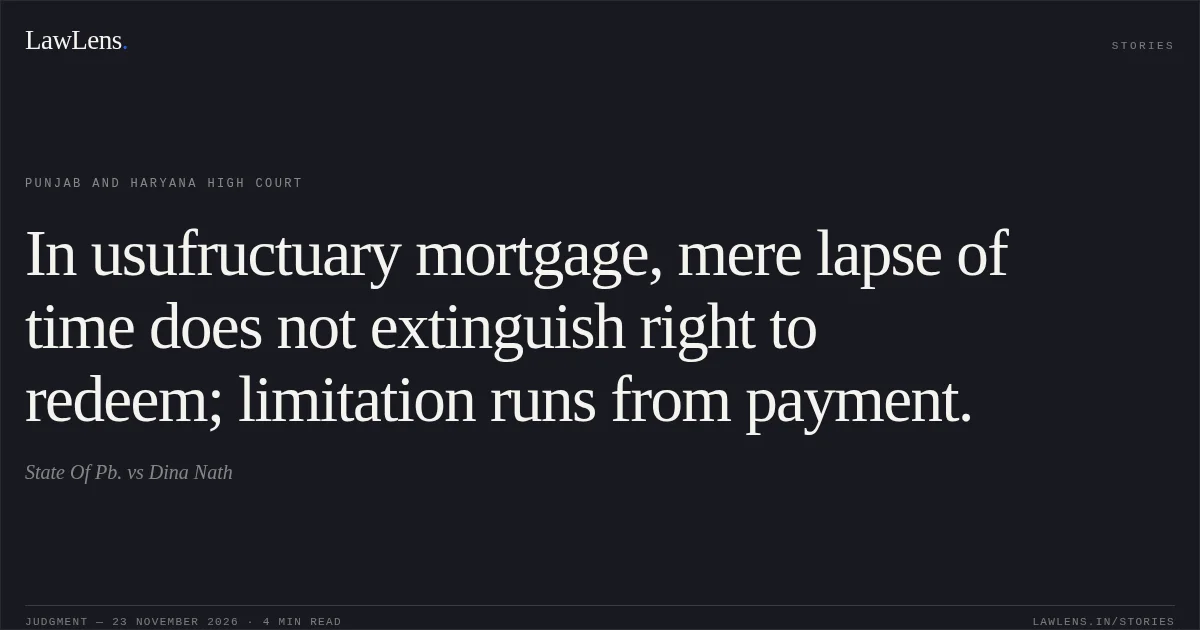
The right of redemption in a usufructuary mortgage is not extinguished by the mere expiry of 30 or 60 years from creation, because limitation begins only when the statutory conditions in Section 62 TPA are met.
¶ 22–23The res judicata objection to the State's counterclaim is rejected.
¶ 24, 26The judgment of the first appellate court dated 23.12.1998 is set aside and the first appeal is restored. The State must file a separate appeal against dismissal of its counterclaim and pay the court fee. The first appellate court is directed to decide both appeals on merits, as expeditiously as possible, in light of the observations above. Both RSAs are disposed of in these terms, with no final adjudication of the ownership claim by this Court.
¶ 26Original Court PDF
State Of Pb.vsDina Nath
Click to open original judgment
Original judgment, available to read, download and summarize on LawLens.in