Facts
The assessee, engaged in producing motion pictures, filed his return for Assessment Year 2010–11 declaring taxable income of ₹9,43,459.
Source reference: no citationFollowing CASS scrutiny, the Assessing Officer passed an assessment order under Section 143(3) of the Income-tax Act, 1961, assessing total income at ₹13,88,460 on 19 March 2013.
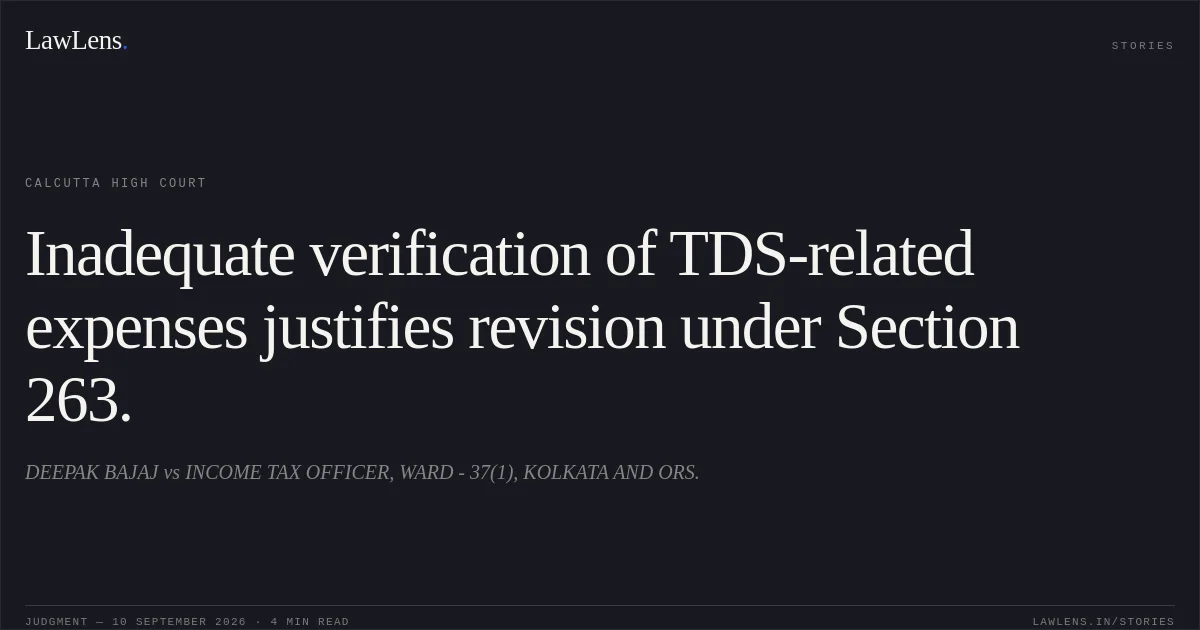
Source reference: para. 5The Commissioner of Income Tax subsequently issued a notice under Section 263 alleging that the assessment was erroneous and prejudicial to the interests of the Revenue because: (i) expenses of ₹1,80,53,232 towards artists’ and technicians’ remuneration and various hire charges were allegedly incurred without proper tax deduction at source; (ii) programme-sale receipts disclosed in Form 26AS exceeded those shown in the profit and loss account; and (iii) a service-tax liability of ₹35,00,000 had not been paid and was allegedly disallowable under Section 43B.
Source reference: paras. 6–7The assessee disputed the proposed additions, contending, inter alia, that approximately 50% of certain expenses represented reimbursements and that the difference in programme-sale receipts represented service tax.
Source reference: paras. 9–11By order dated 30 March 2015, the Commissioner set aside the assessment and directed a fresh assessment after proper examination of the records.
Source reference: para. 12The Income Tax Appellate Tribunal condoned a delay of 1,914 days in filing the appeal, upheld the Commissioner’s exercise of jurisdiction under Section 263 regarding the expenditure/TDS issue, but held that Issues Nos. 2 and 3 were not revisable under Section 263.
Source reference: paras. 13–14, 21, 26The assessee challenged the Tribunal’s decision before the High Court.
Source reference: no citationIssues
1. Whether the Commissioner of Income Tax correctly assumed jurisdiction under Section 263 to revise the assessment order dated 19 March 2013 passed under Section 143(3) for Assessment Year 2010–11.
Source reference: para. 2(a)2. Whether the assessment order was erroneous and prejudicial to the interests of the Revenue in relation to the alleged non-deduction or non-payment of tax at source on expenses of ₹1,80,53,232.
Source reference: para. 2(b); paras. 23–253. Whether the Tribunal’s order dated 9 February 2023 was perverse in upholding the Section 263 proceedings in respect of the expenditure/TDS issue.
Source reference: para. 2(c)4. Whether the Tribunal’s findings concerning the proposed disallowance of approximately ₹1,80,53,232 were arbitrary, unreasonable or perverse.
Source reference: para. 2(d)Law Applied
Section 263 of the Income-tax Act, 1961 empowers the Principal Commissioner or Commissioner to call for and examine the record of any proceeding and revise an assessment order where it is both erroneous and prejudicial to the interests of the Revenue, after granting the assessee an opportunity of hearing and conducting or directing such inquiry as may be necessary.
Source reference: para. 20The power includes modifying, enhancing or cancelling the assessment and directing a fresh assessment.
Source reference: para. 20Section 40(a)(ia) permits disallowance of specified expenditure where the applicable tax has not been deducted or, after deduction, has not been paid in accordance with law; the Tribunal and High Court treated the existence and extent of TDS liability as matters requiring verification.
Source reference: paras. 7(i), 23–25Section 43B governs the allowability of specified statutory liabilities, including service-tax liabilities, subject to the statutory conditions.
Source reference: para. 7(iii)The governing principle applied was that inadequate inquiry or failure by the Assessing Officer to verify material facts may render an assessment order erroneous and prejudicial to the interests of the Revenue under Section 263.
Source reference: paras. 12, 20, 27–29Reasoning
The Court found that the assessment record did not establish whether tax had been deducted on the relevant expenditure or whether the outstanding TDS liability of ₹18,42,097 had been deposited.
Source reference: para. 24The assessee’s assertion that “almost 50%” of the expenditure represented reimbursed expenses was unsupported by sufficient documentary evidence and could not, by itself, determine the applicability of Section 40(a)(ia).
Source reference: paras. 9, 24, 28Since the issue required examination of the assessee’s books, supporting documents and evidence, the Assessing Officer’s failure to conduct adequate inquiry made the assessment order erroneous and potentially prejudicial to the Revenue.
Source reference: paras. 25, 27–29The Tribunal had appropriately limited the Section 263 proceedings to the expenditure/TDS issue and had set aside the Commissioner’s findings on the programme-sale receipts and service-tax liability, thereby avoiding an impermissible revision on those issues.
Source reference: paras. 21, 25–26The High Court therefore found no perversity or legal error in the Tribunal’s reasoning.
Source reference: no citationHolding
The High Court answered the substantial questions in favour of the Revenue insofar as the expenditure/TDS issue was concerned.
It held that the Commissioner had validly assumed jurisdiction under Section 263, that the assessment order was erroneous and prejudicial to the interests of the Revenue for failure to properly examine the expenditure of ₹1,80,53,232 and the related TDS liability, and that the Tribunal’s order was neither perverse nor arbitrary.
Source reference: paras. 27, 30–32The appeal was dismissed, with no order as to costs; the matter remained open for fresh examination in accordance with law, confined to the relevant issue.
Source reference: paras. 28–29, 33–34Acts & Sections Cited
5 provisions across 1 statute referred to in this judgment. Linked provisions open on LawLens.
Income Tax Act, 19615
Original Court PDF
DEEPAK BAJAJvsINCOME TAX OFFICER, WARD - 37(1), KOLKATA AND ORS.
Click to open original judgment
Original judgment, available to read, download and summarize on LawLens.in