Facts
The appellant was previously accused of raping the informant's daughter (Section 376 IPC), leading to a proposal for marriage and a subsequent petition for bail cancellation when the marriage did not occur.
Source reference: p. 3On July 13, 2000, the appellant allegedly entered the informant's house armed with a sword, hurled obscenities, and attempted to assault the family.
Source reference: p. 3The trial court (S.T. No. 47/255 of 2002) acquitted the appellant of Sections 324 (hurt by weapon) and 294 (obscene acts) but convicted him under Sections 452 (house-trespass after preparation for hurt) and 506(ii) (criminal intimidation), sentencing him to two years of rigorous imprisonment.
Source reference: p. 2The appellant challenged this conviction before the High Court of Orissa.
Source reference: no citationIssues
1. Whether the prosecution established the essential ingredients of "house-trespass" under Section 442 to sustain a conviction under Section 452 of the IPC.
Source reference: p. 82. Whether the evidence supported a conviction for criminal intimidation under Section 506(ii) of the IPC.
Source reference: p. 103. Whether the appellant is entitled to the benefit of the Probation of Offenders Act given his prior criminal history.
Source reference: p. 11-12Law Applied
Section 442 of the IPC, which defines "house-trespass" as criminal trespass by entering into or remaining in any building used as a human dwelling.
Source reference: p. 8Section 452 of the IPC, which requires unauthorized entry into a house with the intent to cause hurt or assault.
Source reference: p. 8-9Section 506(ii) regarding criminal intimidation where the threat is to cause death or grievous hurt.
Source reference: p. 10Section 360 of the Cr.P.C. alongside the Probation of Offenders Act, which restricts the extension of such benefits to offenders with prior convictions for serious crimes.
Source reference: p. 12Reasoning
The Court observed that for a conviction under Section 452, the prosecution must prove unauthorized entry into a building.
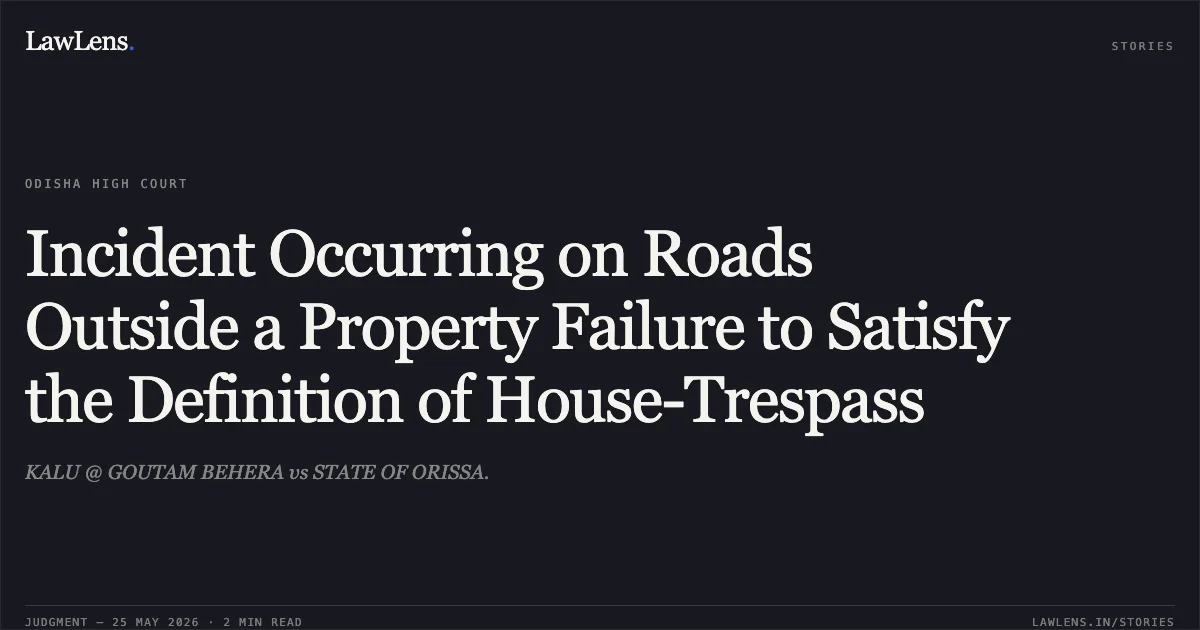
Source reference: p. 8Testimonies from P.W.1 and P.W.2 indicated the incident occurred on the roadside in front of the house, not inside it; thus, the definition of "house-trespass" under Section 442 was not met.
Source reference: p. 9Regarding Section 506(ii), the Court found overwhelming evidence that the appellant, while out on bail for a rape charge, threatened to kill or cause grievous hurt to the informant's family, satisfying the ingredients of criminal intimidation.
Source reference: p. 10The Court denied the benefit of the Probation of Offenders Act because the appellant had already been convicted in a separate proceeding under Section 376 IPC for rape.
Source reference: p. 12Holding
The Court partly allowed the appeal, setting aside the conviction under Section 452 IPC but affirming the conviction under Section 506(ii) IPC.
Due to the 26-year lapse since the incident and the appellant's integration into society, the Court reduced the substantive sentence to the period already undergone, but imposed a fine of ₹7,000 to be paid to the victim as compensation under Section 357 Cr.P.C.
Source reference: p. 13Acts & Sections Cited
11 provisions across 2 statutes referred to in this judgment. Each provision opens on LawLens.
Code of Criminal Procedure, 19734
Indian Penal Code, 18607
Original Court PDF
KALU @ GOUTAM BEHERAvsSTATE OF ORISSA.
Click to open original judgment
Original judgment, available to read, download and summarize on LawLens.in