Facts
The appellants were candidates included in a Rank List (Ext.P2) for the post of Office Attendants (OA) in the High Court of Kerala, following a 2019 notification
Source reference: para. 2, 3Although 24 vacancies were initially notified, the High Court filled significantly more (advising 388 persons from the Main List) during the list's currency
Source reference: para. 5, 14Before the list expired on 16.06.2024, the High Court abolished 34 OA posts in exchange for other necessary posts via a Government Order (Ext.P7)
Source reference: para. 6, 15Simultaneously, the High Court issued a new notification (Ext.P6) on 30.05.2024 for anticipated vacancies arising after the expiry of the current list
Source reference: para. 8, 18The appellants challenged the abolition of the 34 posts, alleging it was illegal and intended to deny them appointment
Source reference: para. 8A Single Judge dismissed the writ petition, leading to this appeal
Source reference: para. 7Issues
1. Whether candidates included in a Rank List possess an indefeasible right to be appointed to abolished or future vacancies
Source reference: para. 7, 162. Whether the abolition of 34 posts by the High Court was capricious, mala fide, or a breach of constitutional trust
Source reference: para. 6, 173. Whether the notification of 34 anticipated vacancies (Ext.P6) while the current Rank List was still in force violated the rights of the empaneled candidates
Source reference: para. 8, 18Law Applied
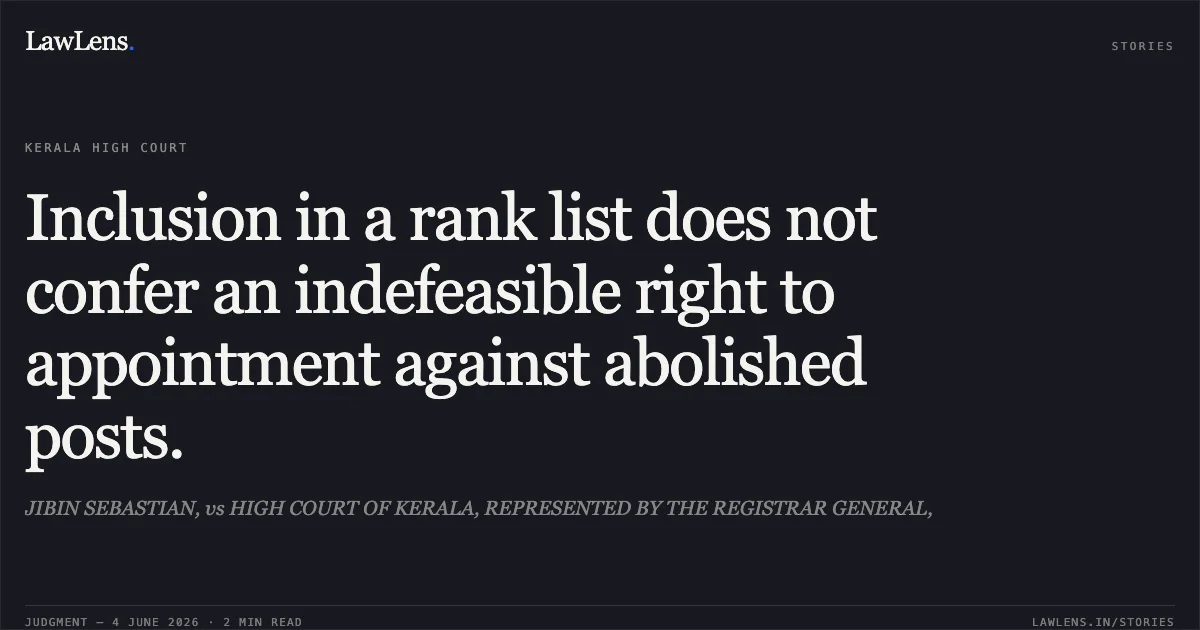
settled principle that inclusion in a Rank List does not confer an indefeasible right to appointment
Source reference: para. 7, 16Kerala Public Service Commission and Another v. Sheejamol M.C. and Others [2020 (5) KHC 555 (FB)], which establishes that the State is not bound to fill all notified vacancies unless the decision not to do so is arbitrary or mala fide
Source reference: para. 7administrative autonomy of the High Court in policy decisions regarding post abolition under Article 226 of the Constitution of India
Source reference: para. 17Reasoning
The Court reasoned that the High Court’s decision to abolish 34 OA posts was a policy matter aimed at restructuring staff requirements, agreed upon by the Government via Ext.P7
Source reference: para. 15The appellants failed to prove any mala fides or specific intent to prejudice them; thus, the court found no grounds for judicial interference
Source reference: para. 17, 20Regarding the new notification (Ext.P6), the Court clarified that although it coincided with the expiry of the old list, it explicitly targeted "anticipated vacancies" arising after 16.06.2024
Source reference: para. 18Evidence showed the first vacancy under the new notification would only arise on 31.08.2024, confirming there were no active vacancies to accommodate the appellants at the time the old list expired
Source reference: para. 19, 21The "coincidence" in the number of vacancies (34) did not equate to the abolished posts being surreptitiously reopened
Source reference: para. 21Holding
The Court held that the appellants had no legal right to claim appointment against abolished posts or vacancies arising after the expiry of their Rank List
Finding no error in the Single Judge's judgment or any violation of Article 14, the Division Bench dismissed the appeals
Source reference: para. 20, 21The court affirmed that administrative decisions regarding the abolition of posts are valid if made for bona fide reasons of staff management
Source reference: para. 17Original Court PDF
JIBIN SEBASTIAN,vsHIGH COURT OF KERALA, REPRESENTED BY THE REGISTRAR GENERAL,
Click to open original judgment
Original judgment, available to read, download and summarize on LawLens.in