Facts
The applicant applied for the post of Junior Assistant in the Revenue Department (District Cadre Poonch) under Advertisement Notice No. 06 of 2015
Source reference: para. 3Although he secured the first position in the Open Merit category, the Jammu & Kashmir Services Selection Board (JKSSB) withheld his recommendation pending verification of his Bachelor of Computer Applications (BCA) degree
Source reference: para. 4-5The degree was obtained through distance mode from Guru Jambheshwar University of Science and Technology, Haryana
Source reference: para. 5On 18.01.2021, the JKSSB issued Order No. 32-SSB of 2021 cancelling his selection on the grounds that his qualification did not meet the parameters of Government Order No. 252-HE of 2012 regarding distance education and territorial jurisdiction
Source reference: para. 6, 10The applicant challenged this cancellation, alleging arbitrariness and seeking parity with other candidates
Source reference: para. 7Issues
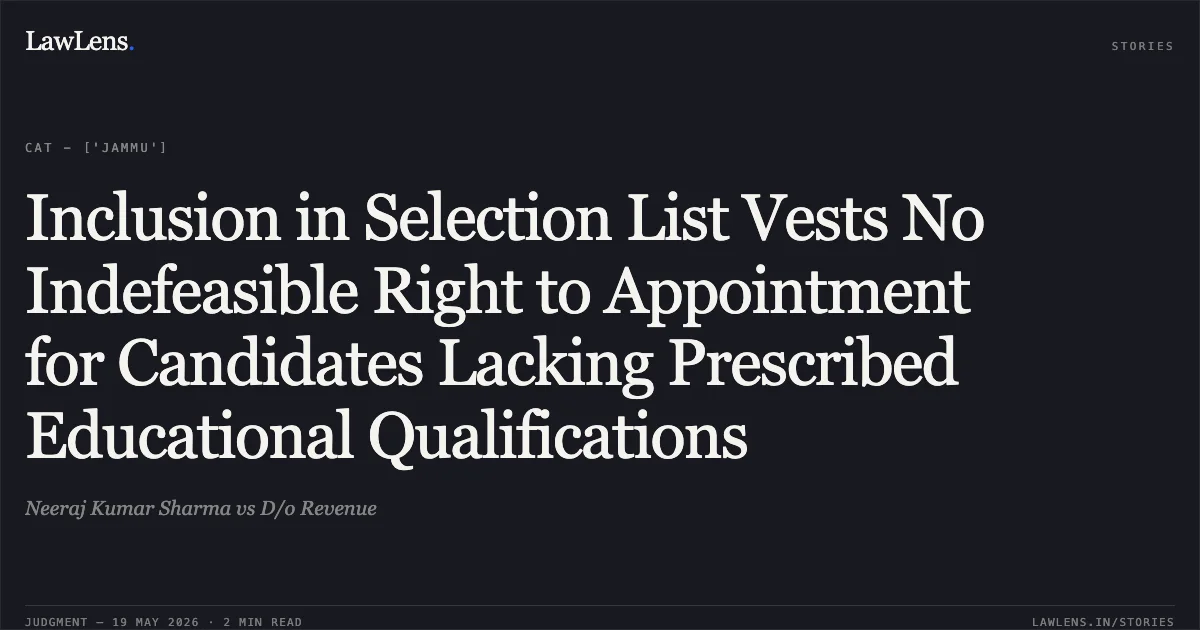
1. Whether a candidate acquires an indefeasible right to appointment merely by inclusion in a selection list when their eligibility is under scrutiny
Source reference: para. 14, 162. Whether the applicant’s distance mode degree, obtained from a university outside its territorial jurisdiction, satisfies the eligibility criteria prescribed by the State Government
Source reference: para. 11, 183. Whether the principle of negative equality under Article 14 can be invoked to claim parity with other allegedly ineligible candidates who were granted benefits
Source reference: para. 22-23Law Applied
The court primarily applied the principle established in Shankarsan Dash v. Union of India (1991), which holds that inclusion in a select list does not confer an indefeasible right to appointment
Source reference: para. 17Regarding the validity of qualifications, the court adhered to Government Order No. 252-HE of 2012 dated 30.05.2012, which regulates the recognition of degrees obtained through distance mode
Source reference: para. 6, 11Furthermore, it relied on Chandigarh Administration v. Jagjit Singh (1995) to affirm that Article 14 of the Constitution does not envisage "negative equality"; an illegality committed in favor of one person cannot be a ground for repeating that illegality for another
Source reference: para. 23Reasoning
The Tribunal reasoned that the JKSSB, as a recruiting agency, is duty-bound to verify eligibility before finalizing a recommendation
Source reference: para. 16It found that the applicant’s degree did not conform to state norms because the awarding university lacked the authority to operate study centers or off-site campuses beyond its territorial jurisdiction, a finding supported by University Grants Commission (UGC) opinions
Source reference: para. 11, 18The Tribunal emphasized that "merit becomes relevant only among eligible candidates" and a high rank cannot cure a fundamental defect in eligibility
Source reference: para. 28Regarding the plea of parity, the Tribunal noted that the respondents had also rejected the similar claim of one Maneer Ahmed, and even if an error had occurred in other cases, the applicant could not claim a "right to illegality" under the doctrine of negative equality
Source reference: para. 11, 23-24The Tribunal concluded it cannot substitute its view for that of the expert recruiting body on matters of academic equivalence or territorial jurisdiction
Source reference: para. 19, 26Holding
The Tribunal answered the issues in the negative, holding that the applicant lacked a vested right to appointment as his recommendation was conditional and his qualification was found invalid under governing norms
The Tribunal upheld Order No. 32-SSB of 2021, finding no evidence of malice or procedural perversity. The Original Application was dismissed, and all interim directions were vacated
Source reference: para. 32, 33-34Acts & Sections Cited
1 provisions across 1 statute referred to in this judgment. Each provision opens on LawLens.
Administrative Tribunals Act, 19851
Original Court PDF
Neeraj Kumar SharmavsD/o Revenue
Click to open original judgment
Original judgment, available to read, download and summarize on LawLens.in