Facts
The case arises from a motor accident where a rashly driven tractor killed a motorcyclist, leaving behind a widow and three children.
Source reference: p. 1The Motor Accident Claims Tribunal (MACT), Gwalior, estimated the deceased's monthly income at ₹4,000 and awarded ₹6,16,000.
Source reference: p.1On appeal, the High Court enhanced this to ₹8,26,000 by applying the Pranay Sethi multiplier for future prospects.
Source reference: p. 2The claimants challenged these orders before the Supreme Court, seeking further enhancement on the grounds that the deceased ran a tent and decoration business and that the determined income was too low.
Source reference: p. 2-3Issues
1. Whether the monthly income of the deceased was correctly determined by the lower courts in the absence of documentary evidence like Income Tax Returns, despite the possession of a PAN card.
Source reference: p. 2-32. Whether the appellants were entitled to "filial consortium" for the children in addition to the spousal consortium awarded by the High Court.
Source reference: p. 3Law Applied
The Court relied on Ramachandrappa v. Royal Sundaram Alliance Insurance Co. Ltd., which established that a coolie’s monthly income was ₹4,500 in 2004.
Source reference: p. 2The Constitution Bench decision in National Insurance Co. Ltd. v. Pranay Sethi, which mandates incremental increases in income over time and provides the standard for future prospects.
Source reference: p. 2Regarding consortium, the Court applied New India Assurance Company v. Somwati and Ors., which expanded the definition of 'consortium' to include "filial consortium" for children.
Source reference: p. 3Reasoning
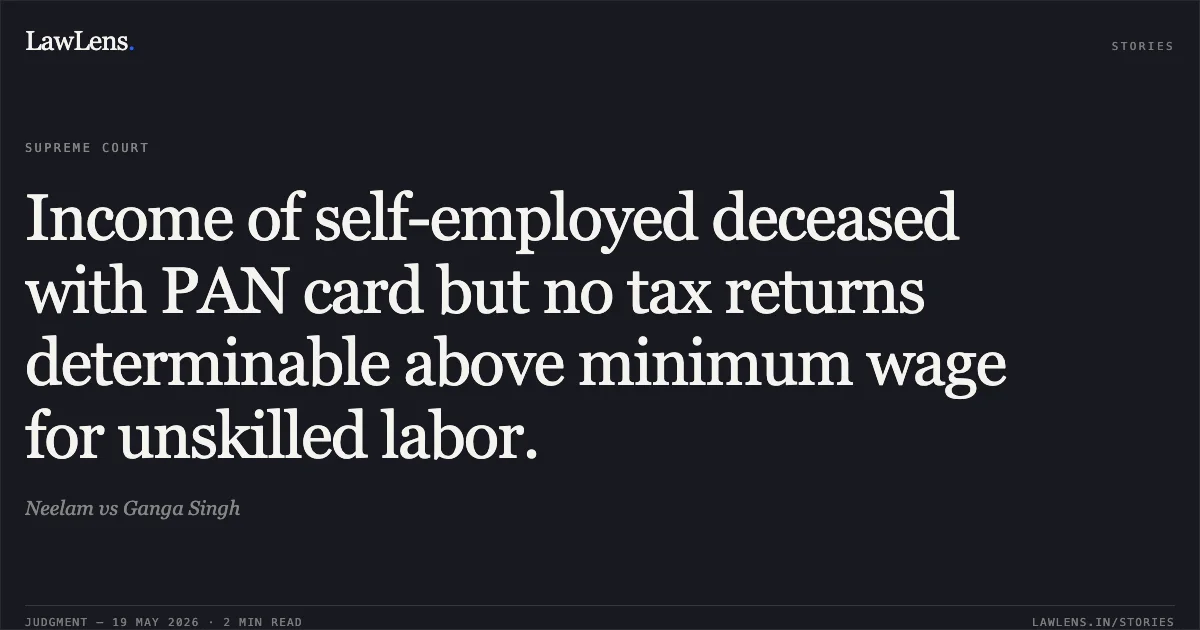
The Court reasoned that since a coolie’s income in 2010 (the year of the accident) is determined at ₹7,500 per month based on the ₹500 annual increment principle, the deceased—who possessed a PAN card and operated a business—must be presumed to have earned more than an unskilled laborer.
Source reference: p. 2-3Despite the lack of Income Tax Returns, the Court found the oral evidence of clients and the existence of a PAN card sufficient to estimate a monthly income of ₹10,000.
Source reference: p. 3The Court observed that the High Court erred in limiting consortium to the spouse; per Somwati, children are also entitled to compensation for the loss of parental company.
Source reference: p. 3Holding
The Supreme Court allowed the appeal and enhanced the total compensation to ₹20,40,000 with 7% interest per annum.
The Court recalculated the Loss of Income at ₹18,90,000 (applying a 140% multiplier for future prospects and a 3/4th deduction for personal expenses) and awarded ₹1,20,000 for loss of consortium to cover both the widow and children. It further directed that if the children have attained majority, the compensation need not be kept in fixed deposits.
Source reference: p. 4Acts & Sections Cited
3 provisions across 1 statute referred to in this judgment. Each provision opens on LawLens.
Motor Vehicles Act, 19883
Original Court PDF
NeelamvsGanga Singh
Click to open original judgment
Original judgment, available to read, download and summarize on LawLens.in