Facts
The Petitioner (husband) challenged an order dated 22.07.2021 passed by the Central Information Commission (CIC).
Source reference: para. 1-2The CIC had directed the disclosure of the Petitioner’s net taxable income from FY 2007-08 onwards to Respondent No. 2 (wife).
Source reference: para. 2The request arose amid a matrimonial dispute where Respondent No. 2 sought the income details to support a maintenance claim pending before the Principal Judge, as remitted by the Allahabad High Court.
Source reference: para. 3The Petitioner contended that such information is personal and protected under Section 8(1)(j) of the RTI Act.
Source reference: para. 4Issues
1. Whether the net taxable income and income tax returns of an individual constitute "personal information" exempt from disclosure under the RTI Act
Source reference: para. 4, 82. Whether the requirement of income details for a maintenance claim constitutes "larger public interest" sufficient to override the exemption under Section 8(1)(j)
Source reference: para. 9-11Law Applied
Section 8(1)(j) of the Right to Information (RTI) Act, 2005, which exempts personal information from disclosure unless a larger public interest justifies it.
Source reference: para. 6-7Girish Ramchandra Deshpande v. CIC Ors., which established that income tax returns are personal information.
Source reference: para. 8Procedural mandate from Rajnesh v. Neha Anr., which requires both parties in maintenance proceedings to file "Affidavits of Disclosure of Assets and Liabilities" to ensure an objective assessment of financial status.
Source reference: para. 11Reasoning
The court reasoned that since income tax returns are settled as "personal information," they are ordinarily exempt from RTI disclosure unless a "larger public interest" is involved.
Source reference: para. 8The court clarified that "larger public interest" must be interpreted in line with the RTI Act’s object of ensuring transparency in public authorities, not for settling private disputes.
Source reference: para. 9The court rejected Respondent No. 2’s argument that her maintenance claim justified the disclosure, noting that the legislative intent was not to allow the misuse of the RTI Act for personal litigation.
Source reference: para. 9-10The court further observed that Respondent No. 2 had an alternative, more appropriate legal remedy: under the Rajnesh v. Neha framework, she could compel the Petitioner to disclose his financial standing via a mandatory affidavit in the matrimonial court, rendering RTI an unnecessary and improper tool for this purpose.
Source reference: para. 11-12Holding
The court held that the CIC’s directions for disclosure were unsustainable in law.
The Court set aside the impugned CIC order dated 22.07.2021 and directed that Respondent No. 2 remains at liberty to seek the Petitioner's financial disclosure through the appropriate matrimonial court via an affidavit of assets and liabilities.
Source reference: para. 12-14Acts & Sections Cited
1 provisions across 1 statute referred to in this judgment. Each provision opens on LawLens.
Right to Information Act, 20051
Original Court PDF
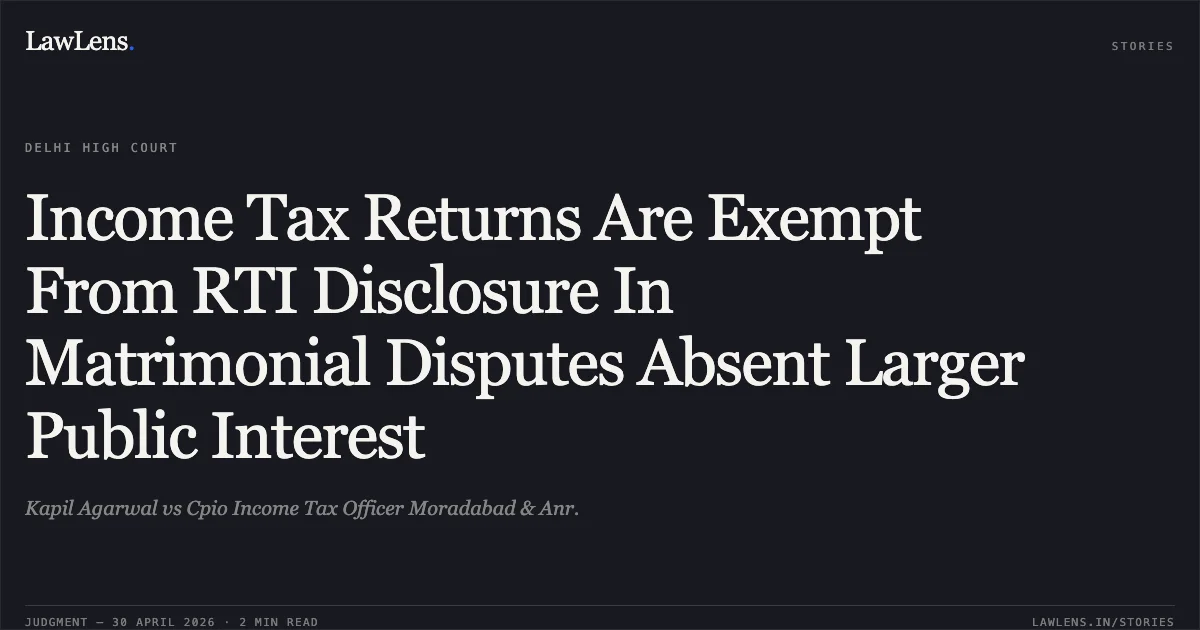
Kapil AgarwalvsCpio Income Tax Officer Moradabad & Anr.
Click to open original judgment
Original judgment, available to read, download and summarize on LawLens.in