Facts
The appellant imported electric two-wheeler components in CKD condition, declared them under CTH 87116020, and claimed concessional duty under Notification No. 50/2017-Cus, as amended.
Source reference: p. 2–7The Department alleged that the goods did not meet the notification’s CKD conditions and issued a show cause notice; the adjudicating authority confirmed differential duty of ₹54,82,066, ordered confiscation under Section 111(m) of the Customs Act, 1962, and imposed a penalty under Section 112.
Source reference: p. 2–7The appellant challenged the order, including on the grounds of the issuing officer’s jurisdiction, defective pre-notice consultation, classification and exemption eligibility, and the absence of misdeclaration
Source reference: p. 2–7Issues
1. Whether the show cause notice and ensuing proceedings were invalid because of the issuing officer’s alleged lack of monetary jurisdiction or the subsequent corrigendum, and whether pre-notice consultation was inadequate
Source reference: p. 10–122. Whether Section 28 proceedings could be initiated to recover differential duty without first challenging the self-assessments on the Bills of Entry
Source reference: p. 12–153. Whether the imported goods had the essential character of complete electric two-wheelers under GRI 2(a), and whether they qualified for the claimed CKD exemption under Notification No. 50/2017-Cus
Source reference: p. 15–194. Whether confiscation under Section 111(m) and the penalty under Section 112 were sustainable
Source reference: p. 7–8, 19–20Law Applied
Under Section 2(34) of the Customs Act, 1962, a Customs officer assigned the relevant functions may act as the “proper officer”; a corrigendum correcting or clarifying a notice may relate back to it where it causes no prejudice.
Source reference: p. 10–12Section 28 permits recovery of duty not levied or short-paid, including where an exemption was wrongly availed; under Jain Shudh Vanaspati Ltd. v. Union of India, a clearance order obtained by fraud does not bar subsequent proceedings, and Famous Steel v. Commissioner of Customs, Mundra distinguished Section 28 recovery from a refund claim requiring amendment of an assessment.
Source reference: p. 12–15GRI 2(a) treats an incomplete or unassembled article as the complete article where, as presented, it has the latter’s essential character; the HSN Explanatory Notes recognize that a vehicle may retain that character even without, for example, its battery.
Source reference: p. 15–18The CKD exemption under the relevant entry of Notification No. 50/2017-Cus required the specified necessary components; the Tribunal also relied on Y.C. Electric Vehicle v. Principal Commissioner of Customs concerning classification of incomplete vehicles and an unclaimed notification benefit.
Source reference: p. 16–19Sections 111(m) and 112 concern, respectively, goods not corresponding with the relevant entry and penalties for acts rendering goods liable to confiscation.
Source reference: p. 7–8Reasoning
The Tribunal rejected the jurisdictional objection, holding that the corrigendum merely changed the notice’s “answerable to” clause, caused no prejudice, and related back to the original notice; it also relied on the appellant’s reference to receipt of the pre-consultation letter.
Source reference: p. 10–12It held that Section 28 proceedings were not barred merely because the self-assessments had not first been challenged.
Source reference: p. 12–15On classification, the appellant’s own description of the imports as an e-bike CKD kit, together with GRI 2(a) and the HSN notes, supported classification as a complete electric vehicle despite the absence of certain components.
Source reference: p. 15–18But the missing battery pack, charger and electric compressor meant the goods did not satisfy the notification’s requirement for a CKD kit containing all necessary components; the alternative exemption was also rejected because it had not been claimed at import.
Source reference: p. 19The Tribunal found no basis to disturb the adjudicating authority’s order on confiscation or penalty.
Source reference: p. 19–20Holding
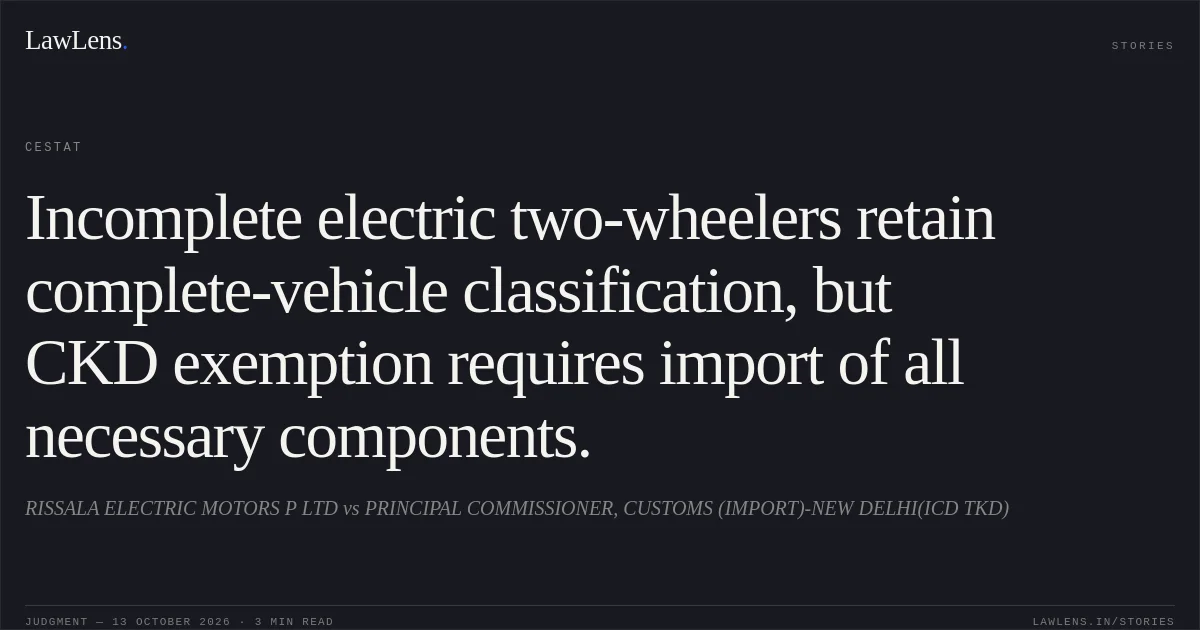
The Tribunal held that the notice and proceedings were not invalid, that Section 28 recovery was available without first setting aside the self-assessments, and that the goods were classifiable as complete electric vehicles but ineligible for the claimed exemption.
It found no reason to interfere with the order-in-original and dismissed the appeal.
Source reference: p. 10–12, 15, 18–20Acts & Sections Cited
11 provisions across 2 statutes referred to in this judgment. Each provision opens on LawLens.
Customs Act,1962
Customs Tariff Act, 19751
Original Court PDF
RISSALA ELECTRIC MOTORS P LTDvsPRINCIPAL COMMISSIONER, CUSTOMS (IMPORT)-NEW DELHI(ICD TKD)
Click to open original judgment
Original judgment, available to read, download and summarize on LawLens.in
![Authorities must individually assess similarly situated employees’ eligibility for benefits under an affirmed precedent.. Swapan Das vs POSTS. CAT - ['Kolkata']. LawLens](/stories/thumbnails/authorities-must-individually-assess-similarly-situated-employees-eligibility-for-benefits-79605d4f38f347acb73daa832fe2a358.webp)
![Competent authority must reconsider the compassionate allowance claim, including limitation, by a reasoned order.. VINAY KUMAR vs DEPTT OF POSTS. CAT - ['Allahabad']. LawLens](/stories/thumbnails/competent-authority-must-reconsider-the-compassionate-allowance-claim-including-limitation-ca3eb833b95c48bba16e267d27ef2dca.webp)