Facts
The appellants (husband, brother-in-law, mother-in-law, and sisters-in-law of the deceased Kamlesh) challenged their conviction under Sections 498-A and 302/34 IPC
Source reference: p.1-2On 30.10.1988, Kamlesh was admitted to J.P.N. Hospital with 90% burn injuries
Source reference: p.3The initial MLC recorded the patient's statement that she was burnt accidentally while cooking
Source reference: p.3, 24However, a subsequent statement recorded by the SDM at 3:30 P.M. implicated the appellants, alleging they set her on fire after starving her for three days due to dowry demands (scooter and cupboard)
Source reference: p.4-5Kamlesh died that evening
Source reference: p.5The Trial Court convicted all appellants based on the SDM’s dying declaration and testimony of the deceased's aunt (PW-1)
Source reference: p.8-9During the pendency of the appeal, the husband (Raj Pal) and mother-in-law (Phoolwati) passed away, causing the appeal to abate against them
Source reference: p.2Issues
1. Whether the dying declarations recorded by the SDM and the oral declaration to PW-1 were reliable enough to sustain a conviction despite contradictions with the initial MLC recording
Source reference: p.10, 182. Whether the prosecution proved the allegations of dowry-related cruelty and intentional murder beyond reasonable doubt
Source reference: p.18, 20Law Applied
The Court applied Section 32 of the Indian Evidence Act regarding the admissibility of dying declarations
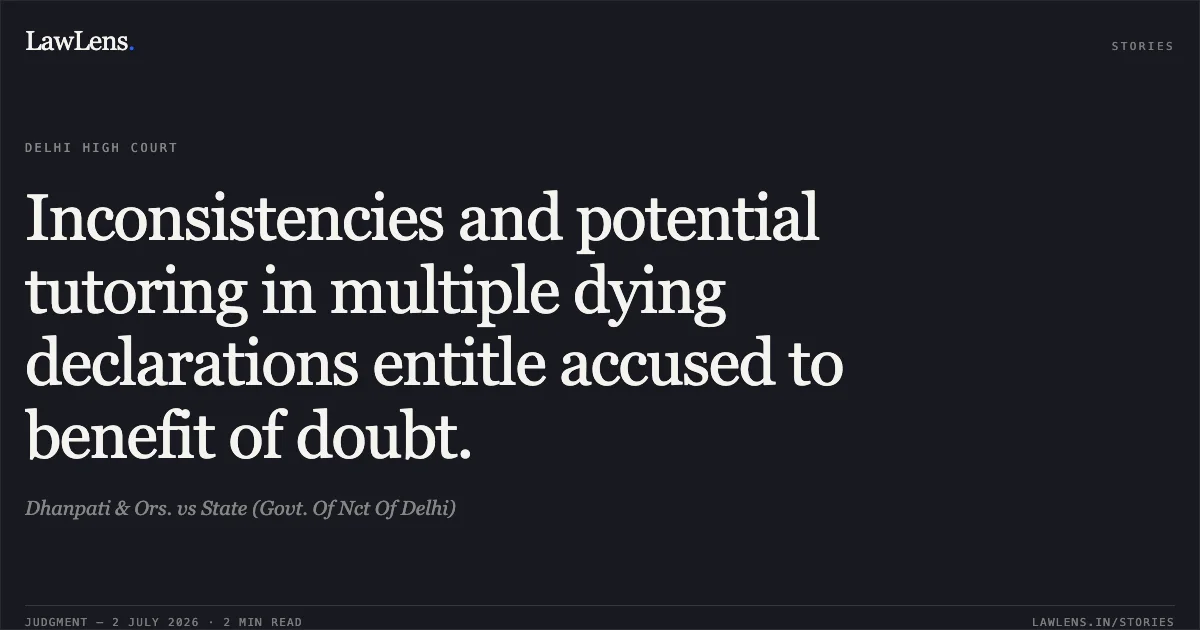
Source reference: p.22It relied on Irfan @ Naka v. State of Uttar Pradesh and Abhishek Sharma v. State (Govt. of NCT of Delhi), which establish that while a dying declaration can be the sole basis for conviction, it must inspire full confidence, be free from tutoring or prompting, and be consistent if multiple declarations exist
Source reference: p.18-20, 23In cases of multiple inconsistent declarations, the court must scrutinize the "rule of first opportunity" and the possibility of influence by interested relatives
Source reference: p.20, 24Reasoning
The Court found the SDM’s dying declaration (Ex. PW-3/A) suspicious because the SDM fails to explain why she did not question the deceased about the contradictory "accidental" version in the MLC
Source reference: p.31The SDM recorded the statement using leading questions, suggesting she had been pre-informed of what to record
Source reference: p.34Furthermore, the fitness certificate was obtained after the statement was recorded, and the doctor who issued it was not examined
Source reference: p.30-31The Court noted a high probability of tutoring as the aunt (PW-1) was with the deceased for hours before the SDM arrived
Source reference: p.31The parents of the deceased (PW-7 and PW-8) turned hostile, stating their daughter was happy, never harassed for dowry, and was "hot-tempered," suggesting she may have burnt herself
Source reference: p.34-35The prosecution also failed to examine the "other aunt" who allegedly witnessed the deceased’s fear prior to the incident, and no medical evidence proved the alleged three-day starvation
Source reference: p.29, 32Holding
The Court held that the prosecution failed to establish the charges beyond reasonable doubt as the dying declarations were not wholly reliable and lacked corroboration from the surrounding circumstances or the deceased's parents
The Court answered the issues in the negative, finding the element of doubt favored the accused
Source reference: p.36The appeals were allowed, and the surviving appellants (Jaswant, Dhanpati, and Suresh) were acquitted of all charges under Sections 498-A and 302 read with Section 34 IPC
Source reference: p.36Acts & Sections Cited
4 provisions across 2 statutes referred to in this judgment. Each provision opens on LawLens.
Indian Penal Code, 18603
Code of Criminal Procedure, 19731
Original Court PDF
Dhanpati & Ors.vsState (Govt. Of Nct Of Delhi)
Click to open original judgment
Original judgment, available to read, download and summarize on LawLens.in