Facts
The State appealed an order of acquittal dated 28.02.2015 passed by the Additional Sessions Judge, Dwarka Courts
Source reference: p. 1-2The prosecution alleged that on 22.03.2013, the respondent sexually assaulted PW1 (a 15-year-old minor) by touching her breast at a beauty parlour
Source reference: p. 2Charges were framed under Section 8 of the PoCSO Act
Source reference: p. 3The accused contended he was falsely implicated due to a property dispute with associates of PW1
Source reference: p. 4Despite the testimony of the victim (PW1), her father (PW7), and the parlour owner (PW3), the trial court acquitted the accused due to material discrepancies
Source reference: p. 5Issues
1. Whether there is any infirmity or perversity in the trial court's judgment of acquittal that warrants interference by the High Court under Section 378 of the Cr.P.C.
Source reference: p. 6, para 132. Whether the prosecution proved the guilt of the accused beyond a reasonable doubt in light of the contradictory evidence regarding the date and time of the incident and the lodging of the FIR
Source reference: p. 17, para 24Law Applied
The court applied Section 7 (definition of sexual assault) and Section 8 (punishment) of the Protection of Children from Sexual Offences (PoCSO) Act, 2012
Source reference: p. 16Regarding the scope of appellate interference, it relied on the principle from Ram Kumar v. State of Haryana, established that while the High Court has extensive powers to reassess evidence, it must respect the trial court’s view on witness credibility and the presumption of innocence unless the findings are perverse or unreasonable
Source reference: p. 15-16while delay in FIRs for sexual offences is not always fatal, material shifts in the "genesis" of the story regarding dates and times can be critical
Source reference: p. 21Reasoning
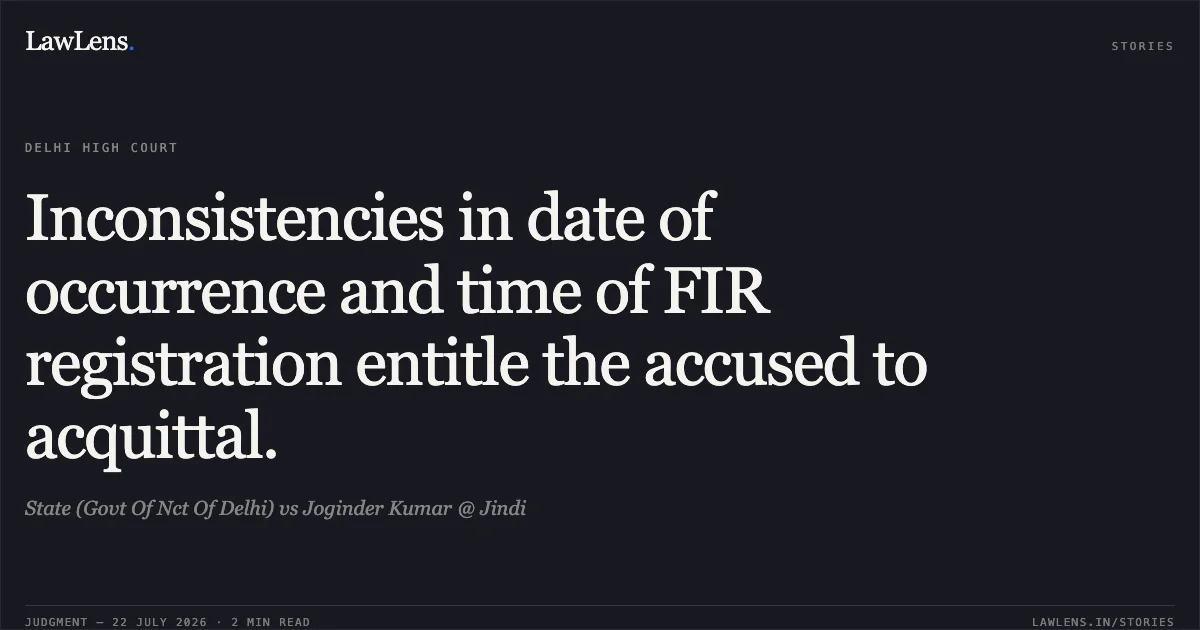
The Court found the prosecution's case riddled with irreconcilable contradictions. First, regarding the date of the incident: PW1’s initial statements (Sections 154 and 164 Cr.P.C.) cited 22.03.2013, but her court testimony changed this to 23.03.2013
Source reference: p. 18Second, regarding the lodging of the FIR: PW1 and PW7 claimed they went to the station on the evening of the 23rd, whereas PW3 claimed they went the following day
Source reference: p. 9, 12, 10-11Crucially, the police witnesses provided conflicting timelines: PW6 claimed the complaint was received at 12:30 PM, while the IO (PW8) claimed it was marked to him only at 7:00 PM
Source reference: p. 13, 20The Court reasoned that these were not "minor discrepancies" but fundamental inconsistencies affecting the very occurrence of the crime
Source reference: p. 21Furthermore, the Court noted the defense's evidence regarding an ongoing property dispute with one R.S. Bali, which provided a plausible motive for false implication
Source reference: p. 14-15Holding
It held that the trial court's view was a "reasonable and plausible" interpretation of the evidence
The Court concluded that the prosecution failed to provide a consistent version of the incident's date and the sequence of police reporting, thus failing to meet the standard of proof beyond a reasonable doubt
Source reference: p. 21The High Court dismissed the appeal and upheld the acquittal
Source reference: p. 22Acts & Sections Cited
9 provisions across 2 statutes referred to in this judgment. Each provision opens on LawLens.
Code of Criminal Procedure, 19736
Protection of Children from Sexual Offences Act, 20123
Original Court PDF
State (Govt Of Nct Of Delhi)vsJoginder Kumar @ Jindi
Click to open original judgment
Original judgment, available to read, download and summarize on LawLens.in