Facts
The de facto complainant alleged that on September 5, 2015, the appellant, Ajit Biswas, and his wife entered their premises to erect a bamboo scaffold for construction work
Source reference: p. 2When the complainant’s father, Ramdhan Biswas, protested, the appellant allegedly slapped/pushed him, causing him to fall and die instantly
Source reference: p. 2A case was registered under Sections 304/34 IPC. After trial, the Additional District and Sessions Judge, 1st Court, Hooghly, acquitted both accused of charges under Sections 447, 506, and 304 IPC, but convicted the appellant under Section 323 IPC, sentencing him to six months of simple imprisonment
Source reference: p. 2-3The appellant challenged this conviction on the grounds of testimonial inconsistencies and lack of evidence regarding the location of the incident
Source reference: p. 3Issues
1. Whether the order of conviction under Section 323 of the IPC is sustainable when the appellant was acquitted of the primary charges of criminal trespass and culpable homicide
Source reference: p. 4, para. 72. Whether the prosecution proved the occurrence of the incident beyond reasonable doubt given the inconsistencies in the testimonies of the alleged eyewitnesses
Source reference: p. 4, para. 7Law Applied
The Court evaluated the conviction under Section 323 of the Indian Penal Code (punishment for voluntarily causing hurt)
Source reference: p. 1The principle of criminal jurisprudence regarding the credibility of witnesses, particularly the requirement for consistency in material facts to establish guilt beyond reasonable doubt
Source reference: p. 6, 8The necessity of proving the locus in quo (place of occurrence) and the physical presence of witnesses to sustain a conviction
Source reference: p. 9-10Reasoning
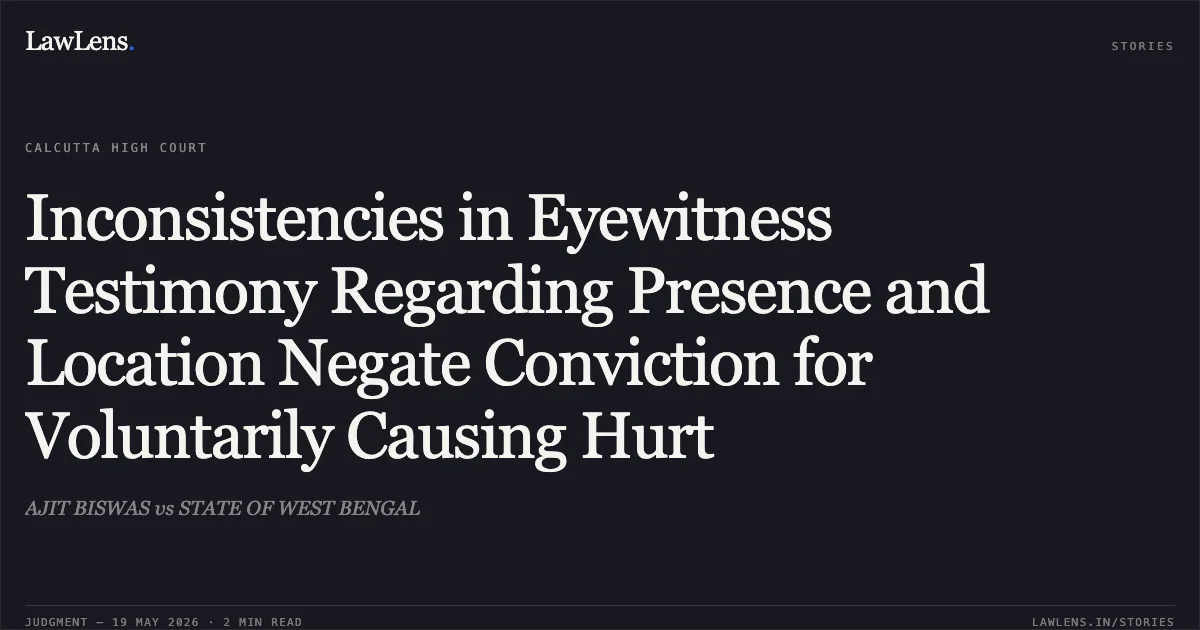
The Court found several "glaring inconsistencies" between the testimonies of P.W. 2 and P.W. 3. P.W. 2 claimed he saw the incident from his own veranda, which was a 7-minute walk away, making his observation improbable in a densely populated area
Source reference: p. 6, p. 8, para. 13P.W. 3 claimed P.W. 2 was physically present "at the spot" with him
Source reference: p. 8While the prosecution alleged the incident occurred during a trespass, the trial court had already acquitted the appellant of Section 447 (criminal trespass), effectively demolishing the claim that the appellant entered the victim’s land
Source reference: p. 10The Investigating Officer’s sketch map also failed to show the appellant’s house as being adjacent to the victim's, or any signs of construction at the alleged site
Source reference: p. 9The High Court held that once the foundation of the incident (the trespass and the location) was discredited, a standalone conviction under Section 323 lacked a legal and factual basis
Source reference: p. 10, para. 15-16Holding
The Court answered the issues in the negative, holding that the prosecution failed to establish the charges due to lack of credible evidence and material contradictions
The appeal was allowed, and the judgement and order of conviction dated July 24, 2017, were set aside. The appellant was ordered to be set at liberty upon the execution of a bond under Section 437A of the Cr.P.C.
Source reference: p. 11, para. 17, 18Acts & Sections Cited
6 provisions across 2 statutes referred to in this judgment. Each provision opens on LawLens.
Indian Penal Code, 18605
Code of Criminal Procedure, 19731
Original Court PDF
AJIT BISWASvsSTATE OF WEST BENGAL
Click to open original judgment
Original judgment, available to read, download and summarize on LawLens.in