Facts
On the night of 22/23.05.1998, 8 to 9 individuals entered the residence of Pradeep Kumar and Kailash, assaulted the occupants, and looted jewelry and cash
Source reference: para. 2Following investigation and recoveries, the Trial Court convicted the appellants under Sections 395 (dacoity) and 412 (dishonestly receiving property stolen in the commission of a dacoity) of the IPC
Source reference: para. 1The State's case relied on Test Identification Parades (TIP) conducted by Magistrates and alleged recoveries of looted items
Source reference: para. 5, para. 18The appellants challenged the conviction on grounds of inconsistent identification, lack of specific roles, and unreliable recovery evidence
Source reference: paras. 7-12During the pendency of the appeal, appellant Hanif expired, causing the appeal to abate regarding him
Source reference: para. 6Issues
1. Whether the identification evidence, comprising TIP and in-court assertions, was sufficient and reliable enough to sustain a conviction for dacoity
Source reference: para. 242. Whether the prosecution established a clear nexus between the recovered articles and the accused to satisfy the requirements of Sections 395 and 412 of the IPC
Source reference: para. 303. Whether the prosecution proved the individual participation of each appellant beyond a reasonable doubt
Source reference: para. 34Law Applied
The Court applied Section 395 (Punishment for dacoity) and Section 412 (Receiving property stolen in the commission of a dacoity) of the Indian Penal Code
Source reference: para. 1It emphasized the evidentiary principle that a Test Identification Parade (TIP) is not substantive evidence but a corroborative tool, and its value is diminished if the process is not free from the possibility of suggestion
Source reference: paras. 24, 27For recovery to be legally valid under Indian law, the prosecution must establish the "conscious possession" of the accused and an "unmistakable nexus" between the recovered property and the crime
Source reference: paras. 30, 31the court adhered to the foundational criminal law principle that the burden lies on the State to prove the identity and specific role of each participant in a multi-assailant crime beyond a reasonable doubt
Source reference: paras. 22, 36Reasoning
The Court observed that while the occurrence of the dacoity was proved, the State failed to conclusively link the specific appellants to the act
Source reference: para. 21The Court found the identification evidence inconsistent; notably, while one witness identified some accused in TIP, another witness identified none at all
Source reference: para. 26Due to the stressful nature of the nighttime assault, the Court held that the witnesses' ability to observe and retain features was compromised
Source reference: para. 25Regarding the recoveries, the Court noted that the Trial Court failed to scrutinize the "authenticity and probative value" of the items, as the State did not prove exclusive or conscious possession by the appellants
Source reference: paras. 31-32the Court ruled that the prosecution's allegations were too "generalized" and lacked the specificity required to fix the individual criminal liability of each appellant in a dacoity case
Source reference: paras. 34-35Holding
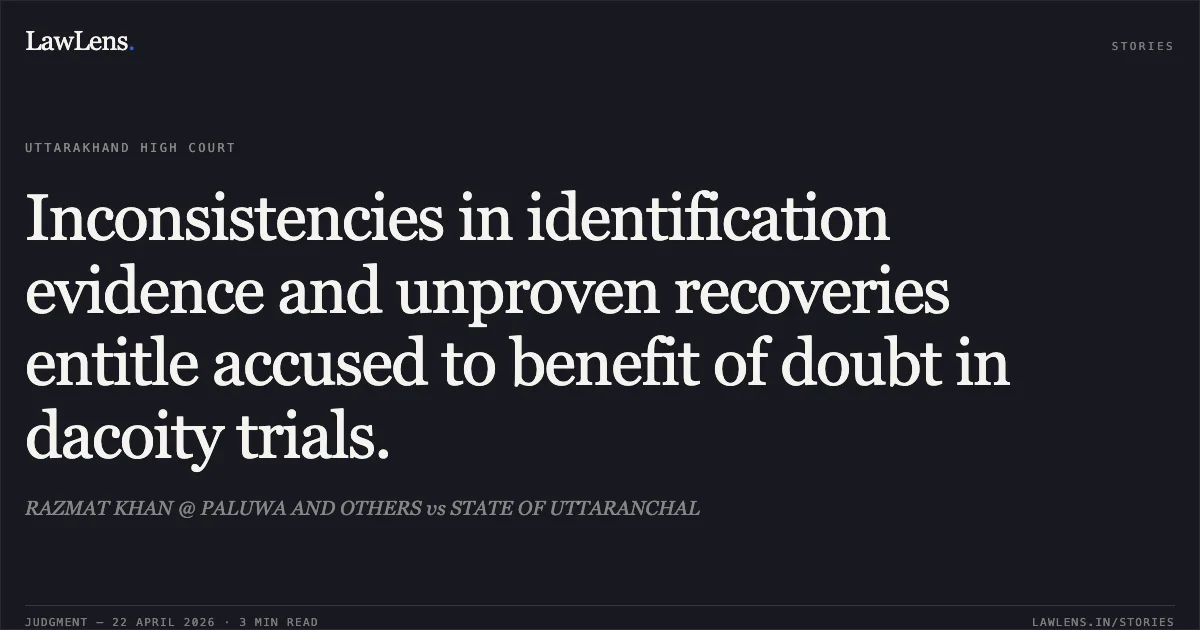
The Court held that despite proving the factum of dacoity, the State failed to prove the identity and participation of the appellants beyond reasonable doubt
The High Court allowed the appeal and set aside the judgment dated 17.03.2005. Razmat Khan @ Paluwa, Israt, and Kamruddin were acquitted of all charges under Sections 395 and 412 IPC on the basis of the "benefit of doubt"
Source reference: Order, p. 8; paras. 42, OrderThe appeal regarding Hanif abated due to his death, and the remaining appellants were discharged from their bail bonds
Source reference: Order, p. 9Acts & Sections Cited
2 provisions across 1 statute referred to in this judgment. Each provision opens on LawLens.
Indian Penal Code, 18602
Original Court PDF
RAZMAT KHAN @ PALUWA AND OTHERSvsSTATE OF UTTARANCHAL
Click to open original judgment
Original judgment, available to read, download and summarize on LawLens.in