Facts
The appellants (father and son) were accused of an incident on December 4, 1980, involving a land dispute under Section 145 CrPC
Source reference: para. 4.2It was alleged that appellant no. 2, Keshav Singh, fired a licensed gun at the informant, Rajendra Singh, but instead hit a chance witness, Shiv Kumar Singh (PW-2), in the head
Source reference: para. 3, 6The FIR was lodged at P.S. Jaswant Nagar, Etawah, despite the incident occurring in District Mainpuri
Source reference: para. 4.7The Trial Court convicted both under Section 307 IPC in 1987
Source reference: para. 3During the pendency of the appeal, appellant no. 1 (the father) died, and the appeal abated against him
Source reference: para. 3The surviving appellant challenged the conviction based on investigative lapses and inconsistent witness testimonies
Source reference: para. 13Issues
1. Whether the Trial Court rightly appreciated the testimonies of the fact and chance witnesses to reach a conclusion of guilt
Source reference: para. 162. Whether the investigative lapses, including the failure to recover the weapon and lack of forensic evidence, entitle the accused to the benefit of doubt
Source reference: para. 24-26Law Applied
The court applied Section 307 of the IPC regarding attempt to murder
Source reference: para. 8It relied on the principle that while the testimony of a "chance witness" cannot be discarded, it requires "cautious and close scrutiny" to ensure their presence is not doubtful, as established in Thangaiya v. State of T.N. and Jarnail Singh v. State of Punjab
Source reference: para. 17Regarding defective investigation, the court applied the doctrine from Dhanaj Singh v. State of Punjab and State of U.P. v. Wasif Haider, holding that while a faulty investigation alone does not necessitate acquittal, the benefit of doubt accrues to the accused if lapses disable the prosecution from proving culpability beyond reasonable doubt
Source reference: para. 25Reasoning
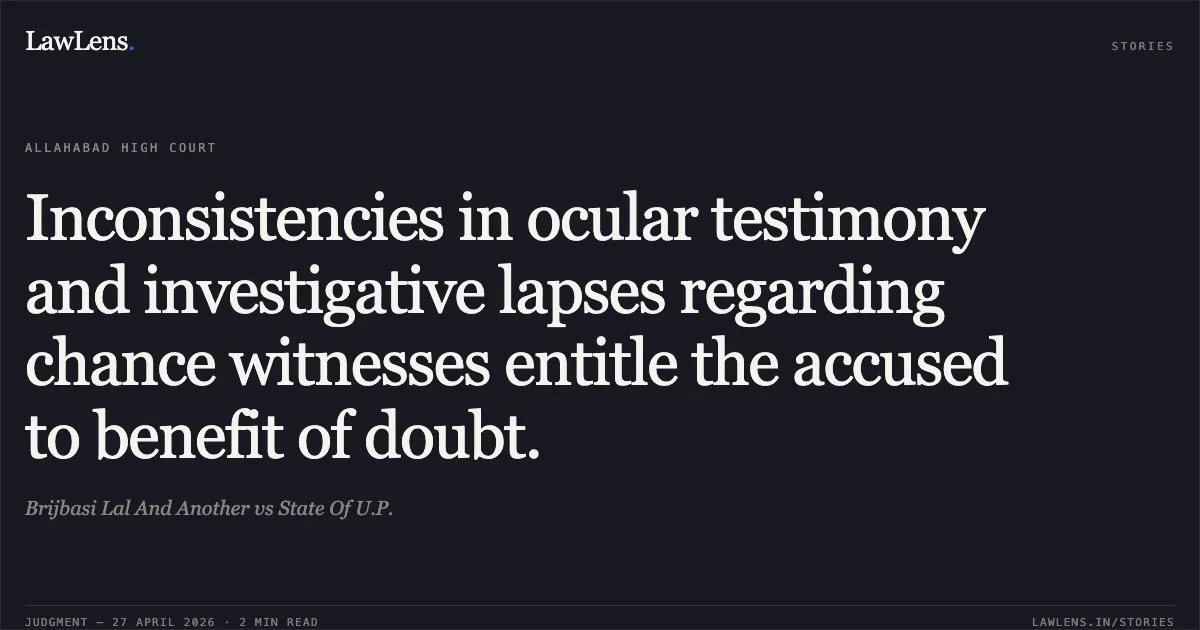
The court found significant inconsistencies between the testimonies of the informant (PW-1) and the chance/injured witnesses (PW-2, PW-3). While PW-1 alleged the shot was intended for him, PW-2 and PW-3 claimed the exhortation was specifically targeted at PW-2
Source reference: para. 19-20The medical evidence and site plan contradicted the ocular versions; specifically, the site plan showed no wall where witnesses claimed the assailant hid, and the distance between the injured parties made the "single-shot-two-injuries" theory improbable
Source reference: para. 20, 21, 22Furthermore, the court noted critical investigative failures: the police failed to recover the weapon, did not collect blood-stained earth or clothing, and provided no explanation for why the FIR was registered in a different district despite a closer police station being available
Source reference: para. 24, 27The court reasoned that when chance witnesses provide conflicting versions and the investigation is "designedly defective" or negligent, the cumulative effect creates a reasonable doubt
Source reference: para. 25-27Holding
The court answered the issues in the negative, holding that the prosecution failed to provide "clinching evidence" or a consistent narrative to sustain a conviction
The judgment of conviction and sentence dated June 26, 1987, was set aside. Appellant no. 2, Keshav Singh @ Kallu, was acquitted of all charges under Section 307 IPC, and his bail bonds were discharged. The criminal appeal was allowed
Source reference: para. 29, 30, 31, 33Acts & Sections Cited
4 provisions across 1 statute referred to in this judgment. Each provision opens on LawLens.
Indian Penal Code, 18604
Original Court PDF
Brijbasi Lal And AnothervsState Of U.P.
Click to open original judgment
Original judgment, available to read, download and summarize on LawLens.in