Facts
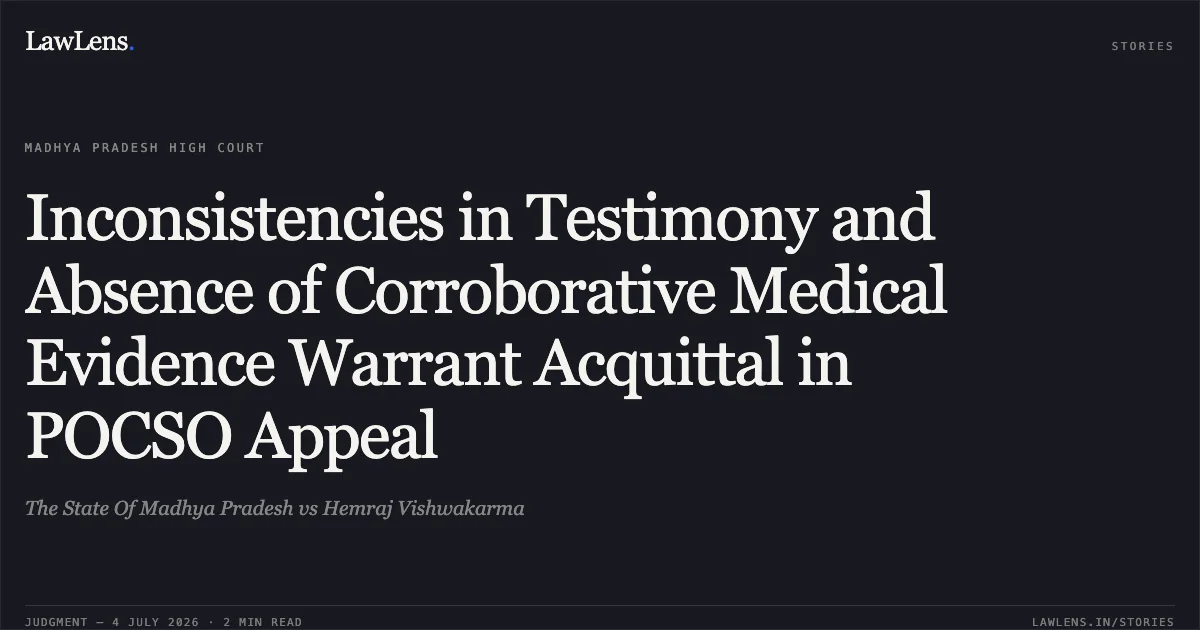
The State appealed the acquittal of the respondent, Hemraj Vishwakarma, previously charged under Sections 354, 342, and 324 of the IPC and Sections 7/8 of the POCSO Act
Source reference: para. 1The prosecution alleged that on May 24, 2017, the accused lured the minor prosecutrix (PW-1) into his house, attempted to outrage her modesty under the influence of liquor, and caused a bite injury to her wrist
Source reference: para. 2It was further alleged that the accused assaulted the prosecutrix’s brother (PW-4) with a stick
Source reference: para. 2The respondent pleaded false implication due to previous enmity with the prosecutrix's father
Source reference: para. 4The Trial Court (Special Judge, POCSO Act, Sidhi) acquitted the respondent on November 29, 2019, citing lack of evidence and material contradictions
Source reference: para. 1, 6Issues
1. Whether the Trial Court erred in law by acquitting the accused despite the testimonies of the prosecutrix and her relatives
Source reference: para. 72. Whether the contradictions, omissions, and lack of medical evidence were sufficient to justify the benefit of doubt in favor of the accused
Source reference: para. 10, 12Law Applied
The court applied the standards for outraging modesty and voluntarily causing hurt under Sections 354, 342, and 324 of the Indian Penal Code and the definitions of sexual assault under Sections 7 and 8 of the POCSO Act, 2012
Source reference: para. 3Regarding appellate jurisdiction, the court relied on H.D. Sundara v. State of Karnataka (2023), which establishes that an appellate court should not overturn an acquittal if the Trial Court’s view is a "legally plausible view"
Source reference: para. 13The court cited Babu Sahebagouda Rudragoudar v. State of Karnataka (2024) and Mallappa v. State of Karnataka (2024) to reiterate that acquittal strengthens the presumption of innocence and interference is only warranted in cases of patent perversity or illegality
Source reference: para. 14, 15Reasoning
The High Court observed that the testimony of the prosecutrix (PW-1) and her brother (PW-2) contained "material contradictions, omissions, and inconsistencies" regarding the manner of the incident, the nature of injuries, and the weapons used
Source reference: para. 10Specifically, the court noted significant deviations from statements recorded under Sections 161 and 164 of the CrPC
Source reference: para. 10Crucially, the prosecution failed to examine the medical officer who conducted the examination of the prosecutrix, leaving the alleged injuries uncorroborated
Source reference: para. 10, 12The Court also found that PW-3 (father) and PW-4 (elder brother) were not eyewitnesses and had been declared hostile
Source reference: para. 9Given the admitted previous rivalry between the families, the Court held that the Trial Court's decision to grant the benefit of doubt was a plausible view based on the evidence
Source reference: para. 11, 16Holding
The High Court held that the prosecution utterly failed to establish the guilt of the respondent beyond a reasonable doubt
The High Court dismissed the appeal and affirmed the judgment of acquittal
Source reference: para. 17The court concluded that the findings of the Trial Court were neither erroneous nor perverse and that the presumption of innocence in favor of the accused was strengthened by the acquittal
Source reference: para. 13, 16Acts & Sections Cited
9 provisions across 3 statutes referred to in this judgment. Each provision opens on LawLens.
Code of Criminal Procedure, 19734
Indian Penal Code, 18603
Original Court PDF
The State Of Madhya PradeshvsHemraj Vishwakarma
Click to open original judgment
Original judgment, available to read, download and summarize on LawLens.in