Facts
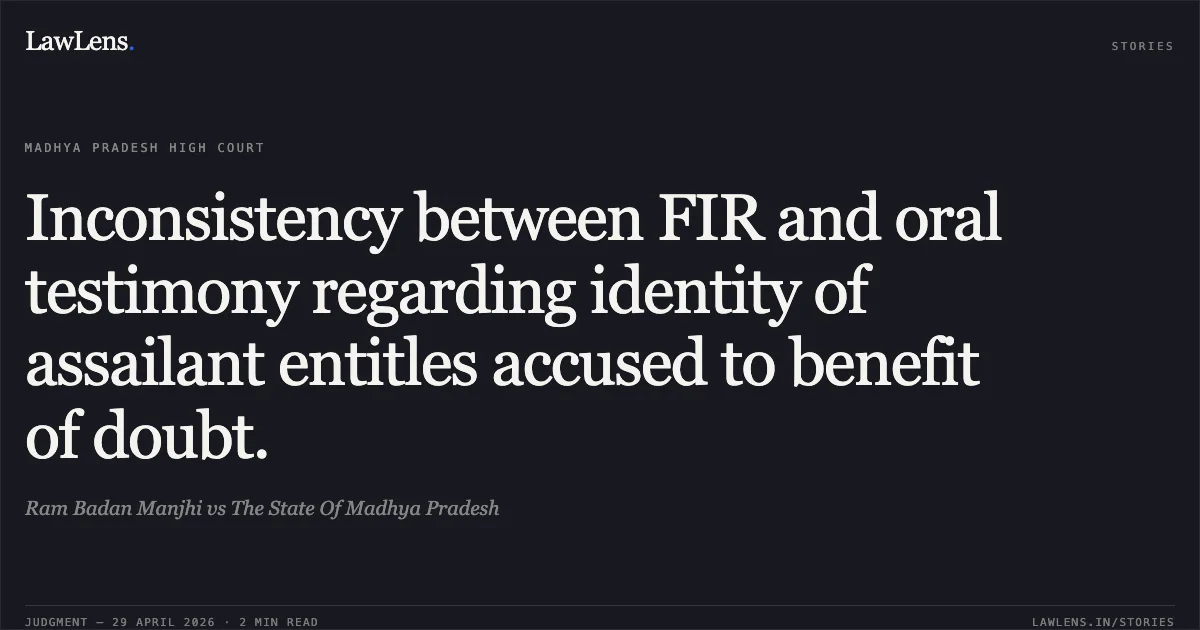
On August 5, 2010, the complainant (PW-3) lodged an FIR alleging that due to a land dispute, the appellant and two others (Shyamlal and Lalta) attacked her husband and herself with wooden staffs.
Source reference: para. 2The FIR specifically attributed the head and body blows to the co-accused, Shyamlal and Lalta.
Source reference: para. 8Following a trial in S.T. No. 395/2010, the 7th Additional Sessions Judge, Rewa, acquitted the co-accused but convicted the appellant under Section 326 IPC, sentencing him to 3 years of rigorous imprisonment.
Source reference: para. 1, 4The appellant challenged this conviction on the grounds that the evidence was contradictory and the prosecution failed to prove the case beyond reasonable doubt.
Source reference: para. 5Issues
1. Whether the conviction of the appellant under Section 326 IPC is sustainable given the material inconsistencies between the FIR and the oral testimony of the complainant.
Source reference: para. 7Law Applied
The court primarily applied Section 326 of the Indian Penal Code, 1860, which deals with voluntarily causing grievous hurt by dangerous weapons.
Source reference: para. 4It also considered Section 320 of the IPC regarding the definition of 'grievous hurt'.
Source reference: para. 9The court relied on the evidentiary principle that the FIR, being the earliest recorded version of an incident, carries high value, and material contradictions between the FIR and subsequent oral testimony regarding the specific roles of the accused create reasonable doubt.
Source reference: para. 10Reasoning
The court found a "pivotal" inconsistency: the FIR stated that Shyamlal and Lalta caused the injuries, yet these individuals were acquitted by the trial court.
Source reference: para. 8-9During the trial, the complainant (PW-3) changed her version, testifying that it was the appellant who gave blows to her head and leg.
Source reference: para. 9The court reasoned that since the FIR is the spontaneous and earliest version of events, a subsequent oral testimony that shifts the role of the assault to a different accused person goes to the "root of the matter" and renders the evidence doubtful.
Source reference: para. 10The High Court held that the trial court erred by relying solely on the oral deposition without reconciling it with the contradictory attribution in the FIR.
Source reference: para. 11Holding
The court answered the issue in the negative, holding that the prosecution failed to establish the charge beyond reasonable doubt.
The appeal was allowed, and the judgment dated July 31, 2013, was set aside. The appellant was acquitted of the charge under Section 326 IPC and ordered to be released forthwith from custody, with any fine deposited to be returned.
Source reference: para. 13Acts & Sections Cited
1 provisions across 1 statute referred to in this judgment. Each provision opens on LawLens.
Code of Criminal Procedure, 19731
Original Court PDF
Ram Badan ManjhivsThe State Of Madhya Pradesh
Click to open original judgment
Original judgment, available to read, download and summarize on LawLens.in