Facts
Basheera Bi claimed that she was injured on 7 November 2011 while riding as a pillion passenger on a motorcycle.
Source reference: p.4–5She alleged that the motorcycle struck a she-buffalo that suddenly came in its path, causing her to fall and sustain injuries.
Source reference: p.4–5She sought compensation under Section 166 of the Motor Vehicles Act, 1988, from the rider, owner and insurer
Source reference: p.4–5The Tribunal awarded ₹50,000 with interest at 6% per annum and held the respondents jointly and severally liable.
Source reference: p.6–7, 9–10The claimant appealed for enhancement, while the insurer appealed against liability, contending that the rider lacked a licence for the relevant class of vehicle
Source reference: p.6–7, 9–10Issues
1. Whether the insurer could be held liable where the rider’s licence, as shown by the licence extract, was for a light motor vehicle rather than a motorcycle.
Source reference: p.9–10, 13–142. Whether the Tribunal’s award should be modified, including in light of the evidence concerning the accident and the claimant’s injuries.
Source reference: p.9, 11–12, 16–19Law Applied
Section 166 of the Motor Vehicles Act provides the basis for a claim for compensation arising from a motor-vehicle accident; Section 173(1) provides for an appeal against an award of the Claims Tribunal.
Source reference: p.2–3The Court noted that, in third-party claims involving a breach concerning the driver’s licence, Pappu v. Vinod Kumar Lamba, (2018) 3 SCC 208, and Shamanna v. Divisional Manager, Oriental Insurance Co. Ltd., (2018) 9 SCC 650, support the principle that an insurer may be required to satisfy the award first and recover the amount from the insured thereafter.
Source reference: p.10The judgment ultimately assessed whether the claim was genuine by considering the accident and treatment records, the timing of the complaint and the evidence before the Tribunal.
Source reference: p.11–12, 17–19Reasoning
The licence extract showed that the rider held a licence for a light motor vehicle, not the motorcycle involved in the accident; the Court therefore accepted that the insurer had established a licence-related policy breach.
Source reference: p.10It nevertheless referred to the pay-and-recover principle for third-party claims.
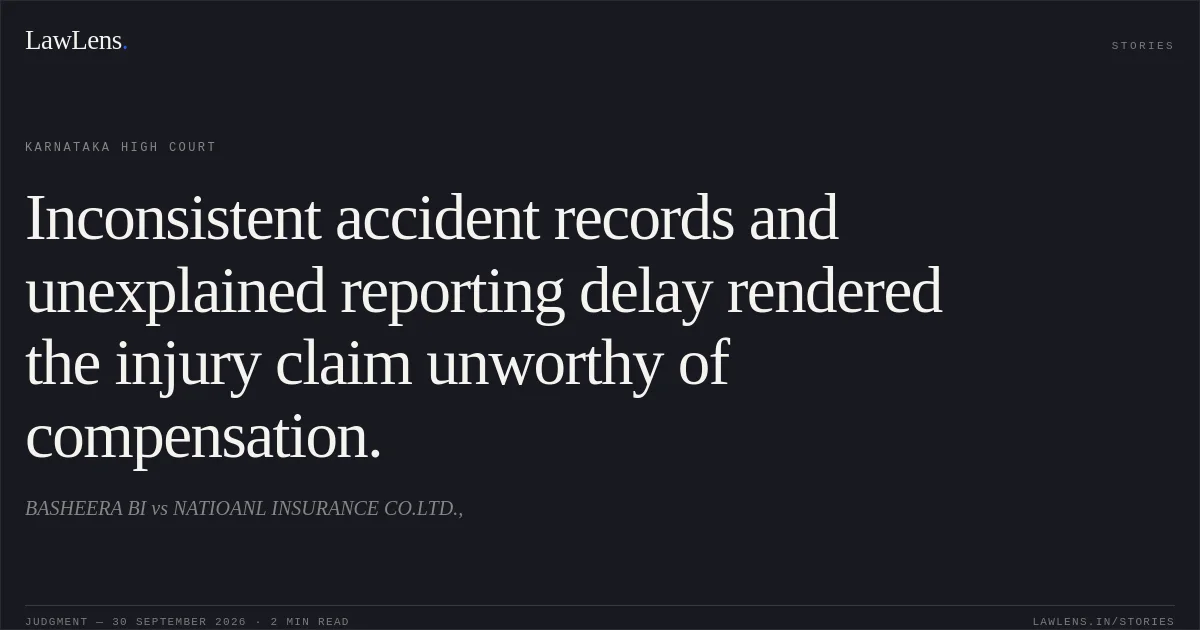
Source reference: p.10The Court then focused on the credibility of the accident claim: hospital records described the injury as resulting from a fall from a bike, the complaint was lodged three days after the accident without an explanation for the delay, and neither the rider nor evidence about his injuries or treatment was produced.
Source reference: p.11–12, 17–18On the overall record, it considered the claim not genuine and held that compensation was not justified.
Source reference: p.19Holding
The Court dismissed the claimant’s appeal, allowed the insurer’s appeal, set aside the Tribunal’s award and dismissed the claim petition.
It also ordered that any amount deposited be refunded to the insurer.
Source reference: p.13Acts & Sections Cited
2 provisions across 1 statute referred to in this judgment. Each provision opens on LawLens.
Motor Vehicles Act, 19882
Original Court PDF
BASHEERA BIvsNATIOANL INSURANCE CO.LTD.,
Click to open original judgment
Original judgment, available to read, download and summarize on LawLens.in