01Facts
The petitioners (husband, father-in-law, and mother-in-law) sought quashment of FIR No. 378/2023 registered for offences under Sections 376, 377, 506, and 34 of the IPC.
p. 1The prosecutrix alleged that on 25.03.2023, while at her parental home in Gwalior, her father-in-law raped her, her husband committed unnatural sex, and her mother-in-law assisted by restraining her.
p. 2The FIR was lodged on 24.09.2023, following a six-month delay.
p. 4Subsequently, a second FIR (No. 468/2023) was filed under Section 498-A IPC and the Dowry Prohibition Act, alleging a demand for dowry on the exact same date (25.03.2023) but omitting any mention of the sexual assault or the first FIR.
pp. 5-6, 9Charges were framed on 13.12.2024, notably excluding Section 377 IPC.
p. 1002Issues
i.1. Whether the inherent powers under Section 528 of BNSS (Section 482 CrPC) should be exercised to quash criminal proceedings when allegations appear inherently improbable and attended with mala fides.
p. 7, 11ii.2. Whether the unexplained delay in filing the FIR and the existence of mutually inconsistent versions of the same incident constitute an abuse of the process of law.
p. 9, 1203Law Applied
The Court applied the landmark principles from State of Haryana v. Bhajan Lal, which allow for the exercise of inherent powers to prevent the abuse of the process of any court or to secure the ends of justice.
p. 11It relied on Mohammad Wajid v. State of Uttar Pradesh, emphasizing that the court must look beyond surface allegations to identify frivolous or vexatious proceedings.
p. 11Furthermore, it cited Pepsi Foods Ltd. v. Special Judicial Magistrate regarding the seriousness of summoning an accused.
p. 12It cited Kahkashan Kausar v. State of Bihar, which cautions against roping in matrimonial relatives through vague and omnibus allegations.
p. 12Provisions in the judgment · 10 · Linked ones open on LawLens
Bharatiya Nagarik Suraksha Sanhita, 2023 Section 528
Code of Criminal Procedure, 1973 Section 482Section 161Section 164
Indian Penal Code, 1860 Section 376Section 377Section 506Section 34Section 406Section 109
04Reasoning
The Court observed that the six-month delay in reporting a grave offence like rape was unexplained, especially since the prosecutrix continued to reside with the accused in the matrimonial home post-incident.
pp. 9-10The Court found a fatal contradiction between the two FIRs: in the first, the prosecutrix alleged sexual assault on 25.03.2023, whereas in the second, she alleged a dowry demand on the same date and place without mentioning the assault.
p. 10, 12This inconsistency, coupled with the omission of Section 377 from the framed charges, indicated that the allegations were "materially inconsistent and improved versions".
p. 10The Court determined that the conduct of the respondent was highly unnatural and that the criminal machinery was set in motion with mala fide intent to exert pressure during a matrimonial dispute.
pp. 12-1305Holding
The Court answered the issues in the affirmative, holding that continuing the proceedings would amount to a clear abuse of the process of the Court.
p. 13The Court allowed the petition and quashed FIR No. 378/2023 of P.S. University, Gwalior, along with all consequential criminal proceedings against the petitioners.
p. 13Original Court PDF
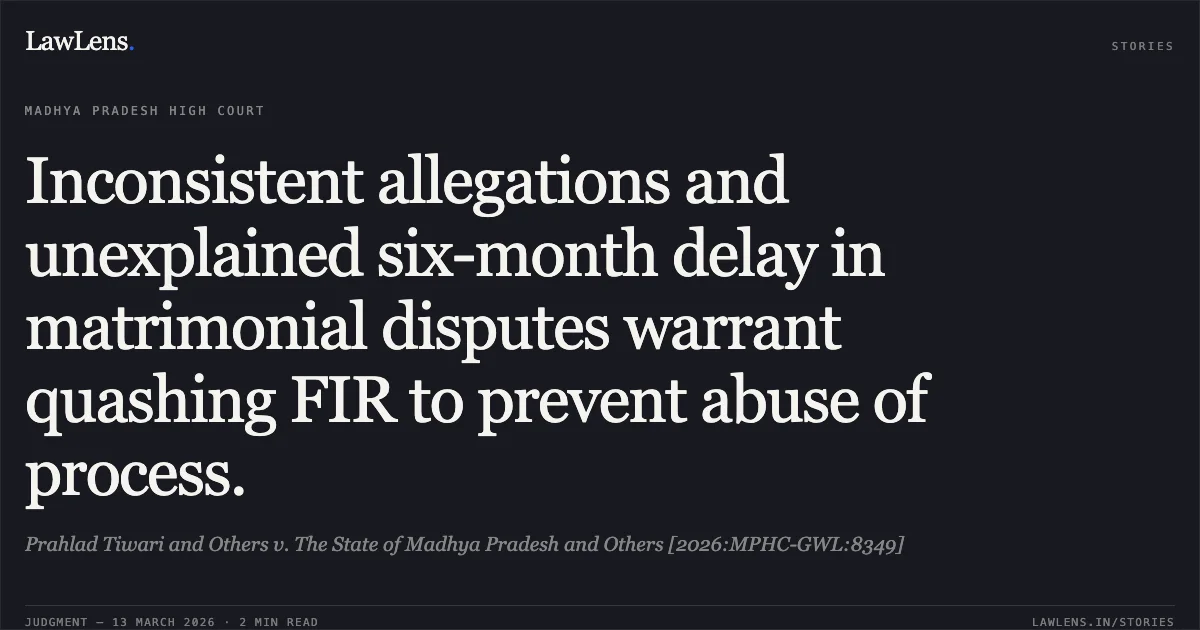
Prahlad Tiwari and Others v. The State of Madhya Pradesh and Others [2026:MPHC-GWL:8349]
Click to open original judgment
Original judgment, available to read, download and summarize on LawLens.in