Facts
The applicant filed his first bail application under Section 483 of the Bharatiya Nagarik Suraksha Sanhita (BNSS), 2023, concerning Crime No. 74/2026
Source reference: p.1The applicant was accused of offences under Sections 296(b), 115(2), 109(1), and 3(5) of the Bharatiya Nyaya Sanhita (BNS), 2023, following an incident on February 18, 2026, where the complainant, Lucky Pawar, was assaulted with a knife
Source reference: p.1-2Initially, the FIR did not name the applicant; the complainant first attributed the assault to one "Kartik" before subsequently naming the applicant, Yash Jogi, in a later statement
Source reference: p.2The applicant was arrested on February 20, 2026, and a knife was recovered at his instance
Source reference: p.3A final report has been submitted following the completion of the investigation, and the parties have reportedly filed a compromise petition before the trial court
Source reference: p.2Issues
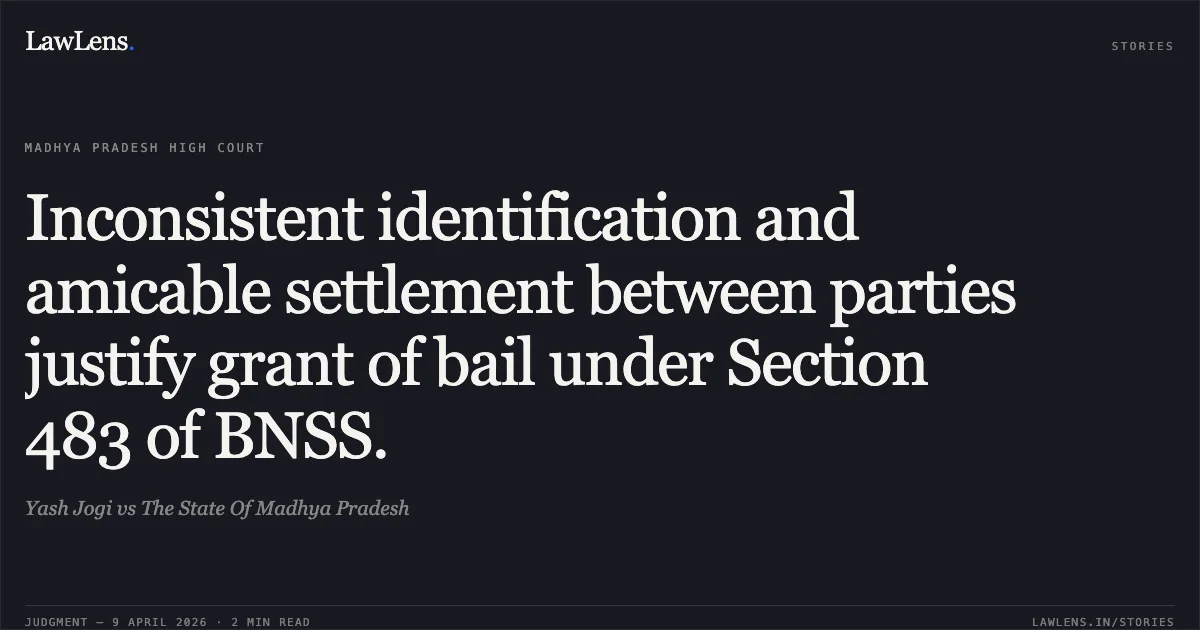
1. Whether the applicant is entitled to the grant of regular bail under Section 483 of the BNSS, 2023, in light of the inconsistencies in the complainant’s identification of the assailant and the subsequent amicable settlement between the parties
Source reference: p.2-3Law Applied
The court applied Section 483 of the BNSS, 2023, which governs the powers of the High Court or Court of Session regarding bail (corresponding to Section 439 of the CrPC)
Source reference: p.1The court considered the substantive offences defined under the Bharatiya Nyaya Sanhita (BNS), specifically Sections 296(b) (Obscene acts and songs), 115(2) (Voluntarily causing hurt), 109(1) (Attempt to murder), and 3(5) (Joint liability/Common intention)
Source reference: p.1The court also relied on established judicial principles regarding bail, including the assessment of the applicant's criminal history, the likelihood of recidivism, the risk of tampering with evidence, and the potential for the accused to flee from justice
Source reference: p.3Reasoning
The court observed that the complainant’s identification of the applicant was inconsistent, as the initial FIR and dying declaration first named another individual before implicating the applicant
Source reference: p.2This inconsistency created a prima facie doubt regarding the applicant's complicity
Source reference: p.3the court noted that the investigation was complete with the final report submitted, and the complainant/objector expressed "no objection" to the bail due to an amicable settlement
Source reference: p.2Regarding the applicant’s background, the court found that although one criminal antecedent was noted, he had no previous convictions and possessed stable family roots, reducing the risk of absconding or recidivism
Source reference: p.2-3The court emphasized that the continued incarceration of the 19-year-old applicant was unnecessary as the trial would take time to conclude and there was no evidence of potential witness tampering
Source reference: p.3Holding
The High Court allowed the application and directed that the applicant be released on bail
The Court held that given the socio-economic status of the applicant and the lack of substantial criminal history, there were no compelling reasons for continued detention
Source reference: p.3The applicant was ordered to be released upon furnishing a personal bond of Rs. 50,000/- with one surety of the same amount, subject to conditions including regular attendance at trial, refraining from committing further offences, and not tampering with evidence or influencing witnesses
Source reference: p.4Acts & Sections Cited
7 provisions across 3 statutes referred to in this judgment. Each provision opens on LawLens.
Bharatiya Nagarik Suraksha Sanhita, 20232
Bharatiya Nyaya Sanhita, 20234
Code of Criminal Procedure, 19731
Original Court PDF
Yash JogivsThe State Of Madhya Pradesh
Click to open original judgment
Original judgment, available to read, download and summarize on LawLens.in