Facts
On July 20, 2005, the prosecutrix was allegedly kidnapped by the Appellant in a Three-Wheeler Scooter (TSR) while on her way to school in Shaheen Bagh.
Source reference: p. 4She was reportedly taken to Narela, a journey of approximately 1.5 hours, and confined in a small room for nine days where she was allegedly raped five times.
Source reference: p. 1, 4-5During this period, she claimed to have survived only on water.
Source reference: p. 5The prosecutrix eventually returned home, either on her own or dropped by the Appellant via bus.
Source reference: p. 4An FIR was registered under Sections 363, 343, and 376 of the Indian Penal Code (IPC).
Source reference: no citationThe Trial Court convicted the Appellant under Sections 376 and 363 IPC, sentencing him to seven years and two years of rigorous imprisonment, respectively.
Source reference: p. 5The Appellant challenged this conviction on grounds of material contradictions in testimony and the prosecution's failure to legally prove the prosecutrix's minority.
Source reference: p. 6Issues
1. Whether the testimony of the prosecutrix was of "sterling quality" and sufficiently reliable to sustain a conviction for rape and kidnapping given her conduct during the alleged incident.
Source reference: p. 112. Whether the prosecution proved the age of the victim as being below 16 years in accordance with the Indian Evidence Act, 1872.
Source reference: p. 6, 83. Whether the absence of corroborative evidence and lapses in investigation, such as the non-examination of the PCO owner and TSR driver, created reasonable doubt.
Source reference: p. 7, 10Law Applied
The court primarily applied Sections 363 (Kidnapping) and 376 (Rape) of the IPC.
Source reference: p. 5Regarding the weight of the victim's testimony, it relied on State of Punjab v. Gurmit Singh, which allows conviction based on the sole testimony of a victim if it is trustworthy.
Source reference: p. 6Rai Sandeep v. State (NCT of Delhi), which requires such testimony to be of "sterling quality".
Source reference: p. 7On the issue of proving age through school records, the court applied the principles from Birad Mal Singhvi v. Anand Purohit, holding that entries in scholar registers have no evidentiary value unless the person who provided the information or made the entry is examined.
Source reference: p. 8The court applied Chapter V of the Indian Evidence Act, 1872, requiring primary evidence for documents unless a foundation for secondary evidence is established.
Source reference: p. 8Reasoning
The court found the prosecutrix’s narrative highly improbable and inconsistent with human conduct.
Source reference: no citationIt noted that she failed to raise an alarm during a 1.5-hour TSR journey through populated areas or during a bus ride.
Source reference: p. 1, 3Despite opportunities to escape when the Appellant left for food or when she accessed a PCO to call her father, she made no attempt to seek help.
Source reference: p. 2-3Her statement that she did not raise an alarm because she feared the Appellant might be arrested indicated an "unnatural concern" for her alleged kidnapper.
Source reference: p. 3Regarding her age, the prosecution produced only photocopies of certificates, failing the requirement for primary evidence.
Source reference: p. 8The parents gave conflicting accounts of her birth year, and the school records were not proved by examining the person who provided the data.
Source reference: p. 8-9Medically, the MLC showed no injuries, and the "two-finger test" (though later banned) suggested a degree of sexual activity inconsistent with the alleged five instances of rape.
Source reference: p. 9-10The court concluded that the investigation was deficient for failing to examine the landlord, neighbours, or the PCO owner, and that the two-month delay in recording the Section 164 Cr.P.C. statement allowed for potential manipulation.
Source reference: p. 7, 10Holding
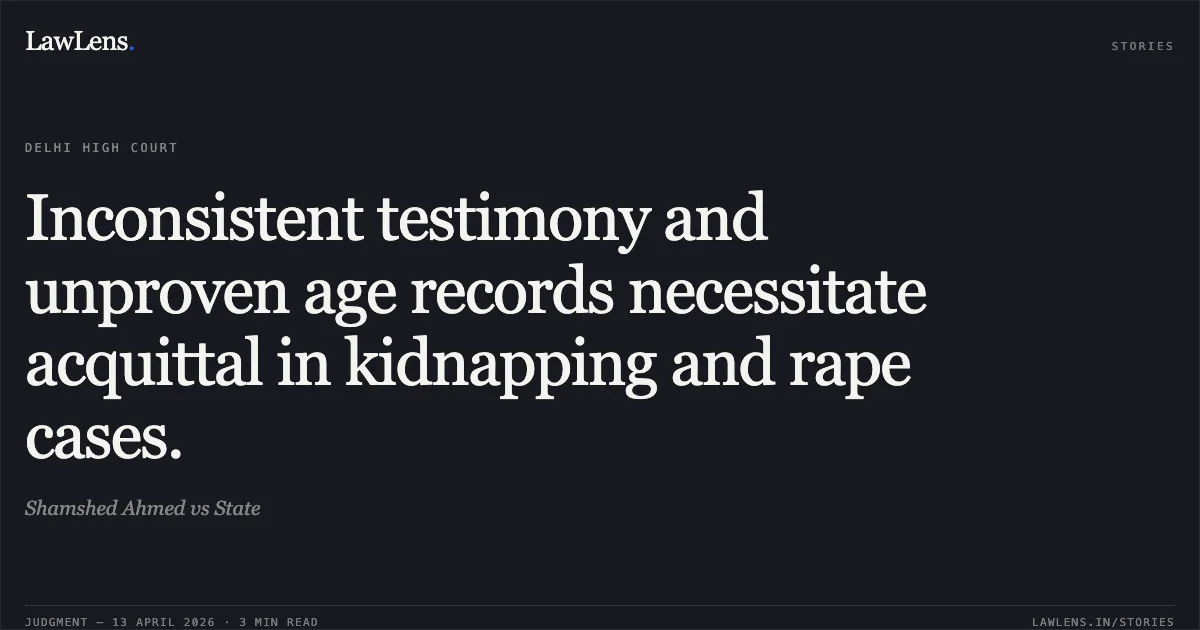
The High Court allowed the appeal, setting aside the Trial Court's judgment of conviction dated December 18, 2008, and the order on sentence dated December 20, 2008.
The court held that the prosecutrix's testimony was not of "sterling quality" and was riddled with material inconsistencies and improbabilities.
Source reference: p. 11Furthermore, the prosecution failed to prove beyond reasonable doubt that the victim was a minor at the time of the incident.
Source reference: p. 8, 11Granting the benefit of doubt to the Appellant, the court ordered his acquittal and the discharge of his bail bonds.
Source reference: p. 11Acts & Sections Cited
6 provisions across 2 statutes referred to in this judgment. Each provision opens on LawLens.
Indian Penal Code, 18604
Code of Criminal Procedure, 19732
Original Court PDF
Shamshed AhmedvsState
Click to open original judgment
Original judgment, available to read, download and summarize on LawLens.in