Facts
Sarwani Das alleged that, following her marriage to the petitioner on 20 April 2006, he and his relatives demanded a further ₹1,00,000 and subjected her to physical and mental cruelty. She alleged that she was taken to her parental home on 7 August 2010 and that the petitioner later assaulted her there on 15 August 2010; she filed a complaint after police allegedly took no action.
Source reference: pp. 2–3, paras. 3–4The complainant and her parents testified for the prosecution; the defence examined two witnesses and produced a letter dated 7 August 2010 and related signatures.
Source reference: pp. 3–4, paras. 5–6The trial court convicted the petitioner under Section 498A IPC and sentenced him to one year’s simple imprisonment and a fine; the appellate court upheld the conviction.
Source reference: p. 4, paras. 7–8The petitioner challenged those decisions in revision.
Source reference: pp. 4–5, para. 9Issues
Whether the evidence established that the petitioner subjected the complainant to “cruelty” within the meaning of Section 498A IPC
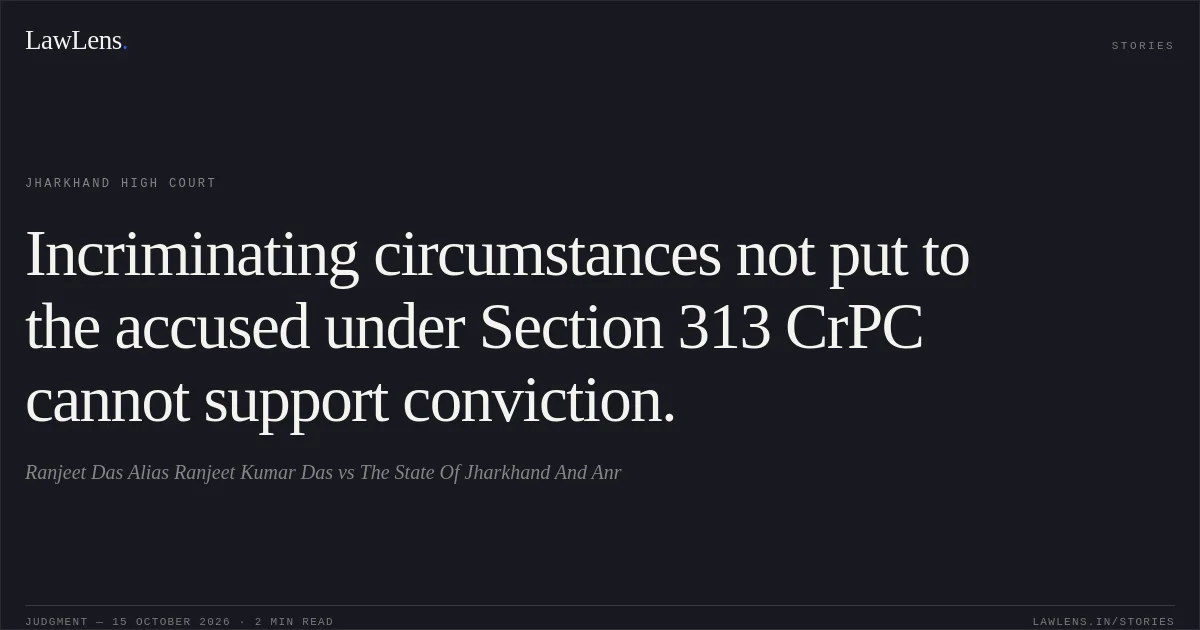
Source reference: pp. 6–8, paras. 12–15Whether incriminating circumstances not specifically put to the petitioner in his examination under Section 313 CrPC could be relied upon to sustain his conviction
Source reference: pp. 8–10, paras. 15–16Law Applied
Section 498A IPC criminalises a husband’s or his relative’s subjection of a woman to “cruelty.” Under its Explanation, cruelty includes wilful conduct likely to drive a woman to suicide or cause grave injury or danger to her health, and harassment intended to coerce her or a relative to meet an unlawful demand, or arising from failure to meet such a demand.
Source reference: p. 6, para. 12Under Section 313 CrPC, the court must specifically put incriminating circumstances to the accused and afford an opportunity to explain them; circumstances not put to the accused cannot be used against him. The Court relied on *Paramjeet Singh v. State of Uttarakhand*, (2010) 10 SCC 439, para. 22.
Source reference: pp. 9–10, para. 16Reasoning
The Court found that the charge did not specify the time or manner of the alleged cruelty and did not clarify which form of cruelty under Section 498A was alleged.
Source reference: pp. 7–8, paras. 13–14It also found no sufficient evidence of specific acts of cruelty on the stated dates.
Source reference: pp. 8–10, paras. 15–16The trial court’s Section 313 questions did not put the alleged incidents and demand to the petitioner in the form relied on to convict him; the Court therefore held that unput circumstances could not support the conviction.
Source reference: pp. 8–10, paras. 15–16The Court further considered the defence evidence concerning the complainant’s departure for her parental home and concluded that the concurrent findings were unsupported by the evidence.
Source reference: p. 10–11, para. 17Holding
The High Court allowed the revision, set aside the conviction and sentence imposed by the trial court and affirmed by the appellate court, and acquitted the petitioner of the charge under Section 498A IPC.
As the petitioner was on bail, he was discharged from his bail bond, and his sureties were also discharged.
Source reference: p. 11, para. 20Acts & Sections Cited
3 provisions across 2 statutes referred to in this judgment. Each provision opens on LawLens.
Indian Penal Code, 18601
Code of Criminal Procedure, 19732
Original Court PDF
Ranjeet Das Alias Ranjeet Kumar DasvsThe State Of Jharkhand And Anr
Click to open original judgment
Original judgment, available to read, download and summarize on LawLens.in